India ASEAN Trade Pact Review and Digital Public Infrastructure
Source:Indian Express ↗
Why It Matters
The renegotiation of AITIGA is critical for India to protect its domestic manufacturing and address trade imbalances while securing its supply chains. Simultaneously, expanding UPI to Vietnam highlights India's growing soft power in fintech and operationalizes its Act East Policy through digital diplomacy.
Summary
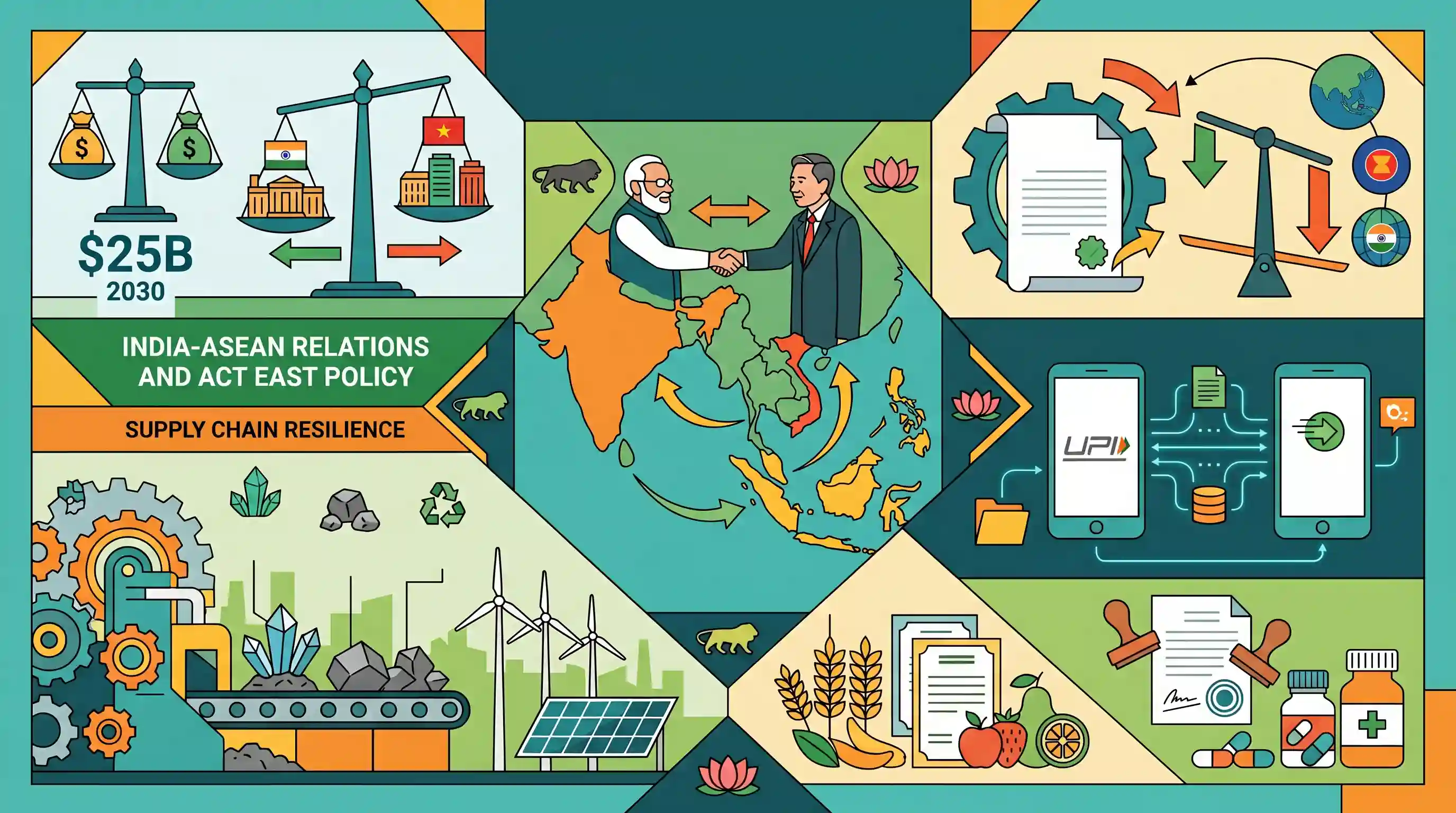
Prime Minister Narendra Modi and Vietnamese President To Lam announced measures to significantly deepen the India-Vietnam strategic partnership, underscored by a goal to reach $25 billion in bilateral trade by 2030. A key highlight is the commitment to update the ASEAN-India Trade in Goods Agreement (AITIGA) by the end of the year to rectify India's widening trade deficit with the bloc, which has been exacerbated by ASEAN's participation in the RCEP. Additionally, the countries plan to integrate India's UPI with Vietnam's Fast Payment System to boost financial connectivity. The partnership also emphasizes supply chain resilience through cooperation in critical minerals, rare earths, and energy, alongside aligning regulatory frameworks for agricultural and pharmaceutical exports.
Key Points
- India and ASEAN have committed to updating the ASEAN-India Trade in Goods Agreement (AITIGA) by the end of the year to address a ballooning trade deficit, which rose from $8 billion in FY13 to $44 billion in FY23.
- Bilateral trade between India and Vietnam has doubled to $16 billion over the last decade, with the two nations setting a new trade target of $25 billion by 2030.
- To enhance financial connectivity, India's UPI will be linked with Vietnam's Fast Payment System.
- India and Vietnam are focusing on strategic cooperation in critical minerals, rare earths, and energy to build resilient supply chains.
- A NITI Aayog report highlighted concerns over India's declining exports to FTA partners and the surge in imports from ASEAN nations after their entry into the China-led RCEP.
Important Terms
ASEAN-India Trade in Goods Agreement (AITIGA)

A 2009 trade pact between India and the 10 ASEAN nations aimed at reducing tariffs on physical goods. It is currently under review to address India's widening trade deficit.
UPSC context
GS Paper 2 & 3; essential for understanding India-ASEAN economic relations, trade deficits, and the shift from 'Look East' to 'Act East'.
Unified Payments Interface (UPI)
A real-time, mobile-based payment system developed by the National Payments Corporation of India (NPCI) for instant inter-bank transfers using a Virtual Payment Address (VPA).
UPSC context
GS Paper 3; critical for topics on Digital Public Infrastructure (DPI), fintech internationalization, and financial inclusion.
Regional Comprehensive Economic Partnership (RCEP)
A mega-regional trade agreement between the 10 ASEAN members and five partners; India withdrew in 2019 due to concerns over trade deficits, especially with China.
UPSC context
GS Paper 2; tests understanding of regional trade blocs and India's strategic autonomy in global economic negotiations.
ASEAN
An intergovernmental organization of ten Southeast Asian nations promoting economic growth and regional stability; it remains central to India's Indo-Pacific and Act East strategies.
UPSC context
GS Paper 2; central to India's foreign policy and regional integration efforts in Southeast Asia.
Fast Payment System (Vietnam)
Vietnam's real-time digital payment infrastructure, planned for integration with India’s UPI to enable seamless, low-cost cross-border retail transactions and remittances.
UPSC context
GS Paper 3; highlights India's fintech diplomacy and bilateral cooperation in digital financial connectivity.
Prelims Trap
India's trade deficit with ASEAN grew exponentially due to India's participation in the Regional Comprehensive Economic Partnership (RCEP).
India withdrew from RCEP in 2019. The deficit worsened because ASEAN is in RCEP, enabling Chinese goods to enter ASEAN tariff-free and route into India.
Static Concepts Connected
What are "Rules of Origin" in Free Trade Agreements (FTAs)?
- Definition: The criteria used to determine the national source of a product in international trade.
- Core Purpose: They prevent "trade deflection"—where third-party countries route their goods through an FTA partner nation to illegitimately claim zero or low-tariff benefits.
- CAROTAR 2020: India implemented the Customs (Administration of Rules of Origin under Trade Agreements) Rules, 2020 to strictly verify origin checks and curb dumping via ASEAN.
What are the core layers of India's Digital Public Infrastructure (India Stack)?
- Identity Layer: Provides a foundational, interoperable biometric identification system (Aadhaar, e-KYC) allowing citizens to prove who they are digitally.
- Payments Layer: A single interoperable interface (UPI) that facilitates real-time, cashless, and low-cost cross-bank fund transfers.
- Data Empowerment Layer: Allows secure, consent-based sharing of personal data (via Account Aggregator framework and DigiLocker) to unlock credit and services.
Cross-Topic Patterns
DPI as Soft Power in Act East
Linking UPI with Vietnam, Singapore, and UAE shifts India's diplomatic toolkit from traditional grants to exporting indigenous digital public goods, embedding India into the financial architecture of the Global South.
RCEP's spillover effect on AITIGA
India's 2019 exit from RCEP didn't fully insulate it. Chinese goods entering ASEAN tariff-free are suspected of being routed to India under AITIGA, necessitating trade pact reviews and stricter Rules of Origin.
De-risking via Vietnam's Rare Earths
Vietnam holds the world's second-largest rare earth reserves. Partnering for critical minerals directly bolsters India's Indo-Pacific strategy to de-risk supply chains and counter Chinese dominance in clean-energy manufacturing.

Expect a 2026 Prelims question linking CAROTAR rules, the ASEAN trade deficit, and how RCEP indirectly impacts Indian imports.
Linked PYQs · 2
Linked PYQs · 2
- 2016MainsGS2
Evaluate the economic and strategic dimensions of India's Look East Policy in the context of the post Cold War international scenario.
- 2023MainsGS3
What is the status of digitalization in the Indian economy? Examine the problems faced in this regard and suggest improvements.
