India and Arab League strategic and economic relations
Source:The Hindu ↗
Why It Matters
Understanding India's relationship with the Arab League is crucial for UPSC aspirants as West Asia is a focal point of India's foreign policy, directly impacting the nation's energy security, diaspora welfare, and geopolitical strategy under the 'Think West' policy.
Summary
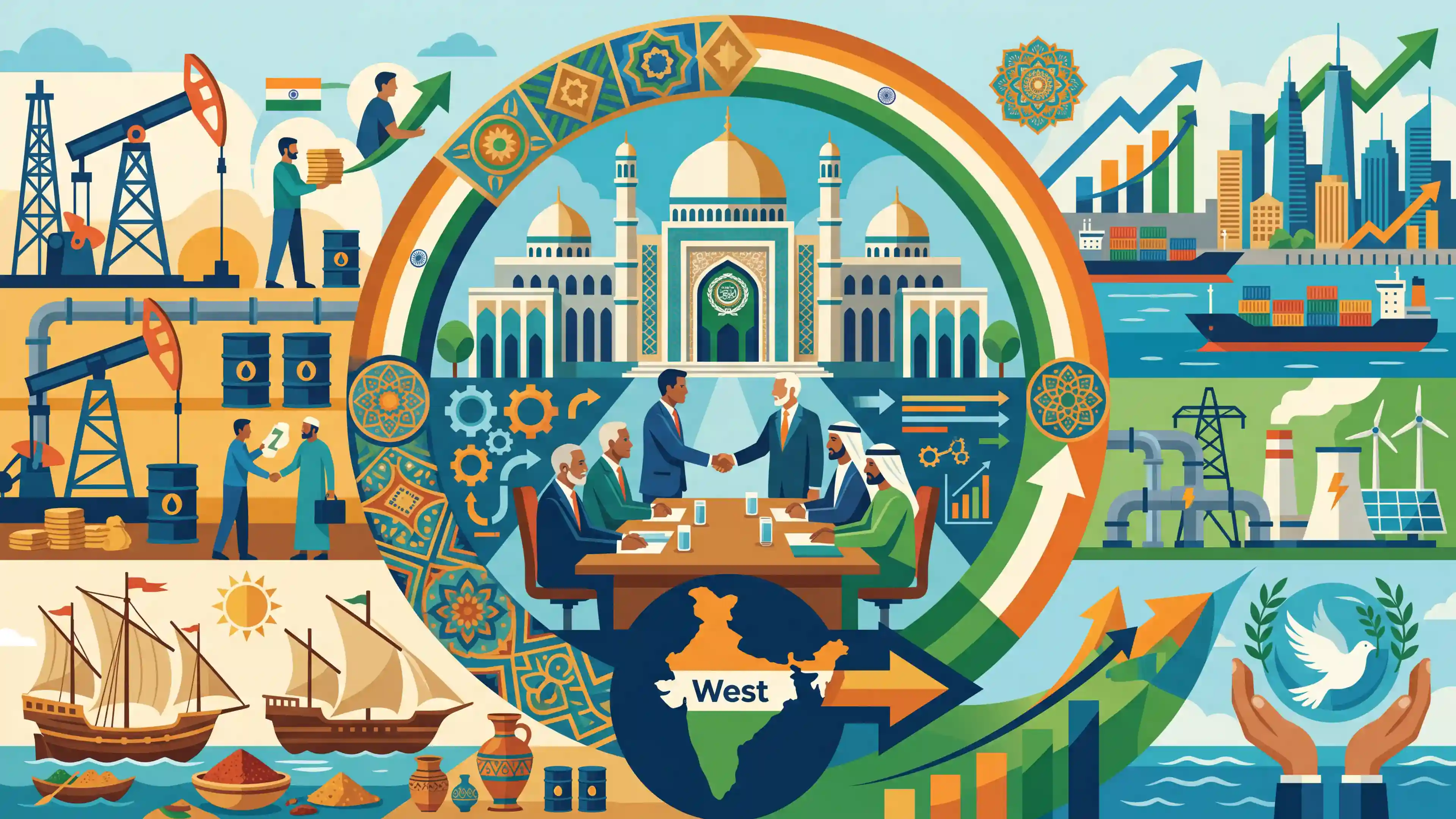
The article discusses the evolving relationship between India and the Arab League, highlighting how deep-rooted historical and cultural ties are being leveraged to create modern economic and strategic opportunities. It emphasizes the shift from purely transactional engagements—traditionally focused on energy and diaspora—toward comprehensive institutional cooperation. By utilizing the Arab League as a multilateral platform, India aims to strengthen its 'Think West' policy, enhance trade and investment, and secure its long-term energy needs while fostering stability in the West Asian region.
Key Points
- India and the Arab League share deep historical and cultural linkages, which provide a strong bedrock for modern diplomatic engagements.
- The relationship is transitioning from a traditional focus on oil imports and diaspora remittances to a broader strategic partnership encompassing trade, investment, and technology.
- The Arab League acts as a crucial multilateral platform for India to consolidate its 'Think West' policy and engage comprehensively with the West Asia and North Africa (WANA) region.
- Enhanced institutional cooperation between India and the Arab League can play a vital role in ensuring regional stability and securing India's energy security needs.
Important Terms
Arab League

A regional organization of 22 member states in the Middle East and North Africa, established in 1945 to foster political, economic, and cultural cooperation. India holds observer status.
UPSC context
GS Paper II (International Relations). Tests understanding of regional groupings and India's multilateral diplomacy in its extended neighborhood.
Think West Policy
India's proactive diplomatic strategy to deepen strategic, economic, and security ties with West Asian nations, representing a more comprehensive engagement than previous transactional models.
UPSC context
GS Paper II (Bilateral/Regional Groupings). Evaluates India’s strategic autonomy and its shifting foreign policy priorities in the Middle East.
Look West Policy
Launched in 2005, this policy aimed to strengthen India’s engagement with Gulf nations, Iran, and Israel, primarily focusing on energy security, trade, and the welfare of the diaspora.
UPSC context
GS Paper II (International Relations). Analyzes the historical evolution of India’s outreach to the Middle East.
West Asia
A geopolitical region connecting Asia, Africa, and Europe, vital to India for energy security, maritime trade (Red Sea/Arabian Sea), and regional stability.
UPSC context
GS Paper II. Crucial for mapping India's strategic interests and energy-security dependencies.
Indian Diaspora
Over 9 million Indians residing in West Asia, serving as a primary source of remittances and a significant pillar of India's soft power and economic stability.
UPSC context
GS Paper II (Effect of Policies on Indian Interests). Tests the socio-economic role of overseas Indians in bilateral relations.
India-Middle East-Europe Economic Corridor (IMEC)
A multi-modal connectivity project launched at G20 (2023) to link India with Europe via the UAE, Saudi Arabia, Jordan, and Israel through rail and shipping.
UPSC context
GS Paper II (Global Groupings/Agreements). Tests India's role in global infrastructure and strategic connectivity initiatives.
Prelims Trap
The Arab League consists exclusively of Middle Eastern nations, and India holds formal dialogue partner status.
Aspirants often confuse the Arab League with the GCC, or assume it is restricted to the Middle East. It spans West Asia and North Africa (WANA), and India is strictly an 'Observer'.
Static Concepts Connected
What is the Arab League and how does India engage with it?
- Origin and Membership: Founded in 1945 in Cairo to safeguard Arab sovereignty, comprising 22 member states across West Asia and North Africa.
- India's Observer Status: India was granted Observer status in 2007, formalizing ties established by a 2002 MoU and leading to the Arab-India Cooperation Forum (AICF) in 2008.
- Energy Security Core: Nations in this grouping supply nearly 60% of India's crude oil, making it critical for India's strategic petroleum reserves and energy transition plans.
What distinguishes India's 'Think West' policy from the earlier 'Look West' approach?
- Look West Policy: Adopted in 2005, it was primarily transactional, focusing narrowly on extracting oil imports and ensuring the welfare of the Indian diaspora.
- Think West Policy: A comprehensive strategic shift emphasizing maritime security, joint military exercises, counter-terrorism, and deep technology and infrastructure investments.
- Strategic De-hyphenation: Maintains independent, parallel relationships with rival regional powers (e.g., Israel, Iran, and the Arab states) without letting one dictate the other.
Cross-Topic Patterns
Energy transition vs. Remittance inflows
As Arab nations transition economies away from oil (e.g., Saudi Vision 2030), the skill demands for the Indian diaspora will shift, directly impacting India's $40B+ remittance corridor.
Minilateralism superseding broad consensus
Minilateral groupings like I2U2 and IMEC highlight India's 'de-hyphenated' strategy, bypassing traditional Arab League consensus bottlenecks to build rapid bilateral and plurilateral economic integration.

Expect a Prelims question contrasting India's Arab League 'Observer' status with its GCC engagement and the broader WANA geography.
Linked PYQs · 2
Linked PYQs · 2
- 2025MainsGS2
"Energy security constitutes the dominant kingpin of India's foreign policy, and is linked with India's overarching influence in Middle Eastern countries.” How would you integrate energy security with India's foreign policy trajectories in the coming years?
- 2017MainsGS2
The question of India's Energy Security constitutes the most important part of India's economic progress. Analyze India's energy policy cooperation with West Asian countries.
