India engagement without recognition policy towards Taliban regime
Source:Indian Express ↗
Why It Matters
The topic is crucial for understanding India's adaptive foreign policy in South Asia. It highlights the shift from ideological posturing to strategic pragmatism, essential for balancing humanitarian diplomacy, regional connectivity (Central Asia), and counter-terrorism imperatives.
Summary
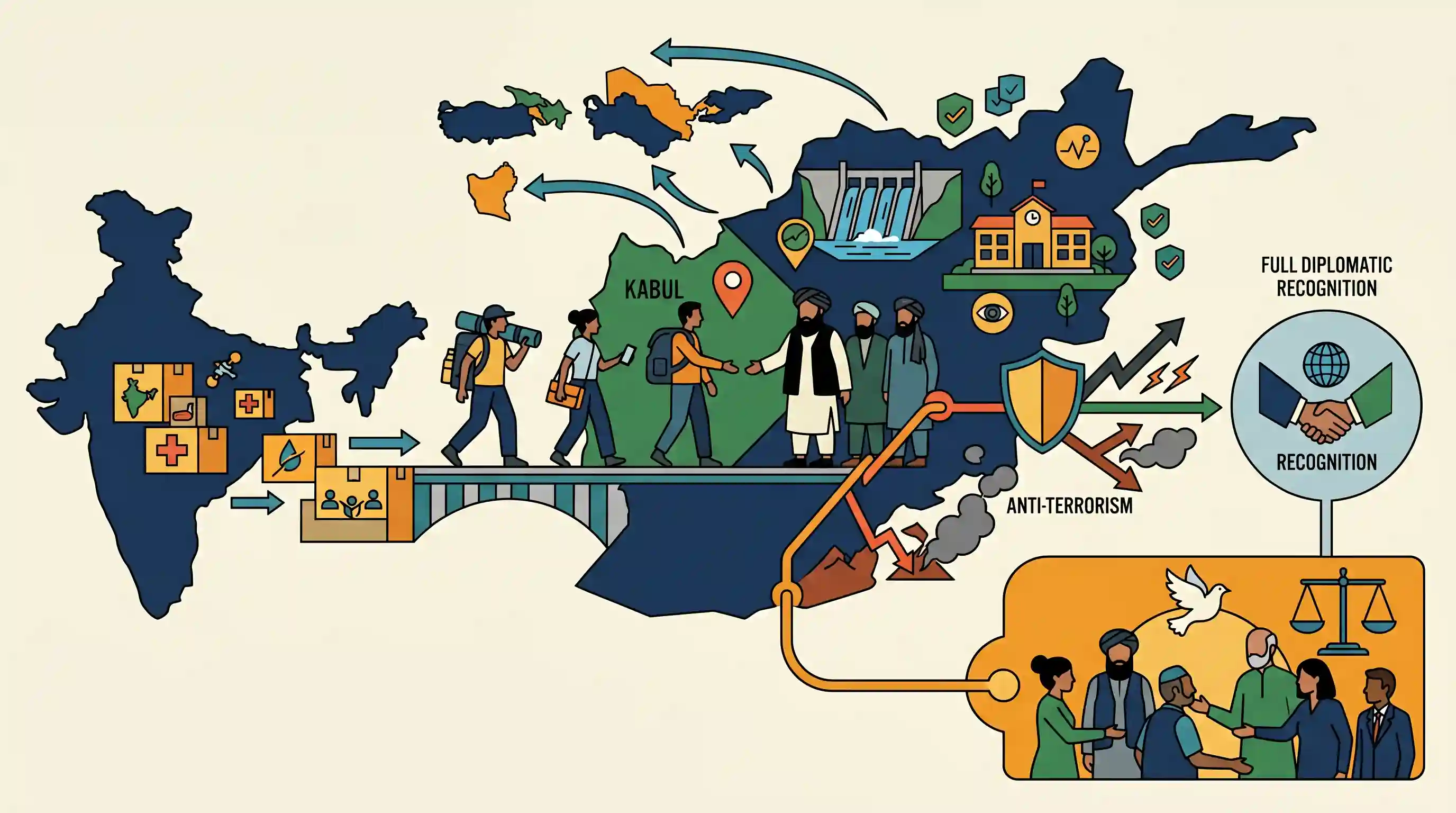
India's strategy toward the Taliban regime in Afghanistan revolves around a pragmatic doctrine of "engagement without recognition." Following the Taliban's 2021 takeover, New Delhi initially closed its embassy but later deployed a "technical team" to Kabul. This approach enables India to interact with Taliban officials, such as acting Foreign Minister Amir Khan Muttaqi, to facilitate critical humanitarian aid and protect investments in developmental projects. Crucially, this ongoing backchannel and technical engagement helps India safeguard its vital geopolitical interests—countering terrorism emanating from Afghan soil and ensuring connectivity to Central Asia—while withholding formal diplomatic recognition until the Taliban establishes an inclusive government and upholds human rights.
Key Points
- India pursues a policy of "engagement without recognition" with the Taliban, balancing strategic necessities with the global consensus against formal diplomatic recognition.
- A "technical team" is stationed in Kabul to oversee humanitarian assistance, including wheat and medical supplies, and ongoing developmental projects.
- Pragmatic engagement allows New Delhi to convey its security concerns, particularly the demand that Afghan territory not be used by terrorist groups like LeT and JeM.
- Maintaining a footprint in Afghanistan is critical for India's regional connectivity ambitions, notably its access to Central Asia via the Chabahar Port.
Important Terms
UNSC Resolution 2593

An August 2021 resolution adopted under India’s presidency demanding Afghan territory not be used to shelter, train, or finance terrorists. It holds the Taliban accountable for human rights and inclusive governance.
UPSC context
GS-II (International Relations); tests India’s leadership in multilateral forums and strategic concerns regarding Afghan-origin terrorism.
Engagement without Recognition
A pragmatic diplomatic strategy where India maintains functional ties and a "technical mission" in Kabul to protect interests without formally acknowledging the Taliban’s political legitimacy.
UPSC context
GS-II (India and Neighborhood); crucial for understanding India's "middle path" diplomacy in contested regional regimes.
Taliban
The Islamist militant group that seized power in Afghanistan in 2021. It functions as the de facto government while facing international pressure to establish inclusivity and sever terror ties.
UPSC context
GS-II (International Relations); central to discussions on regional security, radicalization, and the shift in South Asian geopolitics.
United Nations Security Council (UNSC)
The UN's principal organ for global peace, empowered to issue binding resolutions. It manages the 1267 Sanctions Committee, which monitors groups like Al-Qaeda and the Taliban.
UPSC context
GS-II (International Institutions); fundamental for questions on global governance, UN reforms, and international security frameworks.
Lashkar-e-Taiba (LeT) and Jaish-e-Mohammed (JeM)
UN-designated, Pakistan-based terrorist organizations. India considers their potential to operate or train within Afghan territory as a primary threat to its internal and regional security.
UPSC context
GS-III (Internal Security); tests knowledge of non-state actors, cross-border terrorism, and security implications of the Afghan power vacuum.
Prelims Trap
India has closed all diplomatic presence and halted all engagement with Afghanistan since 2021.
India actually maintains a "technical team" in Kabul to oversee humanitarian aid and engage in backchannel diplomacy, though it strictly withholds formal diplomatic recognition.
Static Concepts Connected
Which countries border Afghanistan according to India's official map?
- Central Asia: Turkmenistan, Uzbekistan, and Tajikistan to the north.
- Neighbors & Wakhan: Iran (west), Pakistan (south/east), and China via the Wakhan corridor (northeast).
- India via PoK: Officially, India shares a 106 km border with Afghanistan in the Gilgit-Baltistan region (currently Pakistan-occupied Kashmir).
What are the core mandates of UNSC Resolution 2593 (2021)?
- Anti-Terrorism: Demands that Afghan territory not be used to shelter, train, or finance terrorist acts, explicitly naming groups like LeT and JeM.
- Humanitarian Access: Calls for unhindered humanitarian assistance, safe departures from the country, and donor access.
- Inclusivity & Rights: Urges the formation of an inclusive government that upholds the human rights of women, children, and minorities.
Cross-Topic Patterns
Chabahar & Central Asia access
Stabilizing ties with Kabul safeguards India's access to Central Asian markets via Iran's Chabahar port, bypassing Pakistan's overland blockade.
De facto vs De jure recognition
India’s "technical team" approach exemplifies de facto (practical) engagement without de jure (formal/legal) recognition under international law principles.

Expect a multi-statement IR question in 2026 linking India's 'engagement without recognition' policy in Kabul with UNSC Resolution 2593.
Linked PYQs · 2
Linked PYQs · 2
- 2024MainsGS2
Critically analyse India's evolving diplomatic, economic and strategic relations with the Central Asian Republics (CARs) highlighting their increasing significance in regional and global geopolitics.
- 2022PrelimsGS1
Consider the following countries: 1. Azerbaijan 2. Kyrgyzstan 3. Tajikistan 4. Turkmenistan 5. Uzbekistan Which of the above have borders with Afghanistan ?
