India UK Free Trade Agreement and Vision 2035 Roadmap
Source:The Hindu ↗
Why It Matters
The finalization of the India-UK Free Trade Agreement (CETA) and the Vision 2035 roadmap demonstrates a significant leap in bilateral diplomacy, effectively balancing economic integration with strategic security interests, such as counter-terrorism and extradition. It serves as a prime case study for India's FTA strategy with developed Western nations.
Summary
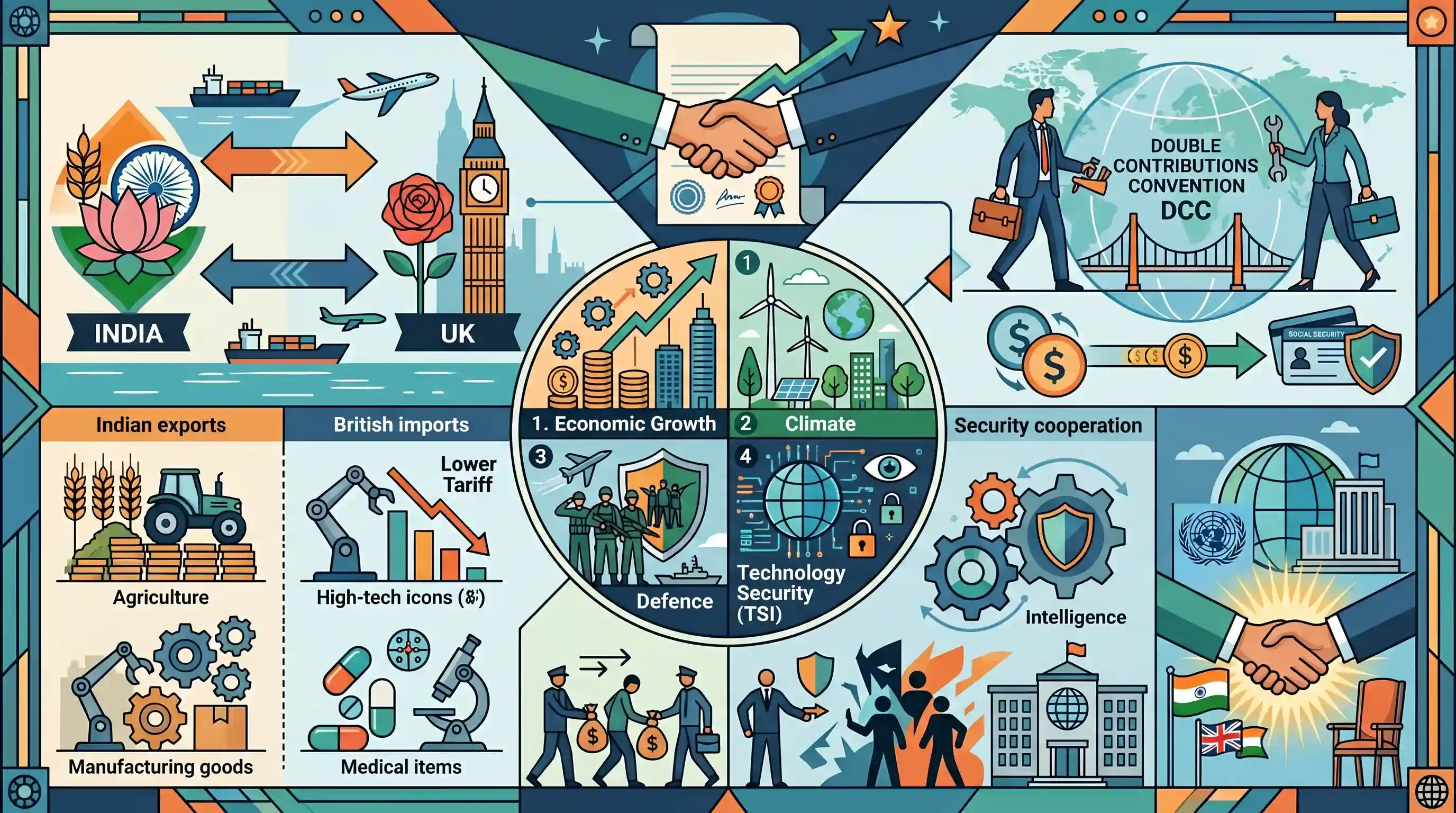
India and the UK signed the Comprehensive Economic Trade Agreement (CETA), formally upgrading their bilateral roadmap to the 'India-U.K. Vision 2035'. This wide-ranging agreement will enhance trade flows, offering improved access for Indian agriculture and manufacturing, while lowering tariffs for British technology and medical imports. Additionally, a new Double Contributions Convention (DCC) addresses social security dual-taxation for migrant professionals. The updated Vision 2035 spans four main pillars—economic growth, climate, defence, and a newly established Technology Security Initiative. Strategically, the UK reiterated its support for India’s permanent membership in the UN Security Council and joint efforts to modernize multilateral institutions. Furthermore, both countries committed to deeper intelligence sharing to combat extremism, secure diplomatic missions, and expedite the extradition of economic absconders.
Key Points
- India and the UK signed the Comprehensive Economic Trade Agreement (CETA), evolving their strategic roadmap to the 'India-U.K. Vision 2035'.
- CETA facilitates market access for Indian agriculture, MSMEs, and manufactured goods, alongside tariff reductions for British aerospace and medical products.
- A reciprocal Double Contributions Convention (DCC) was agreed upon to eliminate dual social security tax burdens for professionals working in either country for up to three years.
- The Vision 2035 framework emphasizes four major pillars: economic growth and jobs, climate and environment, defence and security, and the new Technology Security Initiative.
- Both nations pledged mutual support for reforming multilateral bodies (including the WTO, IMF, and World Bank), with the UK notably endorsing India's bid for permanent UNSC membership.
- India and the UK emphasized cooperation on internal security, specifically committing to tackling terrorism, ensuring the extradition of fugitive economic offenders, and addressing extremism targeting Indian diplomatic missions.
Important Terms
Comprehensive Economic Trade Agreement (CETA)

A landmark bilateral trade pact signed to enhance market access, eliminate 99% of tariffs on Indian exports, and simplify professional mobility in services between India and the UK.
UPSC context
GS Paper II (International Relations) & III (Economy); tests bilateral trade diplomacy and India's "Make in India" export goals.
India-U.K. Vision 2035
An upgraded strategic roadmap endorsed in 2025 to guide India-UK relations until 2035, focusing on economic growth, climate action, defense, and high-end technology.
UPSC context
GS Paper II (Bilateral Groupings); relevant for long-term foreign policy frameworks and strategic partnership evolution.
Reciprocal Double Contributions Convention (DCC)
A social security agreement designed to prevent dual taxation of migrant professionals by ensuring they only pay contributions in one country while working abroad temporarily.
UPSC context
GS Paper II (Indian Diaspora) & III (Economy); tests issues affecting the Indian workforce abroad and ease of doing business.
Technology Security Initiative (TSI)
A 2024 bilateral mechanism focused on securing supply chains and co-innovating in seven key sectors including AI, semiconductors, critical minerals, and telecommunications.
UPSC context
GS Paper II (International Relations) & III (Science & Tech); highlights "Tech-Diplomacy" and strategic autonomy in emerging technologies.
Roadmap 2030
The foundational 10-year framework adopted in 2021 that established the 'Comprehensive Strategic Partnership' and paved the way for the current CETA and Vision 2035.
UPSC context
GS Paper II (International Relations); crucial for understanding the historical trajectory and institutional mechanisms of India-UK ties.
UN Security Council (UNSC)
The UN organ responsible for international peace; the UK supports India's permanent membership as part of the CETA-related diplomatic convergence.
UPSC context
GS Paper II (International Institutions); involves India's pursuit of a global leadership role and multilateral reforms.
Prelims Trap
The Double Contributions Convention (DCC) eliminates double income taxation for professionals.
DCC deals with dual social security/pension contributions, not standard personal income tax. Income tax is covered under a Double Taxation Avoidance Agreement (DTAA).
Static Concepts Connected
What are the key differences between an FTA, CECA, and CEPA?
- FTA: Reduces or eliminates customs duties on a positive/negative list of goods traded between partner countries.
- CECA: Primarily covers tariff reduction on goods. Usually acts as a stepping stone to broader, more comprehensive pacts.
- CEPA: Broader than CECA/FTA, covering not just goods, but trade in services, investment, intellectual property, and competition.
What is the legal framework for declaring a Fugitive Economic Offender (FEO)?
- Threshold: Applies to specified economic offences involving a value of ₹100 crore or more under the FEO Act, 2018.
- Criteria: An arrest warrant must be issued by a special court, and the individual must have left India to avoid prosecution.
- Asset Confiscation: Enables confiscation of all properties (benami or direct) of the offender, even if they are not the direct proceeds of the crime.
Cross-Topic Patterns
Trade Pacts + Totalization Agreements
Modern bilateral FTAs increasingly pair goods market access with social security pacts (Totalization Agreements/DCC) to protect the mobility of India's service-driven, highly skilled diaspora.
Economic Diplomacy + Internal Security
The UK FTA embeds commitments on extraditing economic absconders and curbing anti-India extremism, demonstrating how India leverages domestic market access to achieve internal security and judicial objectives.

Expect a 2026 Prelims question testing the DCC (Totalization Agreement) and a Mains question on India's shift to bilateral FTAs vs RCEP.
Linked PYQs · 3
Linked PYQs · 3
- 2015MainsGS2
Discuss the impediments India is facing in its pursuit of a permanent seat in UN Security Council.
- 2021MainsGS3
Discuss how emerging technologies and globalisation contribute to money laundering. Elaborate measures to tackle the problem of money laundering both at national and international levels.
- 2011MainsGS2
Compared to the South Asian Free Trade Area (SAFTA), the Bay of Bengal Initiative for Multisectoral Technical and Economic Cooperation Free Trade Area (BIMSTEC FTA) seems to be more promising." Critically evaluate.
