India and Israel Finalize Free Trade Agreement Framework
Source:The Hindu ↗
Why It Matters
Highlights India's ongoing efforts to deepen economic and strategic ties with Israel beyond traditional defense cooperation, showcasing active economic diplomacy in West Asia through the pursuit of comprehensive trade agreements.
Summary
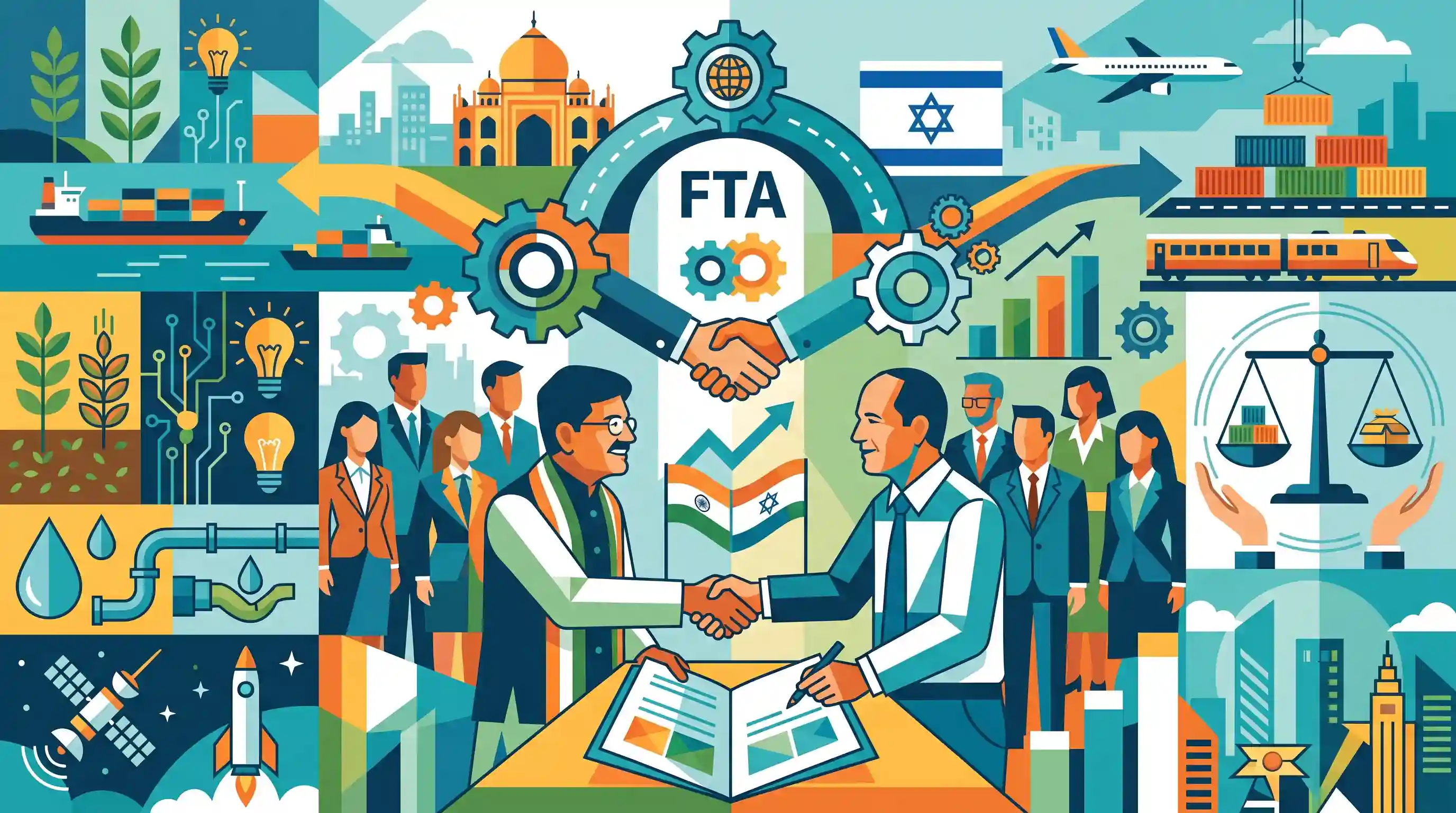
India and Israel have signed the 'Terms of Reference' (ToR) to steer the upcoming negotiations for a Free Trade Agreement (FTA). The agreement was signed by India's Commerce and Industry Minister Piyush Goyal and Israel's Minister of Economy and Industry Nir Barkat during Goyal's visit to Israel with a large business delegation. The proposed comprehensive and balanced FTA aims to expand bilateral trade, enhance the economic and strategic partnership, and identify new cooperative avenues while acknowledging mutual sensitivities.
Key Points
- India and Israel signed the 'Terms of Reference' (ToR) establishing guidelines for negotiating a Free Trade Agreement (FTA).
- The ToR aims to facilitate a balanced, comprehensive, and mutually beneficial trade pact to strengthen strategic and economic ties.
- Commerce Minister Piyush Goyal, along with a 60-member business delegation, met Israeli counterparts to diversify bilateral trade and identify new areas of cooperation.
- The agreement will address trade sensitivities while promoting greater economic integration between the two nations.
Important Terms
Free Trade Agreement (FTA)

A formal pact between nations to reduce or eliminate tariffs and non-tariff barriers on goods and services, aimed at enhancing market access and economic integration.
UPSC context
GS Paper 3 (Economy) and GS Paper 2 (IR); tests India's trade policy and strategic economic engagement.
Terms of Reference (ToR)
A foundational framework document that defines the scope, structure, objectives, and procedural modalities for formal negotiations between two or more entities.
UPSC context
GS Paper 2 (International Relations); tests understanding of the diplomatic roadmap and procedural steps in bilateral agreement-making.
India-Israel CEOs Forum
A high-level institutional platform that brings together top business leaders and policymakers to facilitate investment, technology collaboration, and industrial R&D between the two nations.
UPSC context
GS Paper 2 (International Relations); highlights the importance of economic statecraft and private sector involvement in bilateral strategic partnerships.
Bilateral Trade
The total exchange of goods and services between two countries; India-Israel trade notably includes diamonds, chemicals, defense equipment, and emerging high-tech sectors.
UPSC context
GS Paper 3 (Economy); relevant for trade balance analysis, export diversification, and sectoral economic impact in UPSC Mains.
Economic Diplomacy
The strategic use of trade, investment, and economic tools to advance a nation’s foreign policy objectives and strengthen its international standing.
UPSC context
GS Paper 2 (International Relations); core theme regarding India’s pursuit of strategic autonomy and global economic leadership.
Prelims Trap
India and Israel have recently concluded and operationalized a Free Trade Agreement.
They have only signed the 'Terms of Reference' (ToR), which acts as a blueprint to guide upcoming negotiations. The actual FTA is not yet concluded or operational.
Static Concepts Connected
How does a Free Trade Agreement (FTA) differ from a CEPA or CECA?
- FTA: Focuses primarily on reducing or eliminating tariffs on a positive/negative list of merchandise goods, with limited scope beyond goods.
- CEPA/CECA: More comprehensive pacts that include trade in services, investments, competition, customs cooperation, and intellectual property rights.
- India's Approach: India currently has deeper CEPA/CECA agreements with nations like the UAE and Japan, while negotiating a standard FTA with Israel.
What is India's 'De-hyphenation' policy in West Asia?
- Definition: Treating bilateral relations with Israel and Palestine as independent, standalone tracks rather than a zero-sum game linked to one another.
- Strategic Utility: Allows India to pursue advanced defense, trade, and technological ties with Israel while maintaining its traditional diplomatic stance on the Palestinian cause.
Cross-Topic Patterns
Agriculture tech + Water Management
Israel's expertise in precision farming and micro-irrigation (via IIAP Centres of Excellence) is critical for India's climate-resilient agriculture, linking bilateral trade directly to GS3 water management and food security.
I2U2 + IMEC Geoeconomics
An India-Israel FTA serves as the bilateral bedrock for broader minilateral geoeconomic ambitions in the region, complementing I2U2 joint investments and the India-Middle East-Europe Economic Corridor (IMEC).

India's Middle East geoeconomics (Israel FTA ToR, UAE CEPA, I2U2, IMEC) will likely form a consolidated multi-statement question in 2026.
Linked PYQs · 2
Linked PYQs · 2
- 2018MainsGS2
“India’s relations with Israel have, of late, acquired a depth and diversity, which cannot be rolled back.” Discuss.
- 2022MainsGS2
How will I2U2 (India, Israel, UAE and USA) grouping transform India's position in global politics?
