India and European Union Grant Mutual Most Favoured Nation Status
Source:The Hindu ↗
Why It Matters
The finalization of the India-EU FTA (historically negotiated as the BTIA) marks a watershed moment in India's foreign trade policy, given the EU's position as one of India's largest trading partners. The implementation of MFN status and massive tariff elimination will boost exports, but requires understanding of its impact on domestic industries and alignment with WTO principles.
Summary
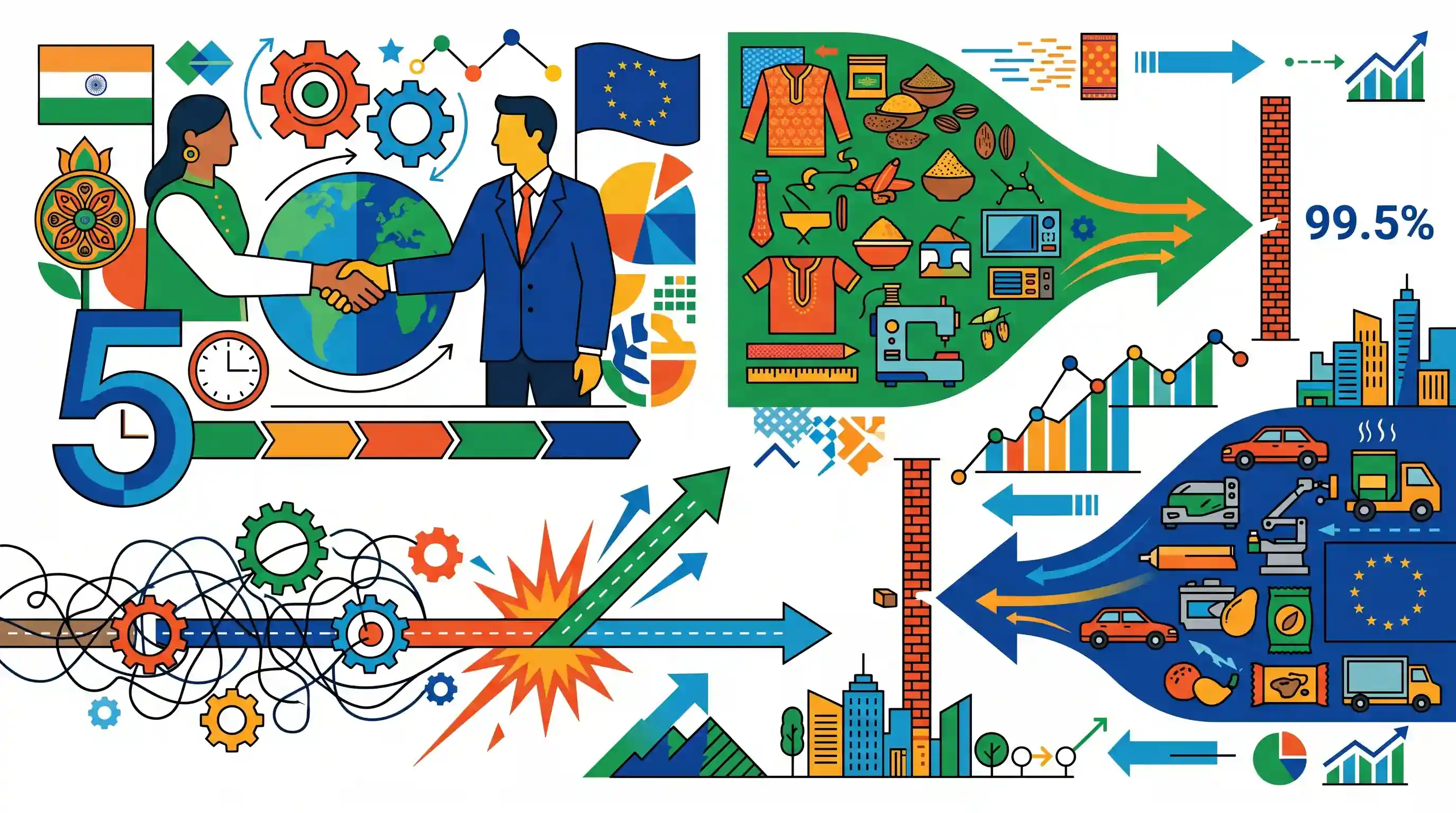
India and the European Union have finalized a landmark Free Trade Agreement (FTA), agreeing to mutually grant 'Most Favoured Nation' (MFN) status for a period of five years starting from the deal's enforcement. The pact resolves years of stalled negotiations, formally re-launched in 2022. The agreement promises massive tariff reductions, eliminating or reducing duties on 96.6% of EU exports to India and 99.5% of Indian exports to the EU based on trade value, significantly deepening bilateral economic integration.
Key Points
- India and the European Union have reached an agreement to mutually grant Most Favoured Nation (MFN) status for five years.
- The MFN status will become effective on the date the finalized Free Trade Agreement (FTA) officially comes into force.
- The FTA eliminates or reduces tariffs on 96.6% of EU exports to India and 99.5% of Indian exports to the EU by trade value.
- The successful pact concludes a long negotiation process, which initially started in 2007 (as the BTIA) and was formally re-launched in 2022.
Important Terms
India-EU Free Trade Agreement (FTA)

A comprehensive pact concluded in 2026 to liberalize trade in goods and services, aiming to eliminate tariffs on over 96% of bilateral trade value.
UPSC context
GS Paper II (Bilateral Agreements) and GS Paper III (Economy); tests understanding of trade diplomacy and regional integration.
Most Favoured Nation (MFN)
A WTO principle requiring members to treat all trading partners equally; in this FTA, a 5-year clause prevents offering better terms to third parties without reciprocating.
UPSC context
GS Paper III (Economy); core concept in international trade law and non-discrimination.
Broad-based Trade and Investment Agreement (BTIA)
The original framework for India-EU trade talks launched in 2007, which stalled in 2013 before being succeeded by the 2026 Free Trade Agreement.
UPSC context
GS Paper II (International Relations); historical context of long-standing bilateral economic negotiations.
European Union (EU)
A 27-member political and economic union that acts as a single market, serving as one of India's largest trading partners and a key strategic ally.
UPSC context
GS Paper II (Bilateral Groupings); focuses on India's engagement with major global power blocs.
World Trade Organization (WTO)
The global body governing trade rules between nations; it oversees agreements like GATT and GATS while allowing FTAs as specific exceptions to non-discrimination rules.
UPSC context
GS Paper III (Economy/Institutions); fundamental for understanding global trade governance and dispute resolution.
Prelims Trap
The India-EU FTA grants MFN status, giving both nations exclusive, preferential tariff reductions over other WTO members.
MFN under WTO means treating all members equally, not exclusively. FTAs provide preferential treatment (exclusive lower tariffs), which is actually a permitted exception to MFN under GATT Article XXIV.
Static Concepts Connected
How does the WTO's Most Favoured Nation (MFN) principle work alongside FTAs?
- GATT Article I: Requires WTO members to extend any trade concession granted to one country equally to all other WTO members, ensuring strict non-discrimination.
- FTA Exception: GATT Article XXIV permits Free Trade Agreements and Customs Unions to bypass MFN rules and offer preferential tariffs, provided they cover "substantially all trade" between partners.
- Generalized System of Preferences: Developed countries can offer non-reciprocal preferential treatment (lower tariffs) to products originating in developing countries, completely bypassing MFN constraints.
What were the historical roadblocks in the India-EU BTIA negotiations?
- EU demands: The EU historically sought massive tariff reductions on European automobiles, wines, spirits, and dairy products, alongside stricter intellectual property (IP) enforcement.
- Indian demands: India consistently sought 'data secure nation' status for its IT sector and easier movement of skilled professionals (Mode 4 services) into European markets.
Cross-Topic Patterns
FTAs vs. Carbon Border Tax (CBAM)
The EU's impending Carbon Border Adjustment Mechanism (CBAM) complicates this FTA, as the newly negotiated tariff reductions could be functionally offset by environmental compliance taxes on Indian steel and aluminum.
EFTA vs. EU Trade Agreements
India recently signed a pact with the EFTA (Switzerland, Norway, Iceland, Liechtenstein), structurally laying the groundwork and building negotiating momentum for this larger, much more complex EU agreement.

Expect a 2026 Prelims statement differentiating WTO's MFN principle (GATT Art I) from FTA preferential exceptions (GATT Art XXIV).
Linked PYQs · 3
Linked PYQs · 3
- 2017PrelimsGS1
'Broad-based Trade and Investment Agreement (BTIA)' is sometimes seen in the news in the context of negotiations held between India and
- 2014MainsGS2
The aim of Information Technology Agreements (ITAs) is to lower all taxes and tariffs on information technology products by signatories to zero. What impact would such agreements have on India's interests?
- 2023PrelimsGS1
Consider the following statements: Statement-I: Recently, the United States of America (USA) and the European Union (EU) have launched the 'Trade and Technology Council'. Statement-II: The USA and the EU claim that through this they are trying to bring technological progress and physical productivity under their control. Which one of the following is correct in respect of the above statements?
