India and European Union Strategic Partnership and Trade
Source:The Hindu ↗
Why It Matters
The India-EU strategic partnership is becoming a cornerstone of a multipolar world order. For UPSC aspirants, the evolving dynamics—especially the finalization of the BTIA and the geopolitical vacuum left by shifting US priorities—are critical for analyzing modern International Relations and trade diplomacy.
Summary
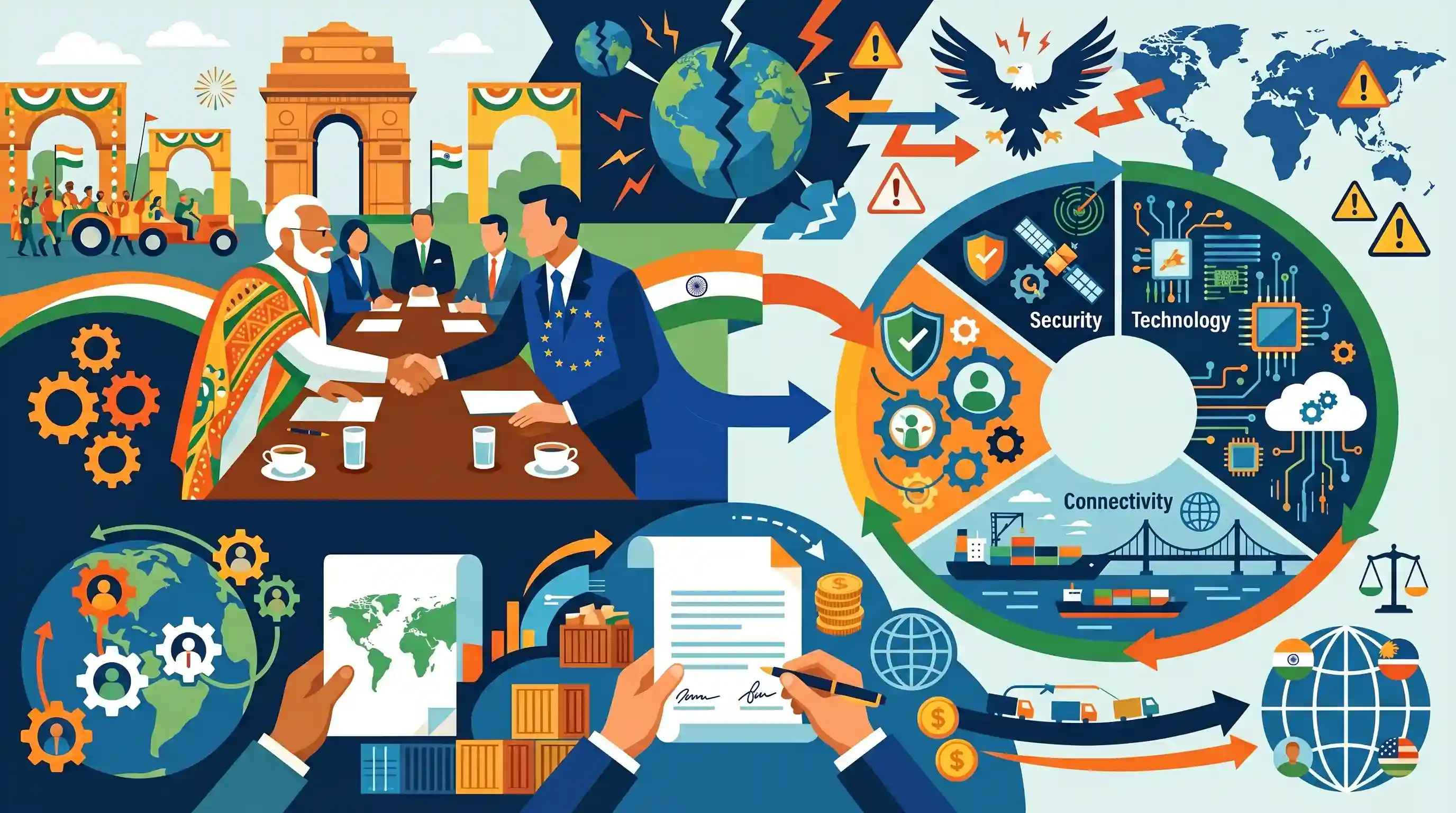
During India's 77th Republic Day celebrations, top European Union leaders met with the Indian leadership to showcase an alternative, cooperative approach in a 'fractured world'. With growing uncertainties around US foreign and trade policy—including transatlantic frictions and shifting US defence strategies—the EU and India have adopted a new comprehensive strategic agenda. This agenda spans security, technology, and connectivity, with both sides signaling that the long-pending Free Trade Agreement (BTIA) is nearing conclusion. The deepening partnership underscores a mutual commitment to a rules-based international order and resilient global supply chains independent of single-power dominance.
Key Points
- EU Commission President Ursula von der Leyen and EU Council President Antonio Costa attended India's 77th Republic Day as chief guests, marking a significant milestone in India-EU bilateral ties.
- India and the EU adopted a comprehensive strategic agenda encompassing security, defence, trade, technology, and connectivity.
- Negotiations for the long-delayed India-EU Free Trade Agreement are nearing a conclusion, driven by the shared need to secure resilient supply chains in a 'fractured world'.
- Growing transatlantic friction—such as tariff threats and the US Defense Strategy 2026 omitting India—is catalyzing stronger strategic cooperation between the EU and India to uphold the rules-based international order.
Important Terms
Broad-based Trade and Investment Agreement (BTIA)

A comprehensive trade pact signed in January 2026 to liberalize trade in goods, services, and investment between India and the EU, significantly reducing tariffs on automobiles and spirits.
UPSC context
GS-II: Bilateral agreements involving India; GS-III: Effects of liberalization on the economy. Tests understanding of major trade milestones.
India-EU Comprehensive Strategic Agenda
An ambitious roadmap adopted in 2026 outlining bilateral cooperation goals until 2030 across security, connectivity, and sustainability, designed to deepen the India-EU partnership in a fragmented world.
UPSC context
GS-II: Bilateral, regional and global groupings. Tests knowledge of foreign policy roadmaps and strategic pivots.
Strategic Autonomy
A state's capacity to pursue national interests and foreign policy independently, without excessive reliance on other powers; it is a shared strategic objective for both India and the EU.
UPSC context
GS-II: Geopolitics and International Relations. Tests conceptual understanding of non-alignment and sovereign decision-making.
Rules-based International Order
A global governance system predicated on international law, treaties, and multilateral institutions (like the UN and WTO) to ensure predictable behavior and peaceful dispute resolution between sovereign states.
UPSC context
GS-II: Important International institutions. Tests knowledge of the principles governing global diplomacy and multilateralism.
Trade and Technology Council (TTC)
A high-level bilateral platform for India and the EU to coordinate on critical technologies like AI and semiconductors, ensuring economic security and resilient supply chains.
UPSC context
GS-II/III: Technology missions and international agreements. Tests understanding of contemporary techno-diplomatic mechanisms.
US National Defense Strategy (NDS) 2026
A 2026 US policy shift prioritizing homeland security and "burden-sharing," signaling reduced international military interventionism and prompting allies to seek independent strategic partnerships.
UPSC context
GS-II: Effect of policies of developed countries on India's interests. Tests awareness of external drivers in India's foreign policy.
European Commission
The executive branch of the European Union responsible for proposing legislation, enforcing treaties, and negotiating international trade agreements like the FTA with India.
UPSC context
GS-II: Important International institutions. Tests knowledge of the structural entities that govern global trade partnerships.
Prelims Trap
"The Broad-based Trade and Investment Agreement (BTIA) is a new post-pandemic trade negotiation mechanism."
BTIA negotiations actually began in 2007, stalled in 2013 over tariff and IP disputes, and were relaunched later. It is not a new framework.
Static Concepts Connected
What is the EU-India Trade and Technology Council (TTC)?
- Bilateral mechanism: A strategic coordination forum created to tackle challenges at the nexus of trade, trusted technology, and economic security.
- Exclusive tier: India is only the second partner (after the US) with which the European Union has established such a high-level council.
- Working Groups: Focuses on digital governance, green tech, and resilient supply chains (countering single-power dominance).
What historically stalled the India-EU BTIA negotiations?
- Tariff disputes: EU demands for drastic tariff reductions on European automobiles, wines, and dairy products.
- IPR & Data: EU insistence on stricter Intellectual Property Rights (TRIPS-plus) and reciprocal data secure status.
- Services & Visas: India's demand for easier cross-border movement of skilled professionals (Mode 4 of services) into Europe.
Cross-Topic Patterns
Hedging against US protectionism
As the US leans toward protectionism, middle powers and blocs like India and the EU are converging to build parallel resilient supply chains (e.g., IMEC) independent of Washington and Beijing.
CBAM vs. Free Trade ambitions
While India and the EU expedite the BTIA, the EU's incoming CBAM (carbon tax) remains a conflicting non-tariff barrier for Indian steel and aluminum exports, testing the new strategic alignment.

The convergence of India-EU BTIA, IMEC, and the Trade & Technology Council makes Europe's geoeconomic pivot to India a likely 2026 Mains Q.
Linked PYQs · 3
Linked PYQs · 3
- 2017PrelimsGS1
'Broad-based Trade and Investment Agreement (BTIA)' is sometimes seen in the news in the context of negotiations held between India and
- 2023PrelimsGS1
Consider the following statements: Statement-I: Recently, the United States of America (USA) and the European Union (EU) have launched the 'Trade and Technology Council'. Statement-II: The USA and the EU claim that through this they are trying to bring technological progress and physical productivity under their control. Which one of the following is correct in respect of the above statements?
- 2023MainsGS2
‘The expansion and strengthening of NATO and a stronger US-Europe strategic partnership works well for India.’ What is your opinion about this statement ? Give reasons and examples to support your answer.
