India and Croatia Agree on Long-Term Defence Cooperation Plans
Source:The Hindu ↗
Why It Matters
This bilateral visit highlights India's strategic outreach to Central and Eastern Europe. Cooperation in defence production and coastal infrastructure (like the Sagarmala project) aligns with India's self-reliance and maritime goals, while Croatian support is pivotal for India's larger European Union engagements.
Summary
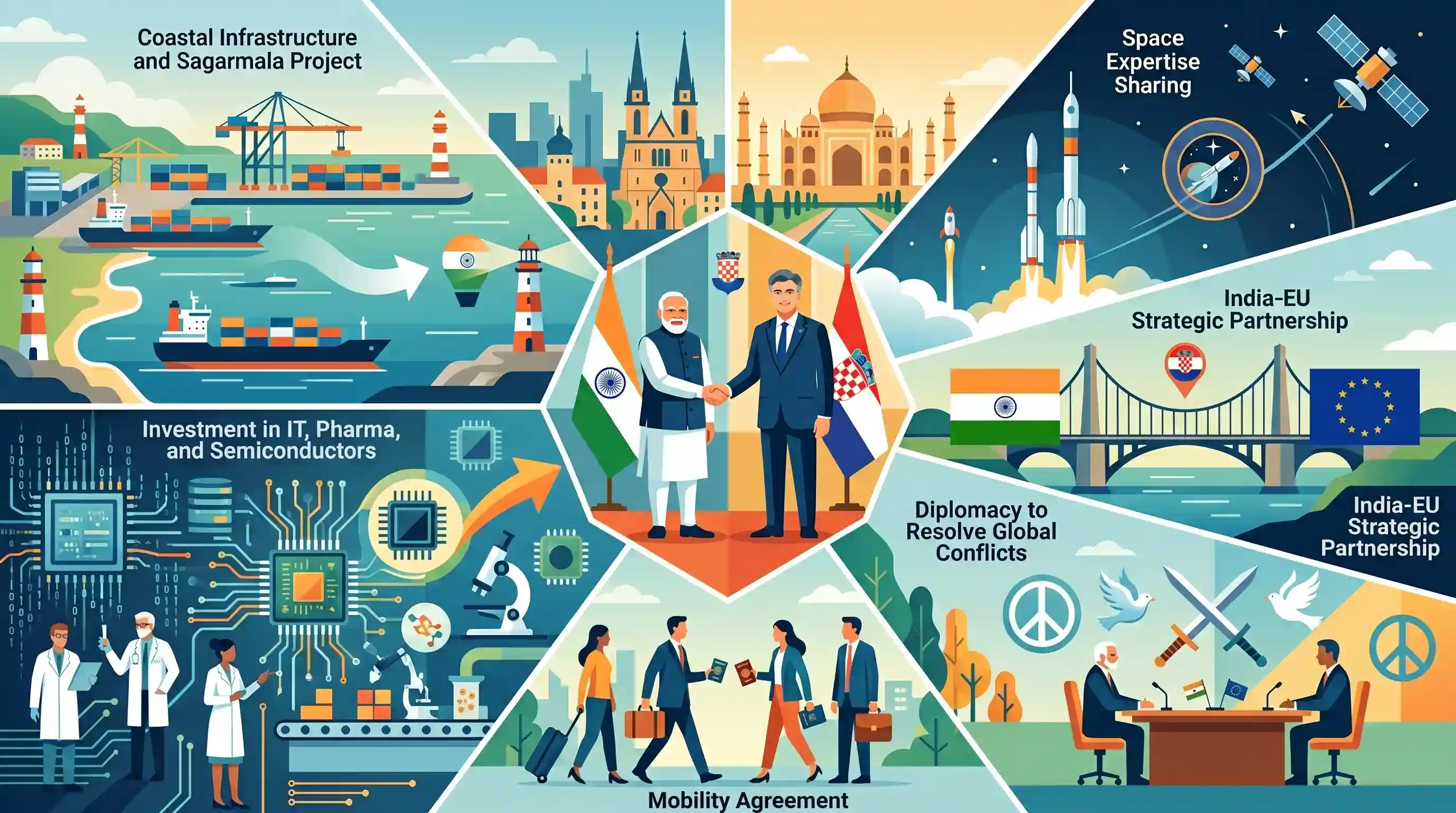
Indian Prime Minister Narendra Modi and Croatian Prime Minister Andrej Plenkovic held bilateral talks in Zagreb, focusing on expanding long-term defence cooperation, trade, and strategic ties. Key outcomes include inviting Croatian expertise for India's coastal infrastructure and Sagarmala project, and promoting Indian investments in Croatia's IT, pharma, and semiconductor sectors. The leaders highlighted the impending signing of a mobility agreement and India's commitment to sharing space expertise. The talks also underscored Croatia's vital role in bolstering the India-EU strategic partnership and emphasized diplomacy to resolve ongoing global conflicts.
Key Points
- India and Croatia are forging long-term plans for defence cooperation, focusing on defence production, military training, and institutional exchange.
- Croatia was invited to participate in India's coastal infrastructure development, including the Sagarmala project, port modernization, and shipbuilding.
- The two nations emphasized enhancing Indian investments in Croatia's strategic sectors like pharmaceuticals, agriculture, IT, clean technology, and semiconductors.
- India will share its space technology expertise with Croatia and facilitate joint research between academic institutions.
- Croatia's support is viewed as crucial for firming up India's broader strategic partnership with the European Union, with a bilateral mobility agreement also in the works.
Important Terms
Sagarmala project

A flagship initiative for "port-led development," aiming to modernize ports, reduce logistics costs, and boost coastal industrialization along India's 7,500 km coastline through infrastructure and multimodal connectivity.
UPSC context
GS Paper III (Infrastructure); tests understanding of maritime logistics, coastal economy, and port-modernization strategies for trade efficiency.
Mobility agreement
A bilateral pact (Migration and Mobility Partnership Agreement) designed to facilitate the legal movement of students, professionals, and researchers between nations while addressing irregular migration challenges.
UPSC context
GS Paper II (International Relations); relevant for bilateral pacts, diaspora engagement, and formalizing labor mobility with European partners.
European Union (EU)
A political and economic union of 27 European member states. It is one of India's largest trading partners and a key strategic ally for climate and technology.
UPSC context
GS Paper II (Global Groupings); critical for topics like the India-EU FTA, strategic autonomy, and Indo-Pacific cooperation.
G7
An intergovernmental forum of the world's leading industrialized democracies (Canada, France, Germany, Italy, Japan, UK, USA). India participates as a frequent guest representing Global South interests.
UPSC context
GS Paper II (IR); tests India’s engagement with elite global forums and its role in addressing global economic crises.
Prelims Trap
Croatia is a landlocked Central European nation serving as a transit route to the EU.
Croatia has a prominent coastline on the Adriatic Sea, making it maritime-focused. This is precisely why India is seeking its expertise for the coastal Sagarmala project.
Static Concepts Connected
What are the core components of India's Sagarmala Project?
- Port Modernization: Transforming existing ports and building new world-class facilities to handle increased cargo traffic efficiently.
- Enhanced Connectivity: Developing multi-modal logistics, including inland waterways and rail networks, to connect ports seamlessly with hinterlands.
- Port-led Industrialization: Establishing Coastal Economic Zones (CEZs) near ports to reduce logistical costs for export-import industries.
- Community Development: Focusing on skill-building, fisheries development, and sustainable livelihoods for coastal populations.
What is the objective of India's Migration and Mobility Partnership Agreements (MMPAs)?
- Legal Pathways: Facilitating smooth, legal movement of students, academics, and skilled professionals between partner nations.
- Curbing Irregular Migration: Establishing cooperation mechanisms to prevent illegal immigration and streamline the return of irregular migrants.
- Demographic Diplomacy: Maximizing India's demographic dividend by safely integrating its workforce into countries with aging populations.
Cross-Topic Patterns
Adriatic Sea as an EU gateway
Croatia’s Adriatic ports offer India alternative logistical nodes into Europe, complementing larger multi-modal trade initiatives like the India-Middle East-Europe Economic Corridor (IMEC).
ISRO as a foreign policy tool
Sharing space expertise with Croatia parallels past initiatives like the South Asia Satellite, leveraging India’s space capabilities for geopolitical soft power and fostering bilateral tech alliances.

Expect a 2026 Prelims map question identifying Adriatic Sea bordering nations, coupled with India’s recent European mobility agreements.
Linked PYQs · 3
Linked PYQs · 3
- 2023MainsGS2
‘The expansion and strengthening of NATO and a stronger US-Europe strategic partnership works well for India.’ What is your opinion about this statement ? Give reasons and examples to support your answer.
- 2025MainsGS3
Why is maritime security vital to protect India's sea trade? Discuss maritime and coastal security challenges and the way forward.
- 2016MainsGS1
Enumerate the problems and prospects of inland water transport in India.
