भारत और चीन के बीच द्विपक्षीय व्यापार और सीमा वार्ता
स्रोत:द हिंदू ↗
क्यों मायने रखता है
The evolution of India-China bilateral relations is a crucial geopolitical issue, directly impacting regional security and economic supply chains. Understanding the nuances of their border de-escalation, trade concerns involving critical minerals, and India's anti-terrorism stance at multilateral forums like the SCO is essential for GS Paper 2 (International Relations).
सारांश
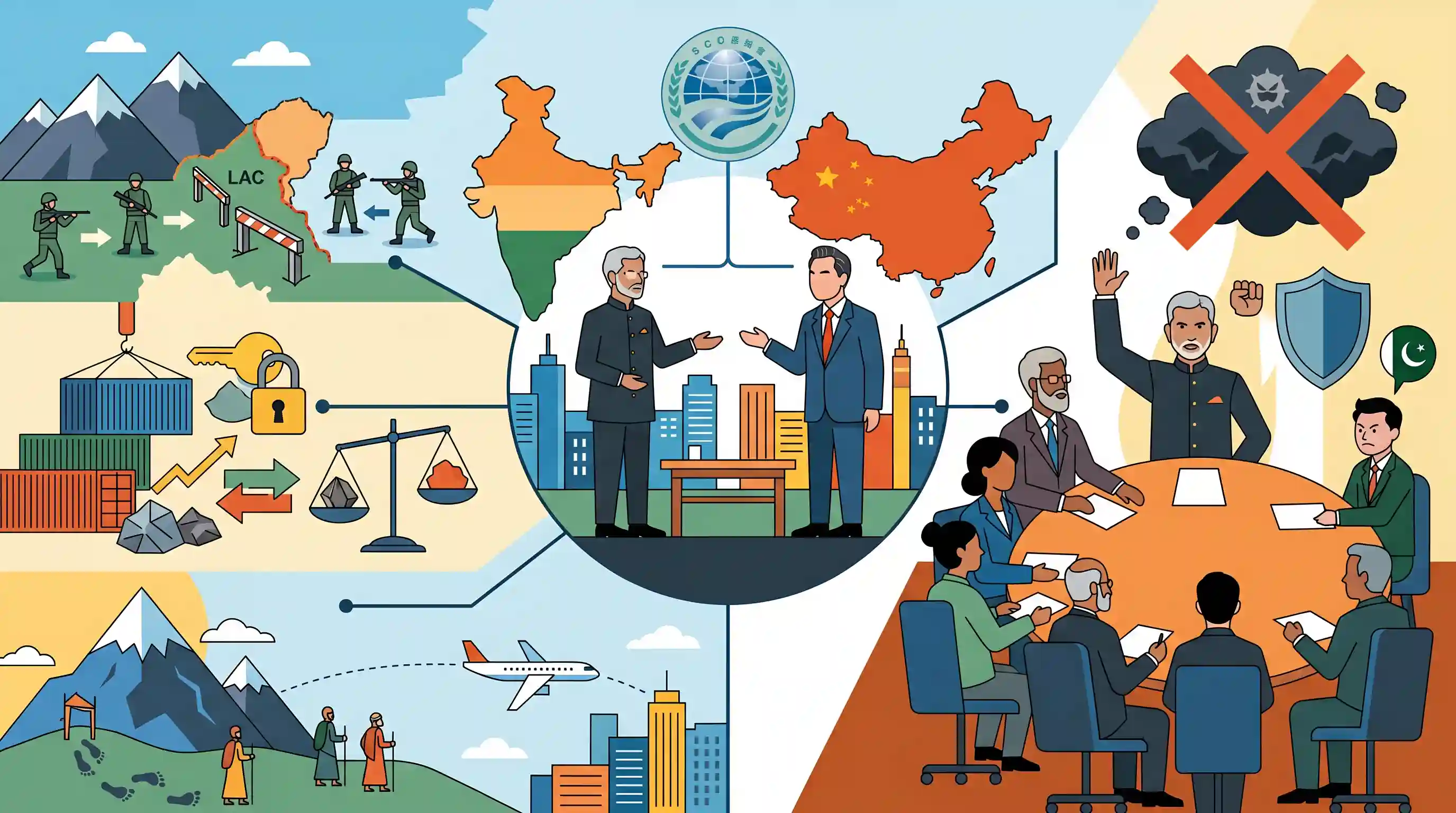
External Affairs Minister S. Jaishankar’s visit to Beijing for the Shanghai Cooperation Organisation (SCO) Foreign Ministers meeting underscored efforts to normalize India-China relations. In talks with Chinese Foreign Minister Wang Yi, Jaishankar advocated for complete de-escalation at the Line of Actual Control (LAC) following recent disengagement, and stressed the need to remove restrictive trade measures, such as China's export controls on critical minerals. The meeting also addressed resuming people-to-people ties, including the Kailash Manasarovar yatra and direct flights. Meanwhile, at the SCO, India strongly pushed for a 'zero tolerance' policy on terrorism, countering opposition from Pakistan.
मुख्य बिंदु
- India and China discussed further de-escalation at the LAC following earlier disengagement at Demchok and Depsang.
- EAM S. Jaishankar emphasized avoiding restrictive trade measures, specifically concerning Chinese export restrictions on critical minerals.
- China highlighted its opposition to unilateral protectionism and tariffs, mainly targeting U.S. policies.
- India pushed for a 'zero tolerance' approach to terrorism at the SCO Foreign Ministers meeting, a stance currently blocked by Pakistan.
- Steps towards normalizing bilateral ties include resuming the Kailash Manasarovar yatra, initiating dialogue on direct flights, and upcoming high-level visits.
महत्वपूर्ण शब्द
Shanghai Cooperation Organisation (SCO)

A Eurasian intergovernmental political, economic, and security alliance founded in 2001. Its ten members include India, China, Russia, Pakistan, Iran, and Belarus, focusing on regional stability and counter-terrorism.
UPSC context
GS Paper II: International Relations. Tests understanding of regional groupings, India's Eurasia policy, and the 'Extended Neighbourhood' concept.
Line of Actual Control (LAC)
The notional, non-demarcated boundary separating Indian-controlled territory from Chinese-controlled territory. It spans approximately 3,488 km across the Western, Middle, and Eastern sectors.
UPSC context
GS Paper II/III: India-China relations and Border Management. Tests knowledge of border disputes, perceptions, and security challenges.
Critical Minerals
Non-fuel minerals like lithium, cobalt, and rare earths essential for modern technology, green energy, and defense. Their high supply-chain concentration makes them a strategic geopolitical priority.
UPSC context
GS Paper I/III: Resources and Economy. Tests awareness of resource security, energy transition, and global trade dependencies.
Disengagement
A tactical process where troops in a face-off at specific friction points step back to a safe distance to prevent immediate physical clashes and reduce local tensions.
UPSC context
GS Paper III: Internal Security/Border Management. Tests ability to distinguish tactical military maneuvers from broader diplomatic resolutions.
De-escalation
A comprehensive strategic process involving the reduction of overall military buildup and returning troops from forward border positions to their original peacetime locations.
UPSC context
GS Paper II: International Relations. Often tested as the necessary next step after disengagement to normalize bilateral relations.
Zero Tolerance Policy
India's diplomatic and security doctrine asserting that no act of terrorism is justifiable, targeting not only individual terrorists but also their financial networks and state sponsors.
UPSC context
GS Paper II/III: IR and Security. Essential for discussing India's stance in global forums like SCO and UN.
Export Controls
Regulatory restrictions, such as licensing requirements or bans, placed on the trade of strategic goods (like critical minerals or dual-use tech) to protect national security.
UPSC context
GS Paper III: Economy/Trade. Relevant to discussing 'trade as a weapon' and its impact on India's industrial interests.
प्रारंभिक ट्रैप
The SCO adopted a unanimous resolution on a 'zero tolerance' policy against terrorism initiated by India.
Pakistan actively blocks India's push for 'zero tolerance' language at the SCO. The organization operates on consensus, meaning bilateral disputes continually stall joint security resolutions.
संबंधित अवधारणाएँ
What are the traditional Indian routes for the Kailash Mansarovar Yatra?
- Lipulekh Pass: Located in Uttarakhand near the Kalapani tri-junction of India, China, and Nepal. It is the older, more arduous traditional trekking route.
- Nathu La Pass: Located in Sikkim, it was opened later to provide a safer, motorable alternative route for pilgrims traversing the Tibetan plateau.
What is the SCO's institutional mechanism for counter-terrorism?
- RATS framework: The Regional Anti-Terrorist Structure (RATS), headquartered in Tashkent, is mandated to combat the 'three evils' of terrorism, separatism, and extremism.
- Consensus blockages: Its practical effectiveness is often hindered by consensus rules, notably Pakistan's opposition to defining and targeting specific state-sponsored cross-border terrorism.
अंतर-विषय पैटर्न
Critical Minerals + Renewable Targets
China's export controls on gallium and germanium directly threaten India's Panchamrit climate goals, as these minerals are indispensable for solar PV manufacturing and EV battery supply chains.
China Plus One + Trade Wars
China's protest against 'unilateral protectionism' highlights its struggle with US tariffs. This presents a geopolitical window for India's PLI schemes to attract supply chains relocating away from Beijing.

Expect a multi-statement Prelims question linking critical minerals (gallium/germanium) to their strategic use in trade wars & renewables.
संबद्ध PYQ · 3
संबद्ध PYQ · 3
- 2023MainsGS2
‘Virus of Conflict is affecting the functioning of the SCO’ In the light of the above statement point out the role of India in mitigating the problems.
- 2021MainsGS2
Critically examine the aims and objectives of SCO. What importance does it hold for India?
- 2014MainsGS2
With respect to the South China sea, maritime territorial disputes and rising tension affirm the need for safeguarding maritime security to ensure freedom of navigation and over flight throughout the region. In this context, discuss the bilateral issues between India and China.
