India among nations driving high global pesticide toxicity
Source:The Hindu ↗
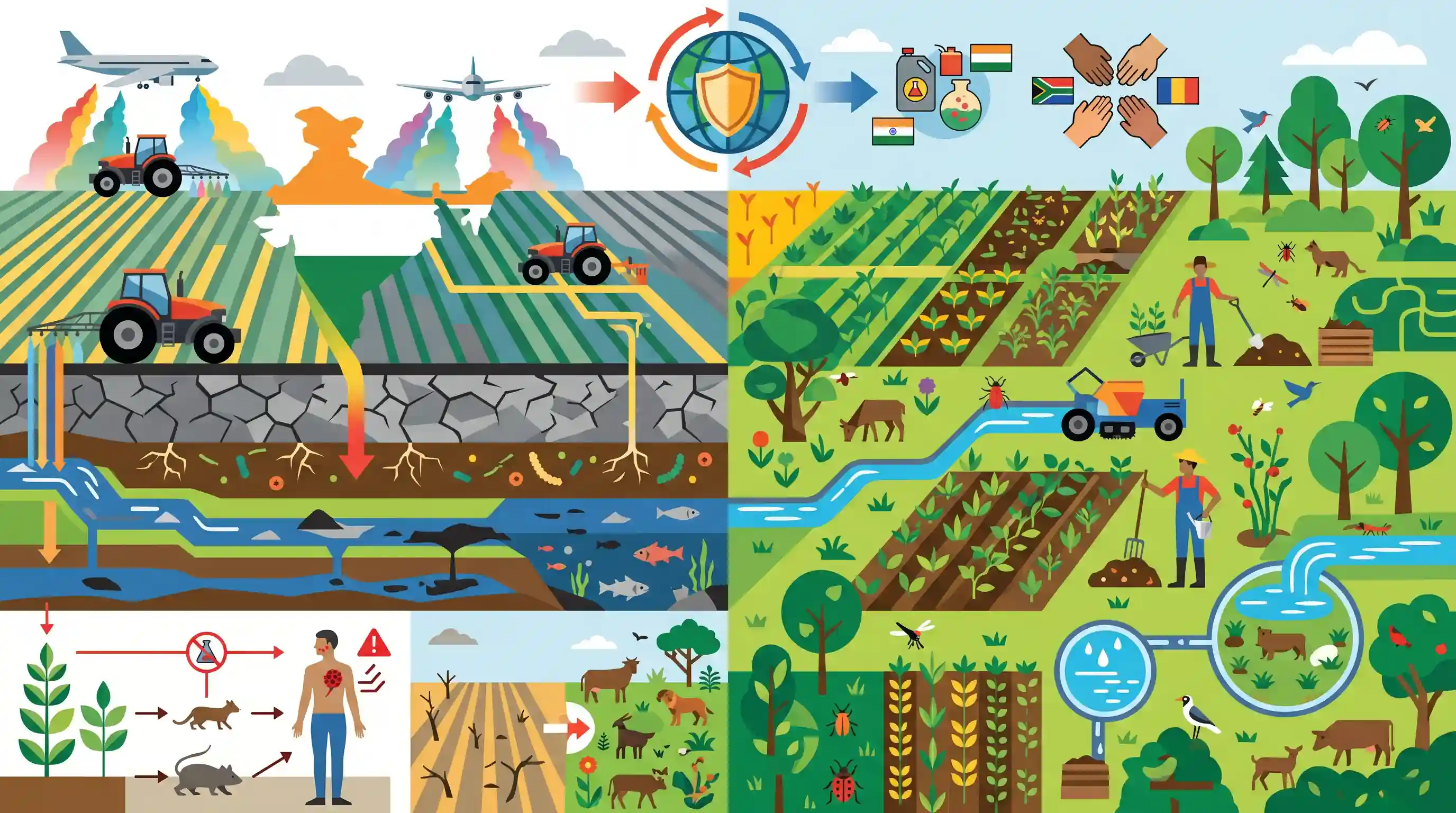
Why It Matters
The indiscriminate use of pesticides directly impacts India's ecological balance and public health. For UPSC candidates, this intersects heavily with GS-III topics such as environmental pollution, the transition from conventional to sustainable agriculture (like permaculture or organic farming), and the regulation of hazardous chemicals (persistent organic pollutants and bioaccumulation).
Summary
A recent study has identified India as one of the four nations driving the highest levels of global pesticide toxicity. The intensive reliance on chemical pesticides in Indian agriculture significantly contributes to environmental degradation, including soil and water contamination, as well as a loss of biodiversity. This high toxicity footprint also poses severe public health risks through the bioaccumulation of toxic chemical residues in the food chain. The study underscores the critical need for a paradigm shift from conventional, chemical-heavy agriculture toward sustainable alternatives like organic farming and permaculture, accompanied by stricter domestic regulation of hazardous agrochemicals in line with global environmental conventions.
Key Points
- A recent study highlights that India is among the top four countries globally driving the majority of pesticide toxicity, alongside major agricultural producers like China, the US, and Brazil.
- The intensive use of chemical pesticides in conventional agriculture contributes significantly to environmental pollution, soil degradation, and loss of biodiversity.
- High pesticide toxicity raises serious public health concerns due to the bioaccumulation and biomagnification of chemical residues in the food chain and water sources.
- The findings underscore an urgent need to transition toward sustainable farming models, such as permaculture and organic farming, and to strengthen the regulatory framework governing synthetic agrochemicals in India.
Important Terms
Stockholm Convention on Persistent Organic Pollutants

A global treaty (2001) to eliminate or restrict chemicals that persist in the environment, bioaccumulate in food chains, and travel long distances (Persistent Organic Pollutants).
UPSC context
GS III: Environment. Tests knowledge of international treaties, hazardous chemicals, and India's obligations toward global environmental safety.
Rotterdam Convention
A 1998 multilateral agreement promoting shared responsibility in trading hazardous chemicals through the Prior Informed Consent (PIC) procedure for informed import decisions.
UPSC context
GS III: Environment and International Trade. Tests understanding of legal frameworks governing the movement of hazardous agrochemicals across borders.
Insecticides Act, 1968
India's primary law regulating the import, manufacture, sale, and distribution of pesticides to prevent risks to humans and animals; currently facing replacement by new legislation.
UPSC context
GS III: Agriculture and Regulatory Framework. Tests knowledge of domestic laws and their limitations in managing modern agricultural toxicity.
Total Applied Toxicity (TAT)
A scientific metric weighing the volume of pesticide used against its lethality for non-target species, capturing the real ecological burden rather than just quantity.
UPSC context
GS III: Environment/Pollution. A specific, contemporary indicator used to assess progress toward global biodiversity goals and pesticide risk reduction.
Bioaccumulation
The process by which toxic substances accumulate in the tissues of living organisms at a rate faster than they can be metabolized or excreted.
UPSC context
GS III: Environment and Ecology. Fundamental concept for understanding how pesticide residues impact the food chain and public health.
Food and Agriculture Organization (FAO)
A UN specialized agency that develops the International Code of Conduct on Pesticide Management and promotes sustainable alternatives like Integrated Pest Management (IPM).
UPSC context
GS II & III: International Institutions and Agriculture. Relevant for global standard-setting and sustainable food production strategies.
Prelims Trap
Total Applied Toxicity (TAT) evaluates only the total volume or tonnage of chemical pesticides used.
TAT evaluates BOTH the volume of pesticides applied and their specific lethality to non-target species. High volume alone does not equate to high TAT.
Static Concepts Connected
What is the difference between Bioaccumulation and Biomagnification?
- Bioaccumulation: The gradual accumulation of toxic chemicals in a single organism over its lifetime, where intake exceeds excretion.
- Biomagnification: The increasing concentration of toxic substances at successive, higher trophic levels within a food chain (e.g., apex predators).
How do the Stockholm and Rotterdam conventions regulate hazardous chemicals?
- Stockholm Convention: A legally binding treaty aimed at eliminating or severely restricting the production and use of Persistent Organic Pollutants (POPs).
- Rotterdam Convention: Promotes shared responsibility via the Prior Informed Consent (PIC) procedure for the international trade of hazardous chemicals and pesticides.
Cross-Topic Patterns
Permaculture vs. Natural Farming (ZBNF)
UPSC often links the ecological principles of permaculture (design-led, perennial systems) with Zero Budget Natural Farming (ZBNF) and organic farming to test viable economic alternatives to chemical-heavy agriculture.
Agrochemical runoff and wetland ecology
High pesticide and fertilizer use directly connects to toxic runoff, linking conventional agriculture practices to the eutrophication of wetlands, groundwater contamination, and the decline of indicator species like amphibians.

Expect a multi-statement prelims question combining TAT metrics, the Insecticides Act of 1968, and globally banned chemicals like Paraquat.
Linked PYQs · 3
Linked PYQs · 3
- 2021PrelimsGS1
How is permaculture farming different from conventional chemical farming? 1. Permaculture farming discourages monocultural practices but in conventional chemical farming, monoculture practices are predominant. 2. Conventional chemical farming can cause increase in soil salinity but the occurrence of such phenomenon is not observed in permaculture farming. 3. Conventional chemical farming is easily possible in semi-arid regions but permaculture farming is not so easily possible in such regions. 4. Practice of mulching is very important in permaculture farming but not necessarily so in conventional chemical farming. Select the correct answer using the code given below.
- 2024PrelimsGS1
With reference to perfluoroalkyl and polyfluoroalkyl substances (PFAS) that are used in making many consumer products, consider the following statements : 1. PFAS are found to be widespread in drinking water, food and food packaging materials. 2. PFAS are not easily degraded in the environment. 3. Persistent exposure to PFAS can lead to bioaccumulation in animal bodies. Which of the statements given above are correct?
- 2020MainsGS3
How is science interwoven deeply with our lives? What are the striking changes in agriculture triggered off by the science-based technologies?
