India Relaxes Procurement Norms for Select Chinese Linked Firms
Source:The Hindu ↗
Why It Matters
This article highlights India's ongoing calibration of its economic strategy toward China. Post-2020 border tensions led to rigid investment and procurement bans (such as Press Note 3 and land-border bidding curbs). However, supply-side realities in critical sectors like power have compelled a selective, pragmatic relaxation. This serves as an excellent case study of the complex trade-offs between national security, supply chain dependence, and domestic infrastructure expansion.
Summary
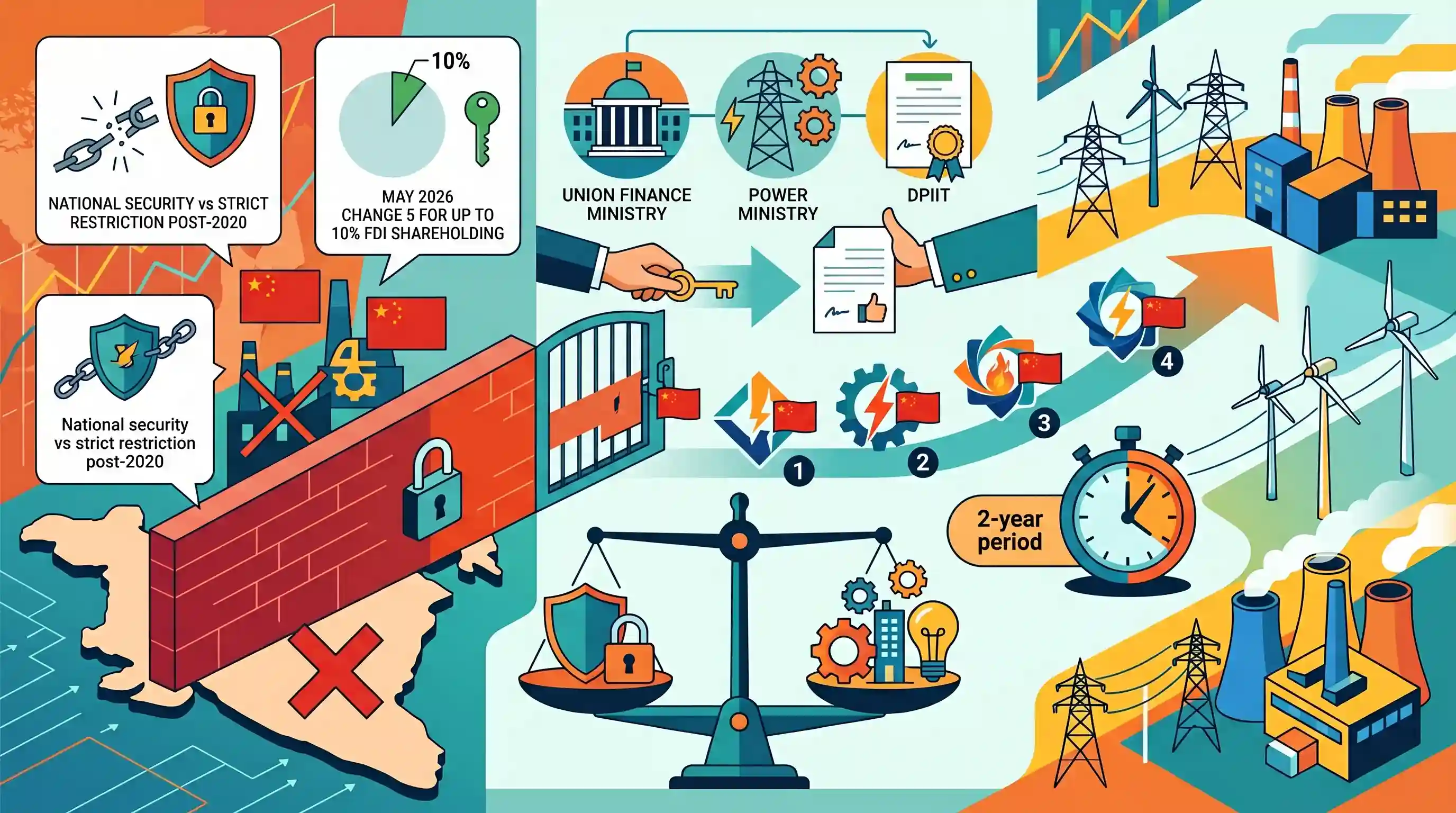
The Union Finance Ministry has relaxed public procurement restrictions to allow four China-linked power equipment companies to bid for public power projects in India for a two-year period. This relaxation, initiated upon request by the Ministry of Power and cleared by the Department for Promotion of Industry and Internal Trade (DPIIT), marks a calibrated shift from the strict restrictions placed on border-sharing countries post-2020. It follows a prior May 2026 relaxation of 'Press Note 3' that allowed automatic route investments for companies with up to 10% Chinese shareholding.
Key Points
- The Department of Expenditure (Procurement Policy Division) under the Ministry of Finance has granted a two-year exemption to four China-linked power equipment firms from public bidding restrictions.
- The exempted companies are TBEA Energy India, Nanjing Electric India, New Northeast Electric India, and Taikai Electric (India), which have direct parentage, subsidiary status, or technical transfer agreements with Chinese entities.
- The decision followed a formal request in January by the Ministry of Power, which was subsequently evaluated and cleared by the Committee of Secretaries and the Registration Committee under the Department for Promotion of Industry and Internal Trade (DPIIT).
- The Procurement Policy Division emphasized that this two-year relaxation is an isolated concession and should not be treated as a precedent for future policy decisions.
- The move builds on a prior policy relaxation in May, where the government amended 'Press Note 3' rules to permit foreign entities with up to 10% Chinese shareholding to invest in India under the automatic route rather than seeking mandatory government approval.
- This development underscores India's pragmatic balancing act between national security interests (stemming from the 2020 border standoff) and domestic infrastructure requirements (achieving critical power-sector goals with cost-effective equipment).
Important Terms
Press Note 3 of 2020

A 2020 Indian FDI regulation mandating prior government approval for foreign investments originating from, or beneficially owned by, entities from countries sharing a land border with India to prevent hostile takeovers.
UPSC context
GS Paper III: Indian Economy and mobilization of resources; tests understanding of investment models, FDI policy, and economic security.
Department for Promotion of Industry and Internal Trade (DPIIT)
A department under India's Ministry of Commerce and Industry responsible for formulating industrial policies, promoting investment, and administering Foreign Direct Investment (FDI) guidelines.
UPSC context
GS Paper III: Industrial policy and growth; tests knowledge of key administrative bodies governing national economic and investment policies.
Department of Expenditure
A key department under the Ministry of Finance responsible for overseeing the public financial management system, framing General Financial Rules (GFR), and managing central government expenditure and public procurement.
UPSC context
GS Paper III: Government Budgeting; tests administrative functions related to fiscal management, resource allocation, and public procurement rules.
Ministry of Power
The Indian Union Ministry responsible for policy formulation, infrastructure planning, project coordination, and regulation of the power generation, transmission, and distribution sectors across the country.
UPSC context
GS Paper III: Infrastructure (Energy/Power Sector); tests policy framework, infrastructure bottlenecks, and strategic coordination.
TBEA Energy India
The wholly-owned Indian subsidiary of the Chinese TBEA Group, manufacturing power transmission equipment locally; it is one of four firms exempted from restrictive bidding rules.
UPSC context
GS Paper III: Infrastructure and Indigenisation; tests understanding of foreign manufacturing firms in critical sectors and economic security tradeoffs.
Prelims Trap
GFR Rule 144(xi) bans all public and private procurements from any nation sharing a land border with India without exception.
Rule 144(xi) of the GFR specifically exempts countries to which India extends Lines of Credit (LoC) or developmental assistance (e.g., Bangladesh, Nepal) and does not apply to private sector entities.
Static Concepts Connected
What is Rule 144(xi) of the General Financial Rules (GFR), 2017?
- National Security Restriction: Allows the Ministry of Finance to restrict procurement from bidders of countries sharing a land border with India on national security grounds.
- Developmental Exception: Does not apply to countries receiving Lines of Credit (LoC) or developmental assistance from India (e.g., Nepal, Bangladesh).
- Clearance Mechanism: Requires affected bidders to obtain mandatory registration from the DPIIT, political clearance from MEA, and security clearance from MHA.
What is Press Note 3 (2020) in India's FDI Policy?
- Prior Approval Requirement: Mandated prior government approval for all Foreign Direct Investments originating from, or with beneficial ownership in, countries sharing a land border with India.
- Core Objective: Introduced to prevent opportunistic takeovers or acquisitions of domestic Indian companies during times of economic vulnerability.
- Absolute Overlook: The rule applies regardless of the FDI route (automatic or government) typically permitted for that sector.
Cross-Topic Patterns
Energy transition vs. strategic autonomy
India's ambitious clean energy and grid-expansion goals clash with domestic capacity deficits, forcing strategic policy compromises with Chinese manufacturers despite active border standoffs.
Press Note 3 and WTO legalities
Targeted restrictions on land-border sharing countries test the boundaries of WTO's Most Favoured Nation (MFN) rules, resting on GATT Article XXI security exceptions.

How India balances infrastructure supply chains with Press Note 3 security checks will likely feature as a GS-3 question in 2026.
Linked PYQs · 3
Linked PYQs · 3
- 2012MainsGS2
Do you think that China's emergence as one of the largest trading partners of India has adversely affected the settlement of the outstanding border problem?
- 2021PrelimsGS1
Consider the following : 1. Foreign currency convertible bonds 2. Foreign institutional investment with certain conditions 3. Global depository receipts 4. Non-resident external deposits Which of the above can be included in Foreign Direct Investments?
- 2011PrelimsGS1
Both Foreign Direct Investment (FDI) and Foreign Institutional Investor (FII) are related to investment in a country. Which one of the following statements best represents an important difference between the two?
