India Targets Increased Manufacturing Share in GDP via PLI Scheme
Source:The Hindu ↗
Why It Matters
Highlights India's ongoing structural economic challenges—specifically the over-reliance on the service sector and gig economy for jobs—and frames the expansion of the manufacturing sector (via the PLI scheme and sunrise industries) as the definitive solution for sustainable demographic dividend utilization.
Summary
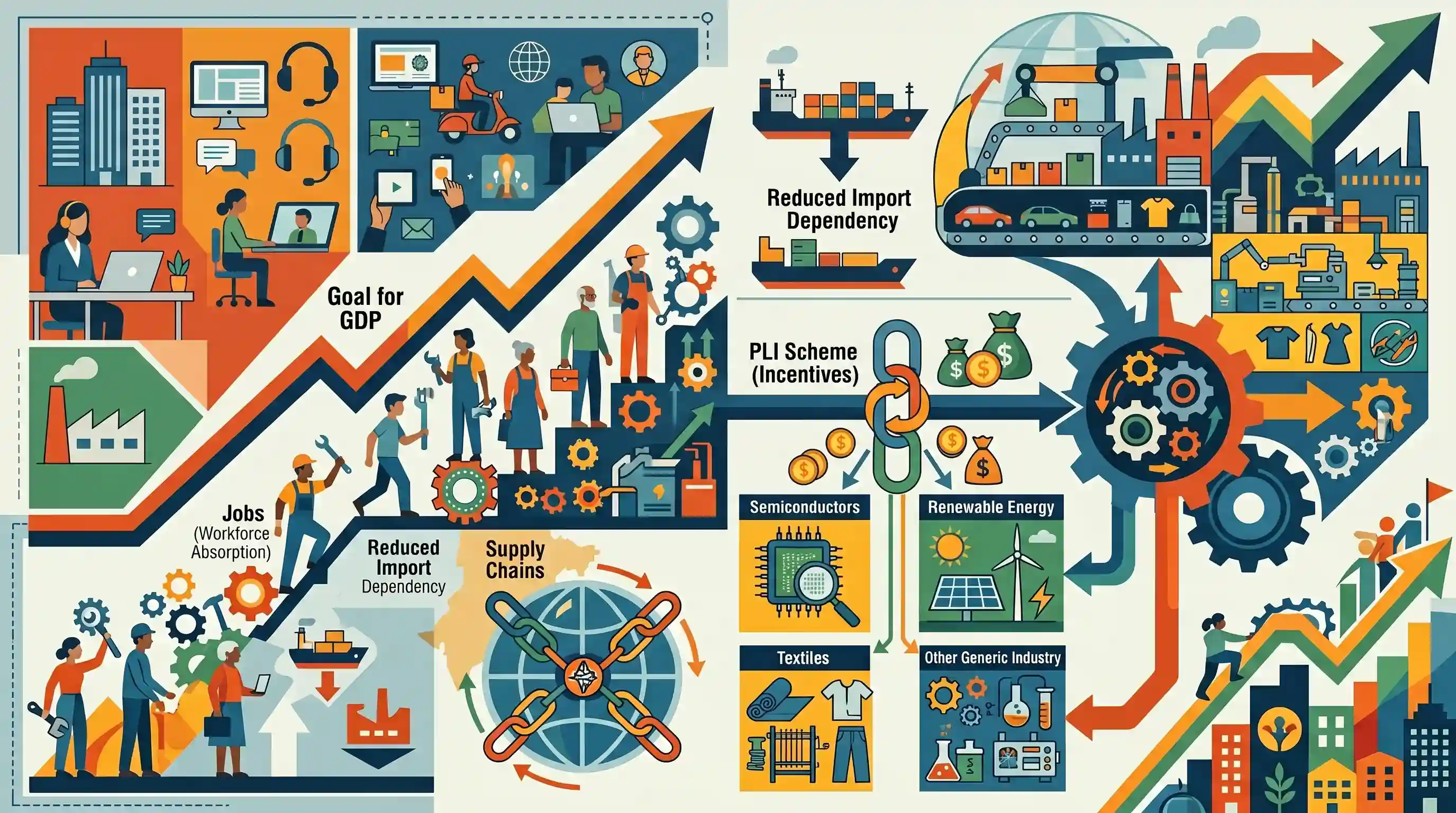
Finance Minister Nirmala Sitharaman announced India's goal to nearly double the manufacturing sector's contribution to GDP, aiming for 22-23% up from the current 12%, over the next two decades. Speaking at the Hoover Institution in California, she emphasized that this structural shift is crucial for absorbing India's youthful workforce, reducing import dependencies, and building competitive global supply chains. The strategy hinges on the Production-Linked Incentive (PLI) scheme, which targets 14 "sunrise sectors" such as semiconductors and renewable energy, as well as traditional labour-intensive industries like textiles. Acknowledging that the service sector currently dominates at 64% of GDP and the gig economy is expanding rapidly, the Minister highlighted that manufacturing remains the indispensable engine for long-term economic transformation and societal cohesion.
Key Points
- India aims to increase the manufacturing sector's share in GDP from 12% to 22-23% over the next two decades to absorb its youthful workforce and drive economic growth.
- The government has identified 14 "sunrise sectors" (including semiconductors, renewable energy, and medical devices) and introduced the Production-Linked Incentive (PLI) scheme to promote them.
- Alongside high-tech industries, the PLI scheme also targets labour-intensive sectors like textiles and leather to maximize job creation.
- The service sector currently contributes around 64% to India's GDP, with the gig economy projected to expand massively from 7.1 million workers in 2021-22 to potentially 230 million by 2030.
- Manufacturing is viewed as a cornerstone for economic transformation, creating backward and forward linkages while shielding the economy through predictable domestic policies against external shocks like U.S. tariffs.
Important Terms
Production Linked Incentive (PLI) Scheme

A performance-linked incentive program offering financial rewards (4–6%) on incremental sales of goods manufactured in India to boost domestic production and exports.
UPSC context
GS-III: Industrial Policy and Growth. Tests understanding of government strategies for 'Atmanirbhar Bharat' and global supply chain integration.
National Green Hydrogen Mission
A strategic initiative aiming to make India a global hub for green hydrogen production, targeting 5 MMT annual capacity and 125 GW renewable energy addition by 2030.
UPSC context
GS-III: Infrastructure (Energy) and Environment. Tests knowledge of decarbonization, energy security, and climate commitments.
Sunrise Sectors
Emerging industries with high growth potential, innovation, and technological advancement, such as semiconductors, green hydrogen, and advanced chemistry cell batteries.
UPSC context
GS-III: Economic Development. Relevant for discussing structural shifts in the economy and future engines of industrial growth.
Gig Economy
A labor market characterized by short-term contracts or freelance work as opposed to permanent jobs, often facilitated by digital platforms.
UPSC context
GS-III: Employment and Growth. Tests awareness of changing labor dynamics and social security challenges for informal workers.
Manufacturing Share in GDP
The percentage of manufacturing value-added in a nation's total output, currently ~12–17% for India, with a long-term goal to reach 25% for economic balance.
UPSC context
GS-III: Planning and Resource Mobilization. Vital for analyzing why India’s growth has been service-led rather than manufacturing-led.
Prelims Trap
Make in India has successfully achieved its target of increasing the manufacturing sector's share in GDP to 25%.
Aspirants confuse the original 2014 policy target (25% by 2022) with reality. The FM explicitly noted the current share is still stuck around 12-15%.
Static Concepts Connected
What are the core design mechanisms of the Production-Linked Incentive (PLI) scheme?
- Incremental Sales Base: Incentives are calculated as a percentage of incremental sales of goods manufactured in India over a designated base year.
- Time-Bound Support: Subsidies are temporary, typically spanning five years, forcing domestic industries to eventually become globally competitive on their own.
- Sectoral Diversity: The scheme deliberately targets both capital-intensive sunrise sectors (semiconductors) and high-employment traditional sectors (textiles).
How does the Code on Social Security (2020) define and protect gig workers?
- Non-Traditional Structure: Legally defines gig workers as those who earn from activities outside a traditional employer-employee relationship.
- Aggregator Contributions: Mandates digital platform aggregators to contribute 1-2% of their annual turnover to a dedicated social security fund for platform workers.
Cross-Topic Patterns
PLI + WTO Subsidy Rules
India's PLI scheme must carefully navigate the WTO's Agreement on Subsidies and Countervailing Measures (ASCM) to avoid being challenged as illegal export subsidies by developed nations.
Premature Deindustrialization + Jobless Growth
India's rapid transition to a 64% services GDP share skipped the manufacturing phase, resulting in 'jobless growth' unable to absorb surplus agricultural labor.

A critical mains question contrasting the 2014 Make in India 25% target shortfall with the new 14-sector PLI strategy is highly probable.
Linked PYQs · 5
Linked PYQs · 5
- 2023MainsGS3
Faster economic growth requires increased share of the manufacturing sector in GDP, particularly of MSMEs. Comment on the present policies of the Government in this regard.
- 2025MainsGS3
Discuss the rationale of the Production Linked Incentive (PLI) scheme. What are its achievements? In what way can the functioning and outcomes of the scheme be improved?
- 2017MainsGS3
Account for the failure of manufacturing sector in achieving the goal of labour-intensive exports. Suggest measures for more labour-intensive rather than capital-intensive exports.
- 2022MainsGS3
Economic growth in the recent past has been led by increase in labour productivity." Explain this statement. Suggest the growth pattern that will lead to creation of more jobs without compromising labour productivity.
- 2017MainsGS3
Industrial growth rate has lagged-behind in the overall growth of Gross-Domestic-Product (GDP) in the post-reform period." Give reasons. How far the recent changes in Industrial-Policy are capable of increasing the industrial growth rate?
