PM Modi Proposes MANAV Framework for Ethical AI Governance
Source:The Hindu ↗
Why It Matters
The PM's introduction of the 'MANAV' framework provides a direct conceptual model for answers regarding ethical AI governance (GS4) and tech policy (GS3). Furthermore, the push for AI democratisation and focus on the Global South ties technology to India's broader diplomatic and governance objectives (GS2).
Summary
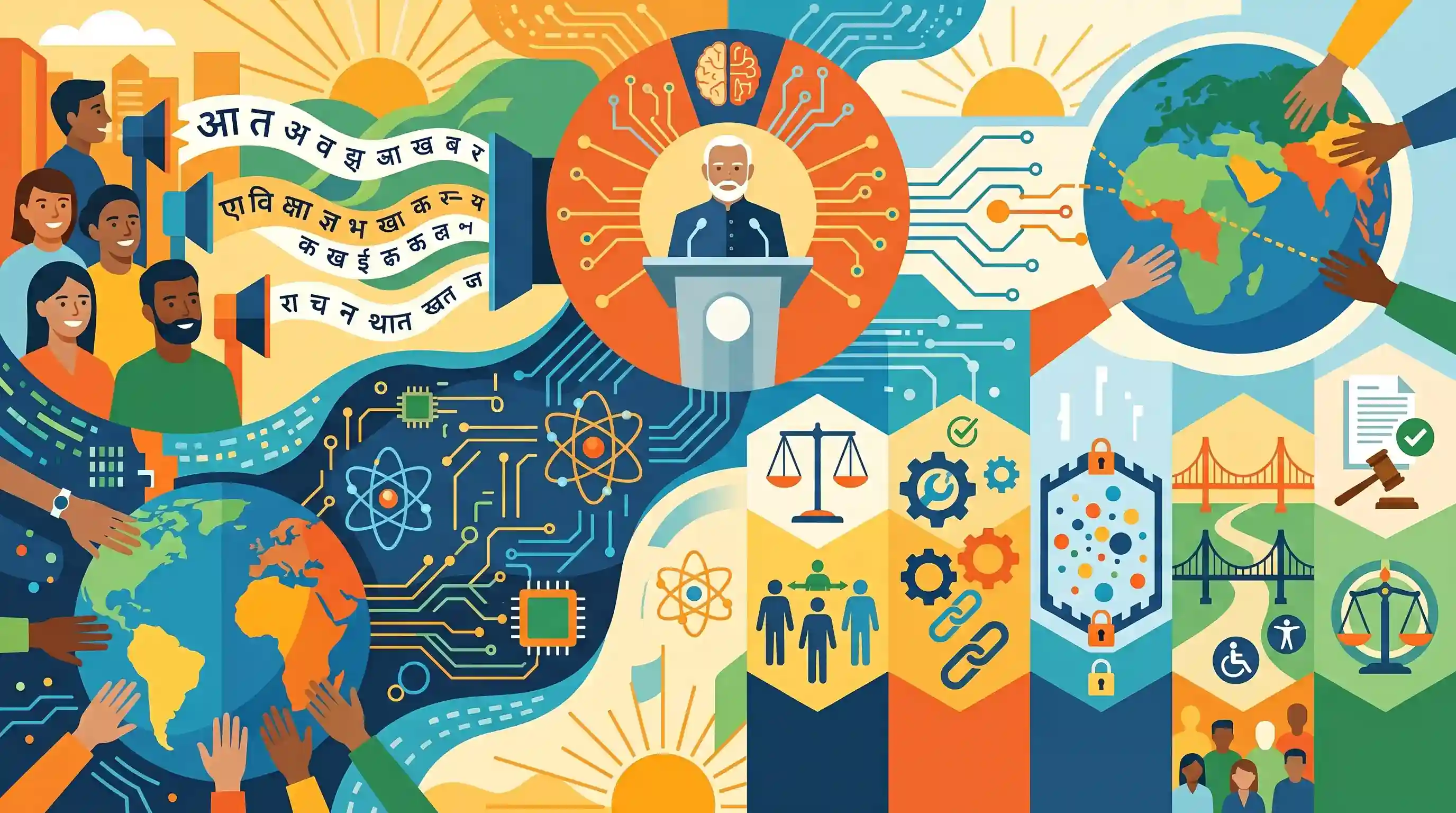
At the India AI Impact Summit in New Delhi, Prime Minister Narendra Modi outlined India's vision for Artificial Intelligence, framing it as a tool for profound transformation rather than a threat. Highlighting India's efforts to build a resilient tech ecosystem involving semiconductors and quantum computing, he stressed the importance of democratising AI to foster inclusion and empower the Global South. He introduced the 'MANAV' framework to guide AI's evolution, emphasizing moral and ethical systems, accountable governance, data sovereignty, accessibility, and legitimate use. The event also practically demonstrated AI's inclusive power by real-time translation of his speech into multiple Indian languages.
Key Points
- Prime Minister Narendra Modi addressed the plenary session of the India AI Impact Summit in New Delhi, describing AI as a profound historical transformation.
- He proposed the 'MANAV' framework for AI: Moral and ethical systems, Accountable governance, National sovereignty over data, Accessible and inclusive means, and Valid and legitimate uses.
- India is proactively building a resilient technological ecosystem spanning semiconductors, chip manufacturing, and quantum computing.
- The PM emphasized that AI must be democratised to serve as an instrument for inclusion and empowerment, particularly benefiting the Global South.
- The Prime Minister's address was live-streamed in English and seven Indian languages simultaneously using AI, showcasing the technology's practical utility.
Important Terms
MANAV Framework

A five-pillar AI governance framework introduced by PM Modi: Moral and ethical systems, Accountable governance, National sovereignty, Accessible and inclusive, and Valid and legitimate.
UPSC context
GS Paper 2 & 3; tests understanding of India's ethical AI policy and its human-centric approach to technological governance.
India AI Impact Summit
The 2026 global summit in New Delhi (the fourth in a series following UK, Seoul, and Paris) and the first hosted by a Global South nation.
UPSC context
GS Paper 2 (International Relations); tests awareness of India's leadership in global technology diplomacy and multilateral digital forums.
Data Sovereignty
The principle that data generated within a country's borders is subject to that nation's laws, ensuring local control over storage, processing, and access to prevent data colonialism.
UPSC context
GS Paper 3 (Cybersecurity/Tech); tests knowledge of digital privacy, localization, and national security in the global digital economy.
Global South
Developing nations in Asia, Africa, and Latin America. In AI diplomacy, it refers to countries advocating for equitable access to technology and representation in global governance.
UPSC context
GS Paper 2 (International Relations); tests understanding of India's role as a representative voice for developing nations in multilateral forums.
IndiaAI Mission
A ₹10,372 crore national initiative to build India's AI ecosystem through GPU computing power, indigenous Large Language Models (LLMs), and safe, responsible AI development.
UPSC context
GS Paper 3 (Science & Tech); tests awareness of government schemes aimed at achieving technological self-reliance and innovation.
Digital Public Infrastructure (DPI)
Open-source, interoperable digital blocks (like UPI or Aadhaar) that allow governments to provide essential services at scale, now being integrated with AI for inclusive growth.
UPSC context
GS Paper 2 & 3; tests understanding of India's model for digital governance and its application in socio-economic development.
Prelims Trap
"MANAV is India's newly commissioned AI supercomputer developed by C-DAC."
MANAV is actually a policy governance framework for human-centric AI (Moral, Accountable, National sovereignty, Accessible, Valid), not a hardware system.
Static Concepts Connected
What is 'Data Sovereignty' in digital governance?
- Local Storage: Mandating that digital data generated by a country's citizens must be physically stored on domestic servers.
- Legal Jurisdiction: Ensuring national data is subject exclusively to the laws, courts, and enforcement mechanisms of the host nation.
- Strategic Autonomy: Preventing foreign tech monopolies from extracting national data wealth, thereby ensuring domestic control over digital intelligence.
What is the core premise of Digital Public Infrastructure (DPI)?
- Interoperable Design: Utilising open-source, interoperable layers (like identity, payments, and data sharing) to democratise e-governance and service delivery.
- Diplomatic Leverage: Positioning India as a Global South tech-leader by exporting digital solutions rather than traditional financial aid.
Cross-Topic Patterns
AI + Semiconductor hardware nexus
AI governance is increasingly coupled with the India Semiconductor Mission, recognising that domestic hardware self-reliance is a strict prerequisite to AI and data sovereignty.
Tech Diplomacy as Soft Power
Exporting scalable AI language tools (like Bhashini) and DPI frameworks to the Global South seamlessly integrates India's foreign policy with its domestic deep-tech ecosystem.

Expect a 2026 multi-statement Prelims question mixing 'MANAV' framework components with India's DPI language tools like Bhashini.
Linked PYQs · 3
Linked PYQs · 3
- 2023MainsGS3
Introduce the concept of Artificial Intelligence (AI). How does Al help clinical diagnosis? Do you perceive any threat to privacy of the individual in the use of Al in healthcare?
- 2024MainsGS4
The application of Artificial Intelligence as a dependable source of input for administrative rational decision-making is a debatable issue. Critically examine the statement from the ethical point of view.
- 2025MainsGS2
e-governance projects have a built-in bias towards technology and back-end integration than user-centric designs. Examine.
