India AI Summit 2026 Focuses on Inclusive Technological Growth
Source:Indian Express ↗
Why It Matters
The application and governance of Artificial Intelligence are critical focal points in contemporary administration and economic development. India's leadership in hosting a major AI summit underlines the strategic importance of aligning global AI advancements with domestic priorities like inclusive growth, which is a highly relevant theme for GS2 (Governance) and GS3 (Science & Technology).
Summary
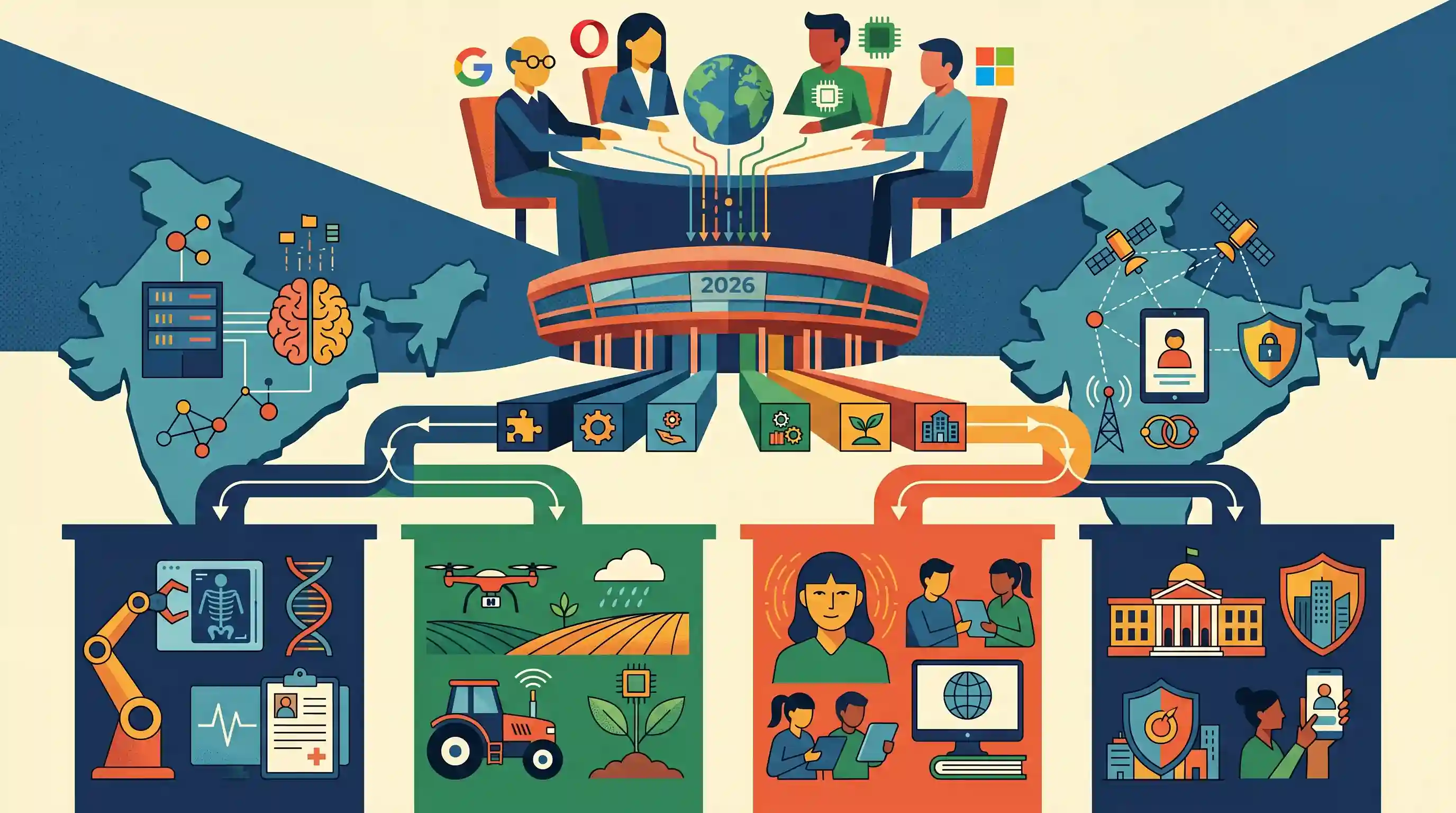
India is hosting a major global AI Summit in 2026 at Bharat Mandapam, New Delhi, attracting top global tech executives like Sundar Pichai, Sam Altman, Jensen Huang, and Bill Gates, among others. The focus of the summit is to translate global discussions on Artificial Intelligence into actionable development outcomes aligned with the IndiaAI mission and Digital India Initiative, targeting key sectors like healthcare, agriculture, education, and governance.
Key Points
- India is hosting the India AI Summit 2026 from February 16-20 at Bharat Mandapam in New Delhi.
- The summit will see the attendance of prominent global technology leaders including Sundar Pichai, Sam Altman, Jensen Huang, and Bill Gates.
- The primary focus is translating global AI discussions into tangible development outcomes that align with the IndiaAI Mission and the Digital India Initiative.
- Thematic focus areas of the summit encompass AI applications in agriculture, healthcare, education, governance, public service, and finance.
- The summit aims to highlight the democratisation of AI resources and the utilization of AI for economic growth and inclusive social empowerment.
Important Terms
IndiaAI Mission

A ₹10,372 crore national program to catalyze India's AI ecosystem. It includes building compute infrastructure (10,000+ GPUs), startup financing, and "Mission 2.0" (2026) which focuses on MSME-centric AI and sovereign models.
UPSC context
GS Paper III: Science & Technology. Tests knowledge of indigenization of technology, digital sovereignty, and high-performance computing (HPC) infrastructure.
Digital India Initiative
A flagship campaign launched in 2015 to transform India into a digitally empowered society. It provides the framework for AI integration into e-governance, digital infrastructure as a utility, and electronic service delivery.
UPSC context
GS Paper II & III: Governance and IT. Essential for understanding Digital Public Infrastructure (DPI) and technology-led governance reforms.
NVIDIA
Global semiconductor leader essential to the IndiaAI Mission's "Compute Capacity" pillar. It provides high-performance GPUs for training indigenous AI models and supports Indian startups through hardware access and research collaborations.
UPSC context
GS Paper III: S&T. Relevant for semiconductor self-reliance, hardware supply chains, and the "Make in India" initiative in electronics.
Microsoft
A major global investor ($17.5 billion) in India's AI landscape. It partners with the government on "AI for Social Good," specifically targeting healthcare, education, and predictive AI for Indian agriculture.
UPSC context
GS Paper III: S&T. Role of private-sector partnerships in achieving Sustainable Development Goals (SDGs) through technological applications.
Investing $15 billion to establish its largest AI hub outside the US in India. It focuses on public-interest AI, linguistic diversity (Indic languages), and scaling digital tools for the Indian economy.
UPSC context
GS Paper III: S&T. Impact of global tech hubs on local innovation, R&D, and the digital economy.
Qualcomm
Leading semiconductor and wireless tech firm focusing on "Edge AI" and 2nm chip design in India. Its $150 million investment supports deep-tech startups in robotics, automotive, and industrial AI.
UPSC context
GS Paper III: S&T (Semiconductors). Key for understanding hardware-level AI, 5G/6G evolution, and strategic semiconductor design.
OpenAI
Leading generative AI developer whose participation in the 2026 Summit highlights global governance challenges. It represents the push for international ethical frameworks, AI safety standards, and responsible deployment.
UPSC context
GS Paper II & III: Governance and Ethics. Relevant for global regulatory frameworks, AI ethics, and data privacy debates.
Adobe
Strategic partner in India's education and AVGC sectors. Through "Create in India," it provides free AI tools to millions of students and educators to build "future-ready" skills for the creative economy.
UPSC context
GS Paper III: Economy/S&T. Focuses on human capital development, vocational skilling, and the growth of the Animation & Visual Effects sector.
Prelims Trap
The IndiaAI Datasets Platform (AIKosh) provides startups with access to both personal and non-personal datasets of citizens.
The IndiaAI Datasets Platform (AIKosh) strictly provides access to anonymized, non-personal data to protect citizens' privacy while training models.
Static Concepts Connected
What is the Global Partnership on Artificial Intelligence (GPAI)?
- Nature: An international, multi-stakeholder initiative to bridge the gap between AI theory and practice.
- Secretariat: Hosted by the Organization for Economic Cooperation and Development (OECD).
- India's Role: India is a founding member, served as Lead Chair in 2024, and championed the 'New Delhi Declaration' for human-centric AI.
What are the foundational pillars of India's Digital Public Infrastructure (DPI)?
- Identity: Aadhaar provides a foundational, biometric-backed digital identity.
- Payments: Unified Payments Interface (UPI) enables an interoperable, real-time fast payment system.
- Data Exchange: Data Empowerment and Protection Architecture (DEPA) allows consent-based data sharing (e.g., Account Aggregator framework).
Cross-Topic Patterns
AI integration in Digital Public Goods
India's push for "voice-first" AI models over DPI (like Bhashini) bridges the digital divide, making digital e-governance services accessible to non-literate and vernacular populations.
Sovereign Compute & Strategic Vulnerability
The IndiaAI Mission focuses on 'Sovereign AI' by subsidizing GPU access for local startups, directly addressing India's strategic vulnerability of relying on foreign cloud and compute infrastructure.
Predictive Analytics in Agriculture
AI intersects with GS3 agriculture through tools like the National Pest Surveillance System, shifting the focus from traditional inputs to predictive, climate-responsive crop monitoring.

IndiaAI Mission's pillars (GPU compute subsidies, AIKosh dataset limits) and the GPAI New Delhi Declaration will likely form a core GS3 MCQ.
Linked PYQs · 3
Linked PYQs · 3
- 2023MainsGS3
Introduce the concept of Artificial Intelligence (AI). How does Al help clinical diagnosis? Do you perceive any threat to privacy of the individual in the use of Al in healthcare?
- 2024MainsGS2
e-governance is not just about the routine application of digital technology in service delivery process. It is as much about multifarious interactions for ensuring transparency and accountability. In this context evaluate the role of the 'Interactive Service Model' of e-governance.
- 2020PrelimsGS1
With the present state of development, Artificial Intelligence can effectively do which of the following? 1. Bring down electricity consumption in industrial units 2. Create meaningful short stories and songs 3. Disease diagnosis 4. Text-to-Speech Conversion 5. Wireless transmission of electrical energy Select the correct answer using the code given below:
