India AI Summit 2026 Convenes Global Tech Leaders in Delhi
Source:Indian Express ↗
Why It Matters
The summit highlights India's proactive role in shaping global AI narratives and its intent to leverage emerging technologies for tangible socio-economic development, e-governance, and digital inclusion.
Summary
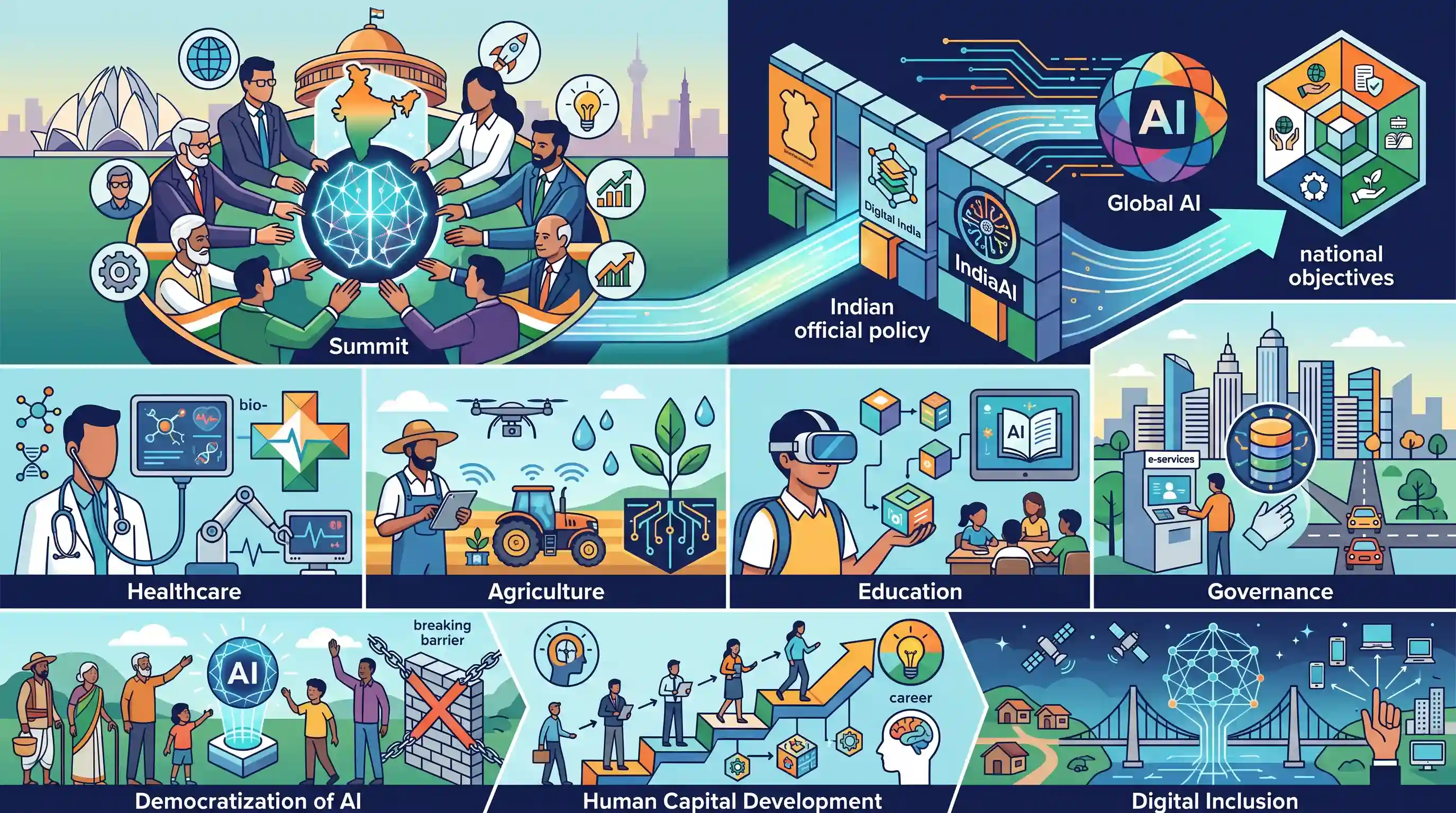
The inaugural India AI Summit 2026 is set to take place in New Delhi, bringing together top global tech CEOs, AI pioneers, and Indian corporate leaders to discuss the future of artificial intelligence. The event aims to steer global AI developments to align with national objectives such as the IndiaAI mission and Digital India Initiative. Crucial discussions will cover the application of AI across sectors like healthcare, agriculture, education, and governance. Furthermore, the summit will emphasise the democratisation of AI resources, human capital development, and digital inclusion for social empowerment and economic growth.
Key Points
- India is hosting its first-ever AI summit, the India AI Summit 2026, from February 16 to 20 at Bharat Mandapam, New Delhi.
- The event will feature prominent global tech CEOs including Google's Sundar Pichai, OpenAI's Sam Altman, Microsoft's Bill Gates, and renowned AI 'godfathers' Yann LeCun and Yoshua Bengio.
- Top Indian industry leaders such as Mukesh Ambani, N. Chandrasekaran, and Nandan Nilekani will also be in attendance.
- The summit aims to transform global AI discussions into developmental outcomes aligned with national priorities under the IndiaAI mission and Digital India Initiative.
- Key discussion topics include AI applications in healthcare, agriculture, governance, and public service, alongside themes of human capital, digital inclusion, and democratising AI resources.
Important Terms
IndiaAI mission

An umbrella program by MeitY to build a domestic AI ecosystem, focusing on computing infrastructure (10,000+ GPUs), foundational models (BharatGen), and high-quality datasets for research and startups.
UPSC context
GS Paper III (S&T). Tests knowledge of national strategies for emerging tech, digital sovereignty, and the "AI for All" vision.
Digital India Initiative
Launched in 2015, this flagship program aims to transform India into a digitally empowered society by improving infrastructure, internet connectivity, and making government services available electronically.
UPSC context
GS Paper II (Governance) & III (Economy/S&T). Core for understanding Digital Public Infrastructure and bridging the digital divide.
OpenAI
An American AI research laboratory (developer of ChatGPT) that pioneered Generative AI, influencing global standards for Large Language Models (LLMs) and triggering debates on AI ethics and safety.
UPSC context
GS Paper III (S&T). Relevant for breakthroughs in generative AI, ethical frameworks, and the global landscape of disruptive innovation.
NVIDIA
A global technology leader in Graphics Processing Units (GPUs) essential for AI compute power. It partners with India to develop sovereign AI capabilities and customized chips for national infrastructure.
UPSC context
GS Paper III (S&T). Tests awareness of semiconductor supply chains, hardware for AI, and India's semiconductor mission.
Qualcomm
A major semiconductor and wireless technology firm leading 5G/6G development. It is crucial for "Edge AI," processing data on-device to power India's digital transformation in IoT and telecommunications.
UPSC context
GS Paper III (S&T). Relevant for telecommunications rollout and the intersection of hardware with the "Industrial Revolution 4.0."
Palo Alto Networks
A global cybersecurity leader specializing in cloud-native security and AI-driven threat detection, vital as AI expands the digital attack surface, requiring automated defense for critical information infrastructure.
UPSC context
GS Paper III (Security). Tests understanding of cybersecurity challenges and data protection in the AI-driven digital age.
Prelims Trap
The IndiaAI Mission is directly implemented and overseen by NITI Aayog.
While NITI Aayog published the 2018 'National Strategy for AI', the IndiaAI Mission is implemented by MeitY's Independent Business Division under Digital India Corp.
Static Concepts Connected
What are the core pillars of the comprehensive IndiaAI Mission?
- Compute Capacity: Building a scalable AI computing ecosystem comprising 10,000+ GPUs through public-private partnerships to support startups.
- Datasets Platform: Creating a unified national architecture providing seamless access to non-personal data for training domestic AI models.
- Innovation Centre: Promoting the creation of indigenous foundational models and domain-specific AI tools for healthcare, agriculture, and governance.
- Skill Development: Establishing IndiaAI FutureSkills programs to democratize AI education at the undergraduate and postgraduate levels.
How does India's approach to AI governance differ from the EU and USA?
- European Union: Focuses on strict, risk-based statutory regulation with heavy penalties for non-compliance (e.g., the EU AI Act).
- United States: Adopts a market-driven, light-touch approach relying heavily on voluntary safety commitments by private tech giants.
- India: A hybrid "development-first" approach prioritizing capacity building (Compute, DPI) while utilizing existing IT rules to manage user harm.
Cross-Topic Patterns
AI integration into Digital Public Infrastructure (DPI)
India's strategy uniquely leverages AI over existing Digital Public Infrastructure (like Bhashini and UPI) to drive multi-lingual inclusion and targeted grassroots public service delivery.
AI Compute + India Semiconductor Mission
The IndiaAI Mission's massive push for domestic GPU computing infrastructure directly ties into India's Semiconductor Mission and geopolitical hardware supply chains.
AI Datasets + Non-Personal Data Governance
The proposed IndiaAI Datasets Platform revives legal debates from the Gopalakrishnan Committee regarding the regulation, sharing, and monetization of anonymized non-personal data.

Expect a 2026 Prelims multi-statement question testing the specific sub-components of the IndiaAI Mission and its implementing agency.
Linked PYQs · 4
Linked PYQs · 4
- 2023MainsGS3
Introduce the concept of Artificial Intelligence (AI). How does Al help clinical diagnosis? Do you perceive any threat to privacy of the individual in the use of Al in healthcare?
- 2023MainsGS3
What is the status of digitalization in the Indian economy? Examine the problems faced in this regard and suggest improvements.
- 2024MainsGS2
e-governance is not just about the routine application of digital technology in service delivery process. It is as much about multifarious interactions for ensuring transparency and accountability. In this context evaluate the role of the 'Interactive Service Model' of e-governance.
- 2023MainsGS2
e-governance, as a critical tool of governance, has ushered in effectiveness, transparency and accountability in governments. What inadequacies hamper the enhancement of these features ?
