India AI Summit 2026 advances Global South digital diplomacy
Source:Indian Express ↗
Why It Matters
This article is important for UPSC aspirants as it bridges International Relations (GS2) with Science & Technology (GS3). It illustrates India's emerging role as a technology diplomat advocating for the Global South, counterbalancing Western tech dominance, and formulating global AI governance frameworks.
Summary
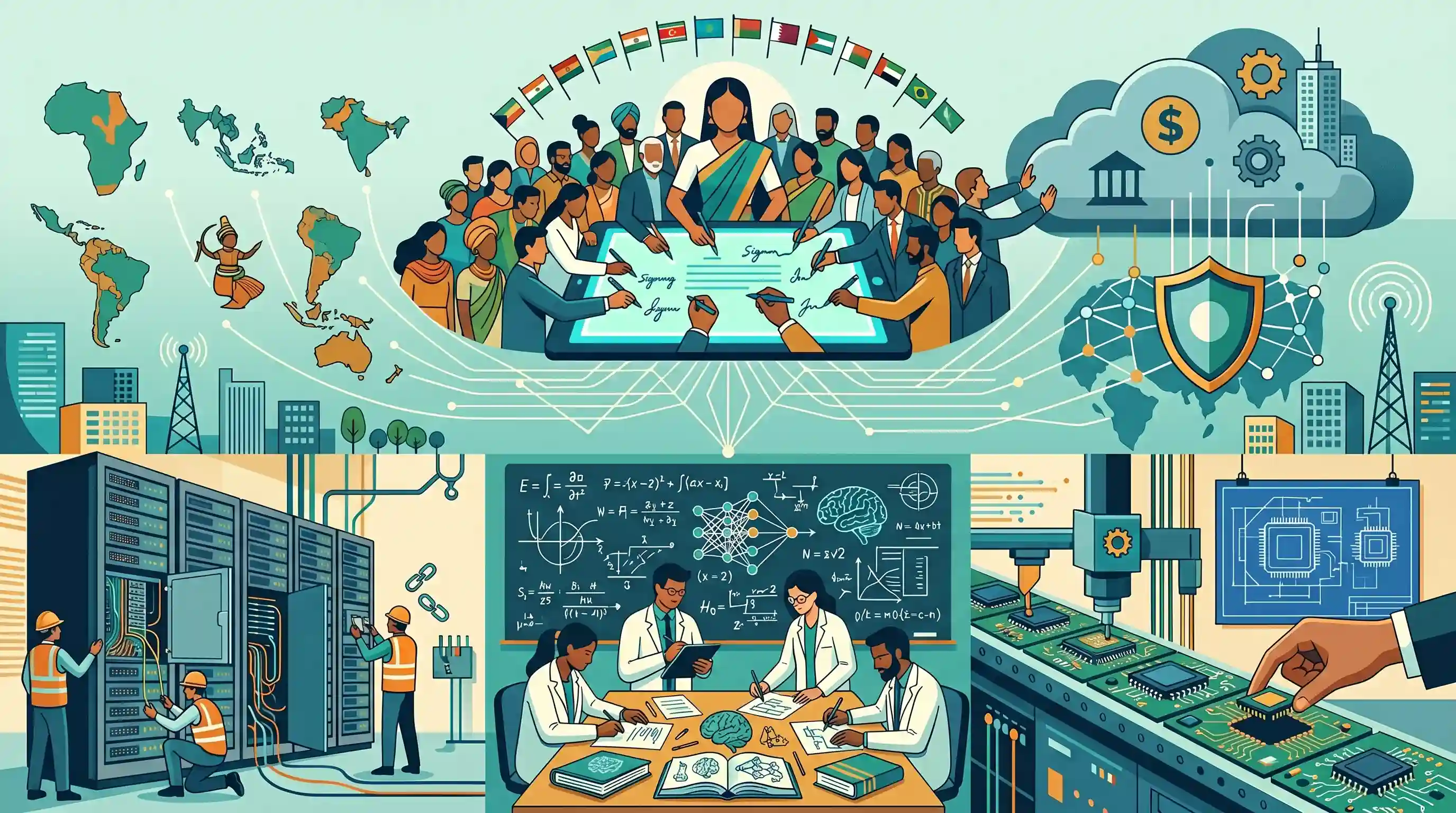
The "India AI Summit 2026" marked a significant diplomatic milestone as 88 nations signed an India-initiated AI pact, positioning New Delhi as a leader for the Global South in technology governance. The summit underscored India's intent to challenge the Western tech monopoly and advocate for digital sovereignty and equitable data frameworks. However, while this diplomatic maneuver represents a strong beginning in global AI leadership, the article notes that India has not yet "arrived" as a complete AI superpower, as it must still bridge substantial domestic gaps in computing infrastructure, foundational AI research, and native technological development.
Key Points
- India hosted the India AI Summit 2026, where 88 nations—primarily from the Global South—signed a New Delhi-backed AI pact.
- The summit signals India\'s ambition to establish digital sovereignty and challenge the prevailing Western monopoly over artificial intelligence technologies.
- It highlights a shift towards global technology diplomacy, aiming to create more equitable data governance frameworks for developing nations.
- Despite this diplomatic victory, the article cautions that India has merely made a strong beginning and has not yet achieved technological parity or "arrived" as an AI superpower, given domestic infrastructure and research gaps.
Important Terms
New Delhi Declaration on AI Impact

A non-binding 2026 agreement by 88 nations advocating "AI for All," focusing on equitable resource distribution, democratizing AI access, and creating shared repositories for secure, trustworthy technological frameworks.
UPSC context
GS Paper 2 & 3: International Agreements and S&T. Tests knowledge of India's role in global digital governance and diplomacy.
Digital Sovereignty
A nation's ability to independently control its digital infrastructure, data, and technological ecosystem without external dependence, ensuring national security and alignment with domestic laws and values.
UPSC context
GS Paper 2: Governance/Internal Security. Crucial for understanding strategic autonomy in the age of Big Tech.
Third Way (AI Governance)
India's unique regulatory model that balances market-led innovation (US model) with rights-based legislation (EU model), prioritizing inclusive development and "AI as Digital Public Infrastructure" for the Global South.
UPSC context
GS Paper 3: Science & Tech. Tests comprehension of India's distinct policy framework compared to global standards.
IndiaAI Mission
A comprehensive national program (2024-2029) with a ₹10,372 crore outlay aimed at building indigenous computing capacity (GPUs), dataset access, and foundational AI models to ensure technological self-reliance.
UPSC context
GS Paper 3: Economic Development and S&T. Essential for questions on India's artificial intelligence readiness and infrastructure.
Sovereign AI
AI infrastructure and models built, trained, and hosted locally to maintain control over strategic data and critical systems, preventing "technological colonization" by foreign entities.
UPSC context
GS Paper 3: Science & Tech/Cyber Security. Relates to national security and indigenous technological development.
India AI Impact Summit 2026
The fourth global AI forum (February 2026), and the first hosted by a Global South nation, focusing on shifting AI safety and governance toward practical "impact" and developmental inclusion.
UPSC context
GS Paper 2: International Relations. Represents India's diplomatic leadership in the global technology arena.
Prelims Trap
India’s 88-nation AI pact signifies that the country has achieved self-sufficiency in AI compute infrastructure and foundational model development.
The pact is a diplomatic governance milestone. India still relies heavily on foreign GPUs and is just beginning to address domestic hardware bottlenecks via the IndiaAI Mission.
Static Concepts Connected
What are the core pillars of the national IndiaAI Mission?
- Compute Capacity: Building a scalable AI computing ecosystem with over 10,000 GPUs via public-private partnerships to bridge the hardware gap.
- Innovation Centre: Developing indigenous foundational and multi-modal models (like BharatGen) tailored to India's diverse linguistic datasets.
- Startup Financing: Providing dedicated funding mechanisms and regulatory sandboxes for deep-tech AI startups to accelerate native technological development.
What does Digital Sovereignty entail for developing nations?
- Data Localization: Mandating that critical citizen data is stored and processed locally to prevent foreign extraction and data colonization.
- Algorithmic Autonomy: Developing sovereign AI models trained on local datasets, free from Western socio-cultural biases and corporate monopolies.
- Hardware Independence: Securing domestic supply chains for critical components like semiconductors to prevent geopolitical chokepoints and ensure self-reliance.
Cross-Topic Patterns
AI Governance + Global South Diplomacy
India is using digital public infrastructure (DPI) and AI pacts to replace traditional Non-Aligned themes, establishing itself as the primary voice of the Global South in equitable tech governance.
AI Sovereignty + Semiconductor Mission
Diplomatic AI pacts require hardware backing. India's AI sovereignty ambitions are structurally dependent on the success of the India Semiconductor Mission to bypass global GPU supply chain chokepoints.

Expect a multi-statement question linking IndiaAI Mission's compute targets, Digital Sovereignty, and Global South tech diplomacy.
Linked PYQs · 3
Linked PYQs · 3
- 2023MainsGS3
Introduce the concept of Artificial Intelligence (AI). How does Al help clinical diagnosis? Do you perceive any threat to privacy of the individual in the use of Al in healthcare?
- 2020PrelimsGS1
With the present state of development, Artificial Intelligence can effectively do which of the following? 1. Bring down electricity consumption in industrial units 2. Create meaningful short stories and songs 3. Disease diagnosis 4. Text-to-Speech Conversion 5. Wireless transmission of electrical energy Select the correct answer using the code given below:
- 2025MainsGS2
India-Africa digital partnership is achieving mutual respect, co-development and long-term institutional partnerships. Elaborate.
