India AI Application Roadmap and Maharashtra First AI University Plans
Source:Indian Express ↗
Why It Matters
Highlights the strategic adoption of AI at the state level, the evolution of specialized technical education (India's first AI university), and the expansion of digital public infrastructure in open learning. Useful for GS3 S&T answers on AI applications across sectors like sports and education.
Summary
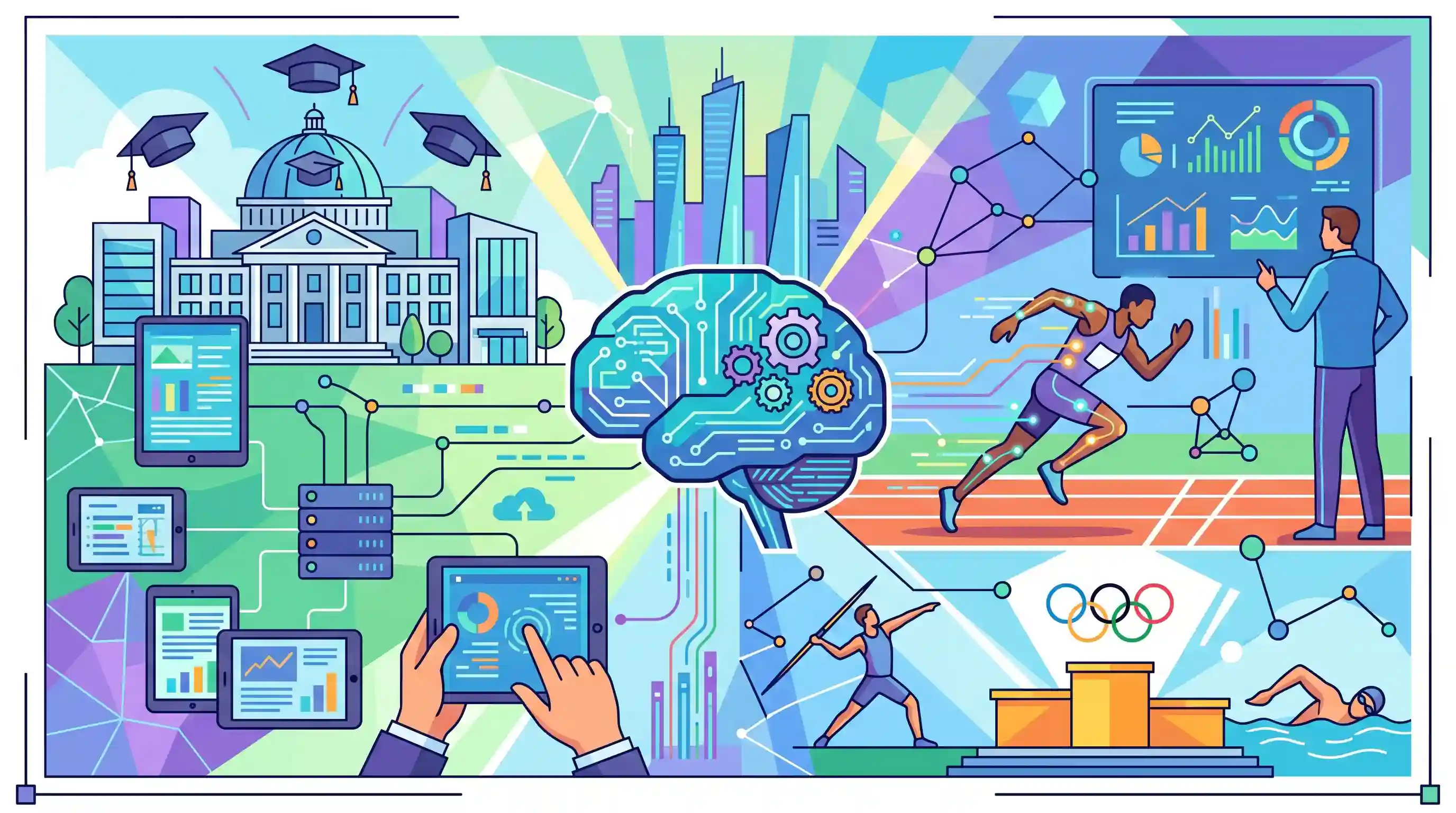
Maharashtra's Minister of Higher and Technical Education, Chandrakant Patil, announced that India has a readiness roadmap for Artificial Intelligence (AI) application, which clearly outlines where the technology should and should not be used. Speaking at the 'BC2AD' (Before ChatGPT to AI Disruption) conference in Pune, he revealed that Maharashtra is establishing the country's first AI university, expected to launch in June. Furthermore, as part of the state government's 100-day agenda, the Yashwantrao Chavan Maharashtra Open University (YCMOU) has launched 38 online courses. Officials also emphasized leveraging AI and data analytics to optimize sports training and bolster India's future Olympic performances.
Key Points
- India has developed a structured roadmap for Artificial Intelligence (AI) deployment, which includes demarcating areas where AI should not be applied.
- Maharashtra is gearing up to establish India's first-ever university dedicated to Artificial Intelligence by June.
- Yashwantrao Chavan Maharashtra Open University (YCMOU) has introduced 38 new online courses as part of the new state government's 100-day program.
- The application of data analytics and AI in sports was emphasized to make athletic training more scientific and improve India's Olympic medal prospects.
Important Terms
Yashwantrao Chavan Maharashtra Open University (YCMOU)

A state open university in Maharashtra providing mass-scale distance and digital education to diverse demographics since 1989.
UPSC context
GS Paper II (Education): Focus on digital literacy, mass education, and the 'Education for All' mandate.
Universal AI University
India's first dedicated AI university, located in Maharashtra, focusing on specialized multidisciplinary education and research in artificial intelligence.
UPSC context
GS Paper III (S&T): Milestone in technology indigenization and building a workforce for the Fourth Industrial Revolution.
IndiaAI Mission
A central government initiative with a ₹10,371 crore outlay to strengthen India's AI ecosystem through compute power, data, and indigenous innovation.
UPSC context
GS Paper III (S&T): Critical for questions on national technology strategies, data sovereignty, and global AI competitiveness.
Digitalization of Sports
The use of AI, wearables, and data analytics to monitor athlete training, optimize performance, and predict injury risks.
UPSC context
GS Paper III (S&T Applications): Tests knowledge of emerging technology applications in non-traditional sectors for national excellence.
National Strategy for Artificial Intelligence
The 2018 policy framework titled 'AI for All,' prioritizing five sectors: healthcare, agriculture, education, smart cities, and infrastructure.
UPSC context
GS Paper III: The foundational document for AI policy, ethics, and sector-specific roadmap evaluations in India.
Prelims Trap
"India's first AI university is a central institute established under the national IndiaAI Mission."
India's first dedicated AI university is a state-level initiative being established by the Maharashtra government, not a centrally-funded institute under MeitY.
Static Concepts Connected
What are the core pillars of the comprehensive 'IndiaAI Mission'?
- Compute Capacity: Building a scalable AI computing ecosystem with 10,000+ GPUs through public-private partnerships.
- Data Platform: Creating a unified IndiaAI Datasets Platform to provide non-personal datasets to startups and researchers.
- Application Development: Promoting AI applications in critical sectors like healthcare, agriculture, and governance for socio-economic transformation.
How does NITI Aayog's "National Strategy for AI" approach ethical deployment?
- Responsible AI: Focuses on 'Responsible AI for All', ensuring AI systems are safe, secure, and unbiased.
- Regulatory Approach: Emphasizes privacy, transparency, and accountability without enforcing rigid statutory bottlenecks (unlike the EU AI Act).
Cross-Topic Patterns
AI integration in Sports Governance
Connects emerging tech (predictive analytics/AI) with national sports policies like the Target Olympic Podium Scheme (TOPS) to enhance bio-mechanic training and injury prevention.
Higher Education + Emerging Tech frameworks
Links the creation of state-level specialized tech universities with the NEP 2020 mandate of integrating disruptive digital technologies into mainstream higher education.

Expect a 2026 prelims question contrasting India's sector-specific AI policy roadmap with statutory models like the EU AI Act.
Linked PYQs · 3
Linked PYQs · 3
- 2023MainsGS3
Introduce the concept of Artificial Intelligence (AI). How does Al help clinical diagnosis? Do you perceive any threat to privacy of the individual in the use of Al in healthcare?
- 2023MainsGS3
What is the status of digitalization in the Indian economy? Examine the problems faced in this regard and suggest improvements.
- 2015MainsGS2
The quality of higher education in India requires major improvements to make it internationally competitive. Do you think that the entry of foreign educational institutions would help improve the quality of higher and technical education in the country? Discuss.
