India AI Impact Summit 2026 Unveils MANAV Vision for Technology
Source:The Hindu ↗
Why It Matters
The \'MANAV Vision\' acts as India\'s official diplomatic and policy template for ethical AI governance, making it highly relevant for Mains GS3 (Science & Tech) and GS4 (Ethics of AI). The discourse from Macron and Guterres highlights the emerging geopolitical concept of "digital sovereignty" and the strategic contest for technological supremacy, vital for GS2 International Relations.
Summary
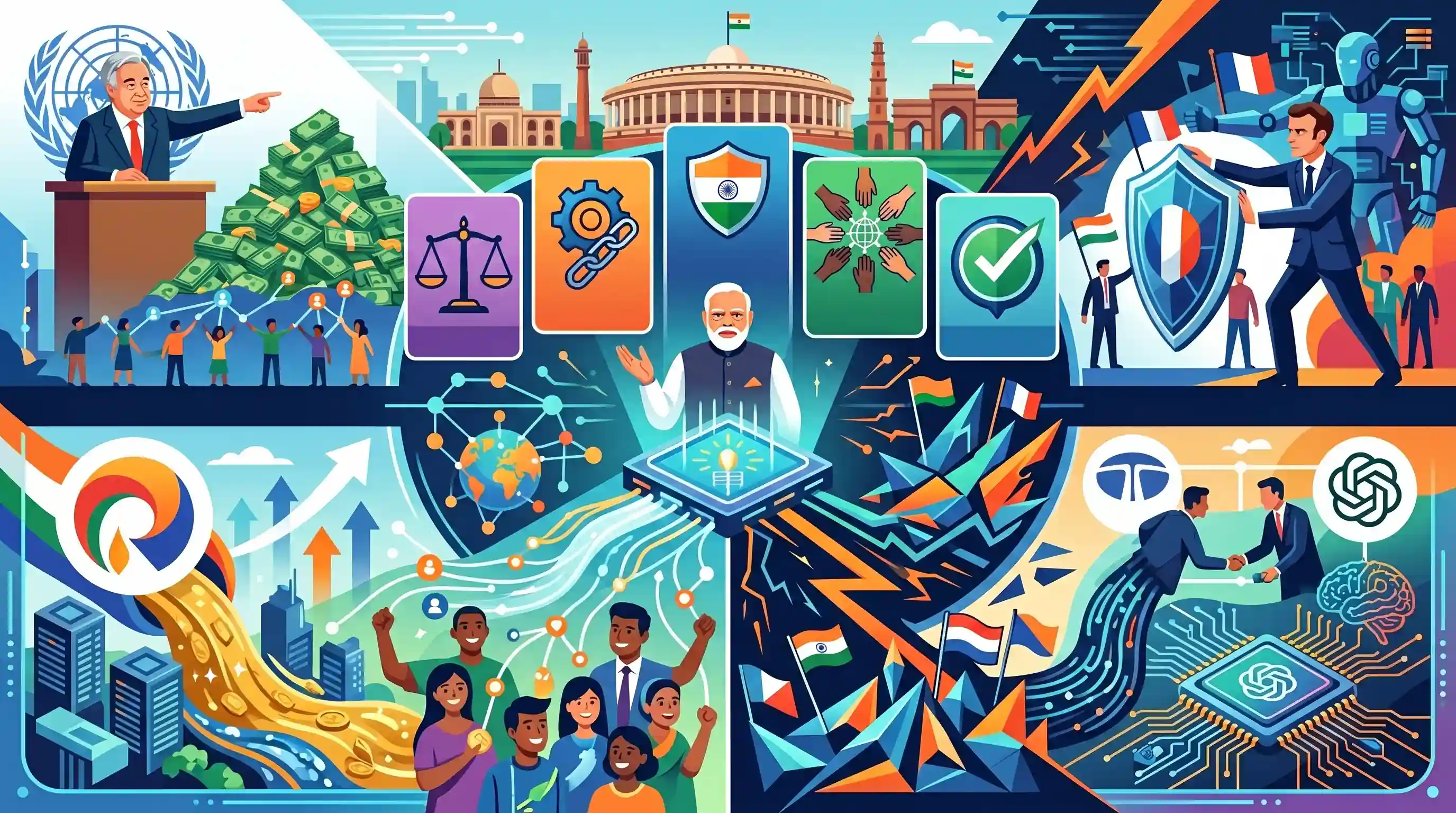
At the India AI Impact Summit 2026 in New Delhi, Prime Minister Narendra Modi introduced the \'MANAV Vision\'—a comprehensive framework advocating for Moral, Accountable, Sovereign, Accessible, and Valid AI development. The summit underscored AI\'s dual nature as a catalyst for democratized growth in the Global South and a frontier of intense strategic competition. Global leaders voiced concerns over technological monopolies; U.N. Chief António Guterres proposed a $3 billion global fund to ensure equitable AI access, while French President Emmanuel Macron advocated for strategic autonomy to avoid a digital "overlord to vassal" system. Domestically, the event showcased massive corporate mobilization, highlighted by Reliance\'s ₹10 lakh crore AI investment pledge and Tata Group\'s chip development partnership with OpenAI.
Key Points
- Prime Minister Narendra Modi unveiled the \'MANAV Vision\' (Moral, Accountable, National sovereignty, Accessible, Valid) to guide responsible, inclusive AI development.
- The Summit emphasized democratizing AI to bridge the digital divide, particularly empowering the youth and nations of the Global South.
- U.N. Secretary-General António Guterres proposed a $3 billion global fund to mitigate AI risks, warning against letting tech billionaires dictate AI governance.
- French President Emmanuel Macron urged countries to pursue strategic autonomy in technology to prevent an "overlord to vassal" dynamic in the new global order.
- Major private sector commitments included a ₹10 lakh crore AI investment by Reliance and the Tata Group\'s partnership with OpenAI to develop industry-specific AI chips.
Important Terms
MANAV Vision

An AI governance doctrine (Moral, Accountable, National sovereignty, Accessible, Valid) emphasizing human-centric development, ethical guardrails, and data rights for the creator.
UPSC context
GS III (Science & Tech) and GS IV (Ethics). Tests knowledge of national AI policy and human-first technology governance.
Strategic Autonomy
A geopolitical strategy ensuring a nation develops independent digital infrastructure and policies to avoid being economically or strategically dependent on foreign technology "overlords."
UPSC context
GS II (International Relations). Tests understanding of digital sovereignty and India's role in the global technological race.
Global South
Nations in Africa, Asia, and Latin America often facing a digital divide. The summit framed AI as a transformative tool for these countries' inclusion and empowerment.
UPSC context
GS II (IR). Tests India’s leadership role in representing developing nations’ interests in multilateral digital governance.
Sovereign AI Infrastructure
Domestically-owned and managed data centers, chips, and energy systems that process national data locally to ensure security and cultural alignment.
UPSC context
GS III (S&T/Infrastructure). Tests knowledge of indigenization of technology and strategic data security.
Technological Monopoly
The concentration of critical artificial intelligence capabilities and data in the hands of a few corporations, potentially leading to inequitable global growth.
UPSC context
GS II (Governance) and GS III (Economy). Tests awareness of the risks associated with concentrated corporate power in tech.
OpenAI
The leading AI firm behind ChatGPT, which formed a strategic partnership with Tata Group to build AI-optimized data centers and industry-specific agentic solutions in India.
UPSC context
GS III (Science & Tech). Tests knowledge of international corporate collaborations and their impact on India’s AI landscape.
Prelims Trap
MANAV Vision is a biological mapping initiative launched by the Department of Biotechnology.
Aspirants may confuse the new AI 'MANAV Vision' (Moral, Accountable, etc.) with the 2019 'MANAV: Human Atlas Initiative' launched by DBT.
Static Concepts Connected
What are the foundational layers of Digital Public Infrastructure (DPI)?
- Identity layer: Systems like Aadhaar that provide a unique, verifiable digital identification for citizens.
- Payment layer: Open networks like UPI enabling fast, interoperable, and low-cost financial transactions.
- Data empowerment: Consent-based data sharing architectures (like DEPA) allowing users to securely control and share their information.
What ethical concerns drive the fear of 'techno-colonialism'?
- Digital dependency: Concentration of AI computing power and foundational models in a few Western tech monopolies.
- Data extraction: Using data from the Global South to train proprietary models without fair economic compensation.
- Algorithmic bias: Imposing Western socio-cultural norms on developing nations through opaque, imported AI algorithms.
Cross-Topic Patterns
AI Governance + Climate Diplomacy
India's push for 'AI for development' over Western 'existential safety' mirrors its Common But Differentiated Responsibilities (CBDR) stance in climate negotiations.
Sovereign Tech + Industrial Policy
Corporate mega-investments in AI chips bridge India's Semiconductor Mission (hardware) with Sovereign AI (software), actively shifting industrial policy away from foreign import dependencies.

Expect a 2026 GS3 Mains question on 'Techno-colonialism' and how India's DPI and MANAV Vision act as a Global South counter-narrative.
Linked PYQs · 4
Linked PYQs · 4
- 2023MainsGS3
Introduce the concept of Artificial Intelligence (AI). How does Al help clinical diagnosis? Do you perceive any threat to privacy of the individual in the use of Al in healthcare?
- 2024MainsGS4
The application of Artificial Intelligence as a dependable source of input for administrative rational decision-making is a debatable issue. Critically examine the statement from the ethical point of view.
- 2023MainsGS3
What is the status of digitalization in the Indian economy? Examine the problems faced in this regard and suggest improvements.
- 2025MainsGS2
"With the waning of globalization, post-Cold War world is becoming a site of sovereign nationalism.” Elucidate.
