India Role in Global AI Governance and South Voice
Source:The Hindu ↗
Why It Matters
This article perfectly bridges the gap between technology (GS3) and international relations/global governance (GS2). It analyzes how emerging tech is reshaping global geopolitics and highlights India's unique role as a leader of the Global South in the digital era, which is highly relevant for Mains questions on digital diplomacy, international technology standard-setting, and South-South cooperation.
Summary
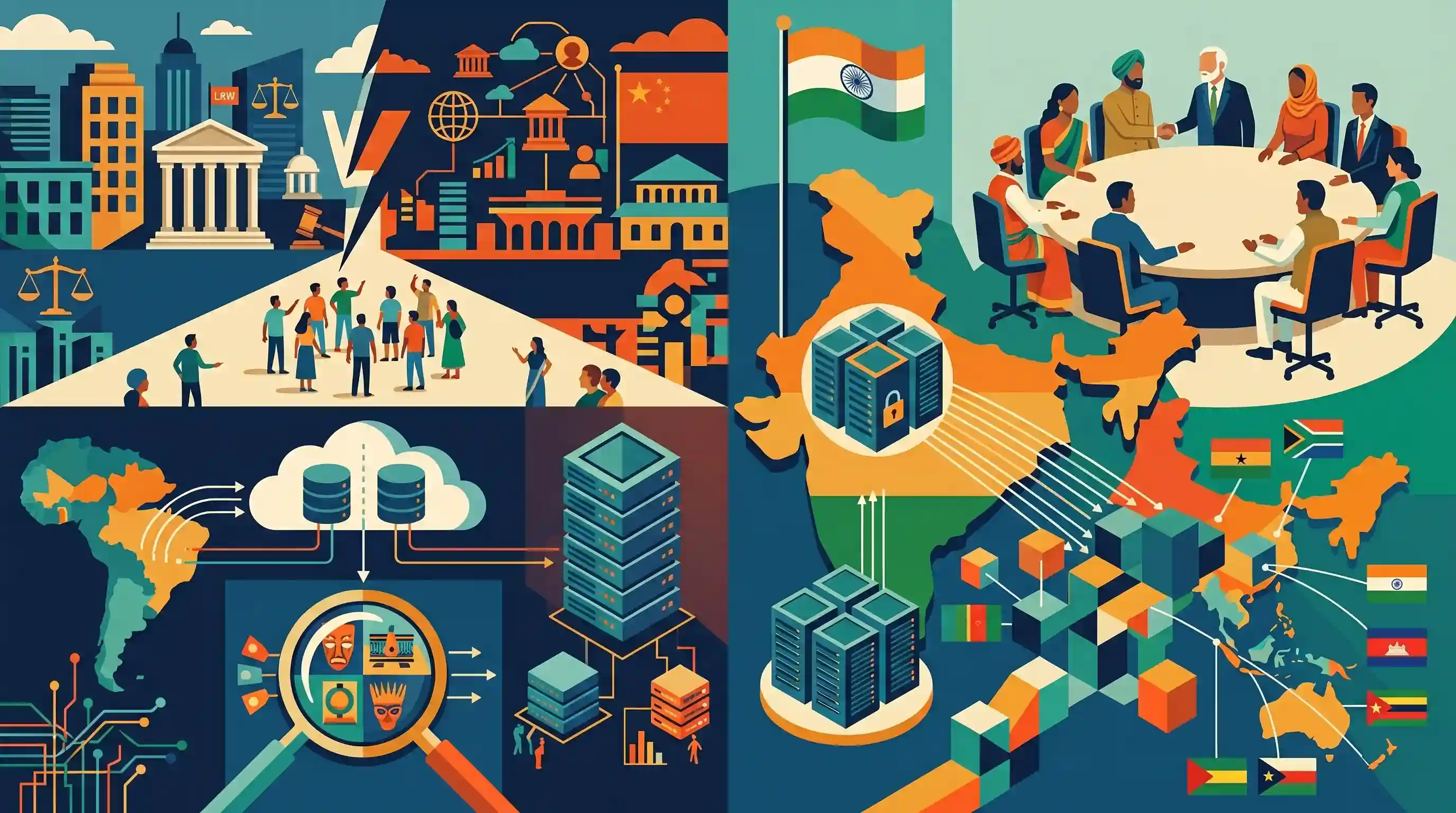
The article discusses how global AI governance is currently polarized between Western regulatory/existential-risk frameworks and Chinese state-led control, sidelining the socio-economic and developmental priorities of the Global South. It highlights the threats of data colonialism, cultural bias, and monopolistic concentration of compute power. India, leveraging its successful Digital Public Infrastructure (DPI) model, sovereign initiatives like the IndiaAI Mission, and leadership in multilateral forums like GPAI and G20, is uniquely positioned to champion a democratic, inclusive, and development-oriented AI ecosystem that empowers developing nations and protects their digital sovereignty.
Key Points
- The global AI governance debate is currently dominated by two models: the Western safety-and-risk-centric paradigm (EU AI Act, US Executive Orders) and China's state-led control model, both of which ignore the developmental needs of the Global South.
- Developing nations face the threat of 'data colonialism,' where they act as suppliers of cheap raw data and low-cost labeling labor, while high-value intellectual property and compute power remain monopolized by the Global North.
- Most foundational Large Language Models (LLMs) are trained on English-dominated datasets, embedding Western cultural biases and systematically excluding local languages and socio-cultural contexts of the Global South.
- India offers an alternative through its Digital Public Infrastructure (DPI) model, advocating that AI algorithms, compute facilities, and datasets should be treated as open-source Digital Public Goods (DPGs) rather than corporate monopolies.
- The ₹10,372 crore IndiaAI Mission and the Bhashini translation initiative provide a scalable blueprint for developing countries to establish sovereign AI capabilities and protect their technological sovereignty.
- Through its G20 Presidency and chairing of the Global Partnership on Artificial Intelligence (GPAI), India has emerged as a diplomatic bridge, advocating for an inclusive global AI governance framework where the Global South acts as rule-makers rather than mere rule-takers.
Important Terms
IndiaAI Mission

A comprehensive national program approved by the Indian Cabinet with an outlay of ₹10,371.92 crore to catalyze AI innovation, establish scalable compute infrastructure, and build secure, trusted AI systems.
UPSC context
GS Paper 3 (Science & Technology). Evaluates government policies on emerging technologies, digital self-reliance, and public-private partnerships.
Bhashini
An AI-powered translation platform developed by MeitY under the National Language Translation Mission, designed to break linguistic barriers and foster digital inclusion by translating content in real-time across major Indian languages.
UPSC context
GS Paper 3 (E-Governance/Technology). Tests knowledge of digital public goods, linguistic accessibility, and AI applications in social empowerment.
New Delhi Declaration of GPAI
A 2023 ministerial-level declaration adopted at the GPAI Summit in India that balances AI innovation and risk mitigation, prioritizing agricultural AI applications, Global South representation, and global consensus on safe, trustworthy AI frameworks.
UPSC context
GS Paper 2 & 3 (International Relations/Tech Governance). Tests India’s role in multilateral technology regimes and global standard-setting.
Global Partnership on Artificial Intelligence
A multi-stakeholder international initiative established in 2020 and hosted by the OECD that coordinates global research and practical applications to ensure artificial intelligence develops in alignment with human rights and democratic values.
UPSC context
GS Paper 2 (Bilateral/Global Groupings). Assesses India's participation in multilateral forums shaping global digital governance and standards.
EU AI Act
A comprehensive horizontal legislative framework enacted by the European Union that regulates artificial intelligence technologies based on a four-tier risk-based approach: prohibited, high, limited, and minimal risk.
UPSC context
GS Paper 3 (Technology Regulation). Tests comparison of international regulatory frameworks, ethical technology governance, and consumer data rights.
Sovereign AI
A nation's capacity to design, develop, host, and govern artificial intelligence systems using its own data, computing power, domestic infrastructure, and workforce to ensure technological self-reliance, security, and alignment with domestic priorities.
UPSC context
GS Paper 3 (Economic Development/Sci & Tech). Examines concepts of technological autonomy, data sovereignty, and digital public infrastructure.
Prelims Trap
The Global Partnership on Artificial Intelligence (GPAI) is a specialized treaty-based agency of the United Nations.
GPAI is an international multi-stakeholder initiative, not a UN agency. Its secretariat is hosted by the OECD in Paris.
Static Concepts Connected
What is Digital Public Infrastructure (DPI) and its core architecture?
- Definition: Open-source networks built on public specifications and interoperable layers enabling society-wide delivery of digital services.
- Three Layers: Comprises Identity (e.g., Aadhaar), Payments (e.g., UPI), and consent-based Data Exchange (e.g., DigiLocker, Account Aggregators).
- Advantage: Democratizes technology and prevents market monopolization, offering open alternatives to proprietary systems.
What is the Global Partnership on Artificial Intelligence (GPAI)?
- Origin & Mandate: An international initiative launched in June 2020 to promote responsible, human-centric development and use of AI.
- Secretariat: Hosted by the Organisation for Economic Co-operation and Development (OECD) in Paris, rather than being a UN body.
- Membership: A group of 29 member countries, including India, which is a founding member and active council leader.
Cross-Topic Patterns
Digital diplomacy and soft power
India's DPI export acts as a non-aligned alternative to US corporate platforms and Chinese digital surveillance, shifting India's role from a tech consumer to a global rule-shaper.
Data colonialism and digital trade
Developing nations struggle against the extraction of raw data without domestic value addition, mirroring historical colonial economic patterns in the digital commerce domain.

Expected 2026 Mains question on how India's 'Sovereign AI' and DPI model can counter 'data colonialism' while shaping Global South diplomacy.
Linked PYQs · 1
Linked PYQs · 1
- 2025MainsGS2
India-Africa digital partnership is achieving mutual respect, co-development and long-term institutional partnerships. Elaborate.
