India prioritizes downstream applications in AI regulatory framework
Source:Indian Express ↗
Why It Matters
As global frameworks for AI governance are being negotiated, understanding the distinction between foundational 'frontier' AI and 'downstream applications' is crucial for civil service aspirants. It highlights how India must tailor technological regulation to balance citizen safety with socio-economic development.
Summary
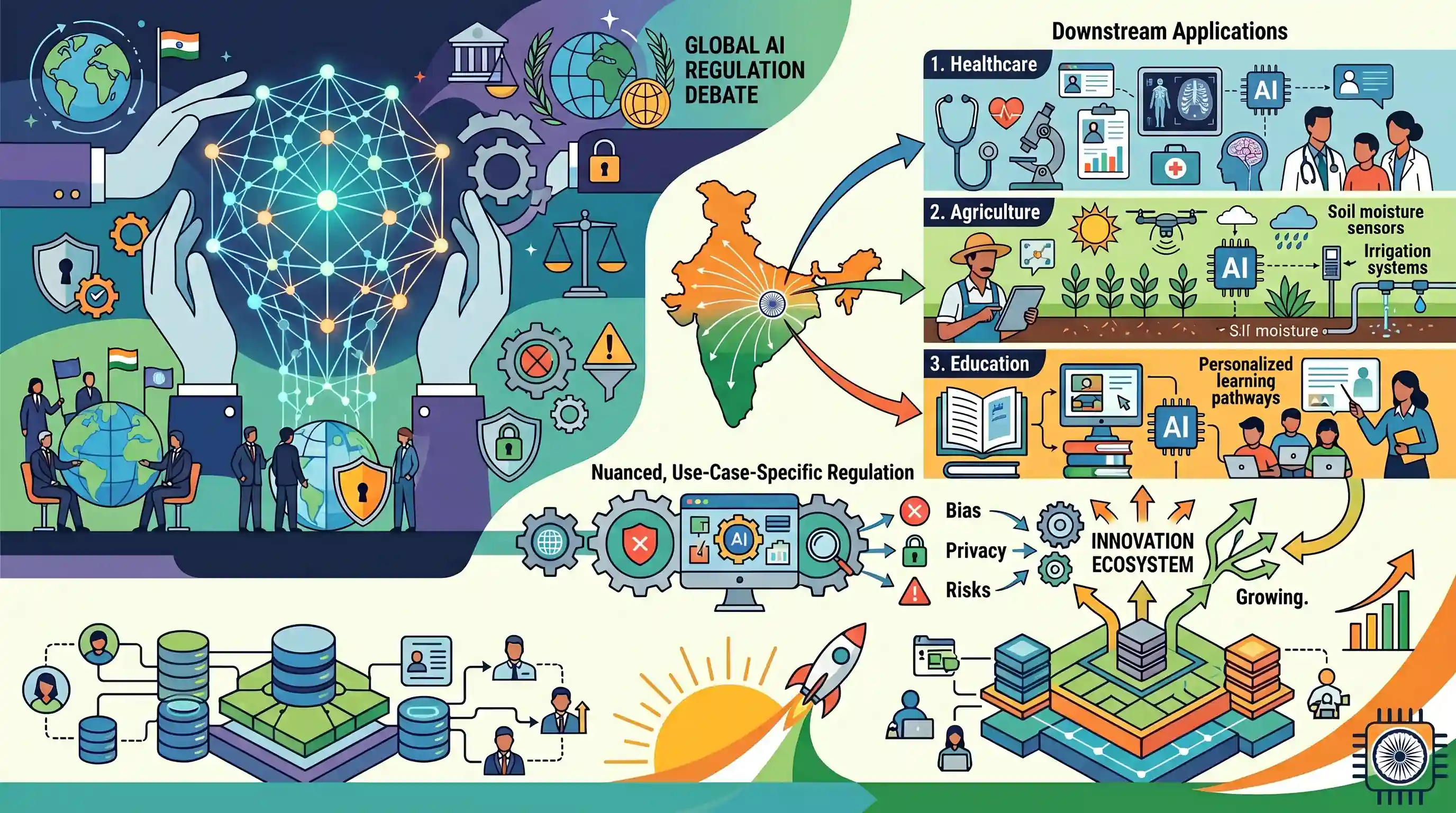
The article analyzes the evolving global landscape of AI regulation, highlighting a divergence between Western priorities and India's developmental needs. While global discourse, including summits like the upcoming Paris AI Action Summit, fixates on regulating advanced 'frontier AI' models to prevent macro-level risks, India's strategic focus should remain on 'downstream applications'. The piece argues that India's comparative advantage lies in applying AI to solve real-world socio-economic challenges in sectors like healthcare, agriculture, and education. Consequently, India must champion a nuanced, use-case-specific regulatory approach that mitigates risks like privacy violations and bias without stifling the domestic innovation ecosystem driven by the India AI Mission.
Key Points
- Global AI summits predominantly focus on regulating 'frontier AI' models (foundational LLMs) to mitigate existential and systemic risks, a narrative driven by developed nations.
- India's core strength and developmental priority lie in the 'downstream applications' of AI, such as deploying AI solutions in healthcare, agriculture, education, and e-governance.
- Adopting overly restrictive regulations designed for frontier models could stifle domestic innovation and limit the deployment of beneficial AI applications in India.
- India requires a nuanced, use-case-specific regulatory framework that addresses localized risks (e.g., privacy, algorithmic bias, deepfakes) without imposing blanket restrictions on the underlying technology.
- The India AI Mission should focus on building robust digital public infrastructure, localized datasets, and computing capabilities to support application-level startups.
Important Terms
India AI Mission

A ₹10,372 crore government initiative to establish India as a global AI leader by building sovereign compute infrastructure, developing indigenous foundational models, and supporting AI startups.
UPSC context
GS Paper III: Science & Technology and Economy; tests knowledge of national digital strategies and technological sovereignty.
Frontier AI
Highly capable, general-purpose generative AI models that match or exceed the most advanced existing systems, often associated with macro-level risks like cybersecurity threats and disinformation.
UPSC context
GS Paper III: Science & Technology; relevant for understanding global regulatory debates and emerging technological risks.
Bletchley Park Declaration
A landmark 2023 international agreement signed by 28 nations, including India, to collaborate on identifying and mitigating safety risks posed by advanced foundation models.
UPSC context
GS Paper II: International Relations; tests awareness of global governance frameworks and India's role in tech diplomacy.
Downstream Applications
The practical, sector-specific implementation of AI in fields like healthcare, agriculture, and education to solve real-world socio-economic problems.
UPSC context
GS Paper III: S&T Applications; emphasizes the developmental utility of technology over pure research.
Paris AI Action Summit
A 2025 global gathering in France that shifted the international discourse from purely 'AI safety' to 'AI action,' focusing on inclusive governance and global-south developmental needs.
UPSC context
GS Paper II: International Relations/Global Summits; relevant for tracking the evolution of international technological cooperation.
Digital Public Infrastructure (DPI)
Shared digital systems—like Aadhaar, UPI, and Data Empowerment and Protection Architecture—that enable the delivery of public and private services at a national scale.
UPSC context
GS Paper III: Economy/S&T; a recurring theme in India's digital leadership and G20 priorities.
Prelims Trap
"The Bletchley Declaration primarily aims to regulate downstream AI applications to ensure equitable socio-economic development."
It actually targets 'Frontier AI' (highly capable foundational models) to mitigate existential and systemic safety risks, whereas India advocates for downstream application regulation.
Static Concepts Connected
What differentiates Frontier AI from Narrow AI and AGI?
- Frontier AI: Highly capable foundational generative models (like advanced LLMs) whose capabilities are broad, evolving, and could pose severe, unpredictable macro-level risks.
- Narrow AI: AI trained for specific, predefined tasks (e.g., disease diagnosis, predictive agriculture). India's 'downstream applications' focus heavily utilizes this.
- AGI: Artificial General Intelligence; a hypothetical system with human-equivalent or superior cognitive abilities across all generalized domains.
What are the three foundational layers of India's DPI ecosystem?
- Identity Layer: Aadhaar provides a verifiable, unique biometric and demographic digital identity for citizens.
- Payments Layer: Unified Payments Interface (UPI) enables interoperable, fast, and scalable digital financial transactions across platforms.
- Data Empowerment: The Account Aggregator (DEPA) framework allows users to securely and digitally share their data with service providers based on consent.
Cross-Topic Patterns
AI as the next DPI layer
India's AI strategy treats compute capacity (34,000 GPUs) and datasets (AI Kosh) as public goods, mirroring the open-source, interoperable framework established by Aadhaar and UPI.
Global AI Regulation vs Global South
Western focus on existential risk (Bletchley) contrasts with India's push for developmental AI, echoing similar North-South priority divides seen in WTO and UNFCCC climate negotiations.

A 2026 prelims question will likely contrast Bletchley's 'Frontier AI' safety mandate with India's DPI-driven 'AI Kosh' and compute grid.
Linked PYQs · 2
Linked PYQs · 2
- 2023MainsGS3
Introduce the concept of Artificial Intelligence (AI). How does Al help clinical diagnosis? Do you perceive any threat to privacy of the individual in the use of Al in healthcare?
- 2021MainsGS3
Discuss how emerging technologies and globalisation contribute to money laundering. Elaborate measures to tackle the problem of money laundering both at national and international levels.
