Deepfakes: India Proposes Mandatory Labelling for AI Content
Source:Indian Express ↗
Why It Matters
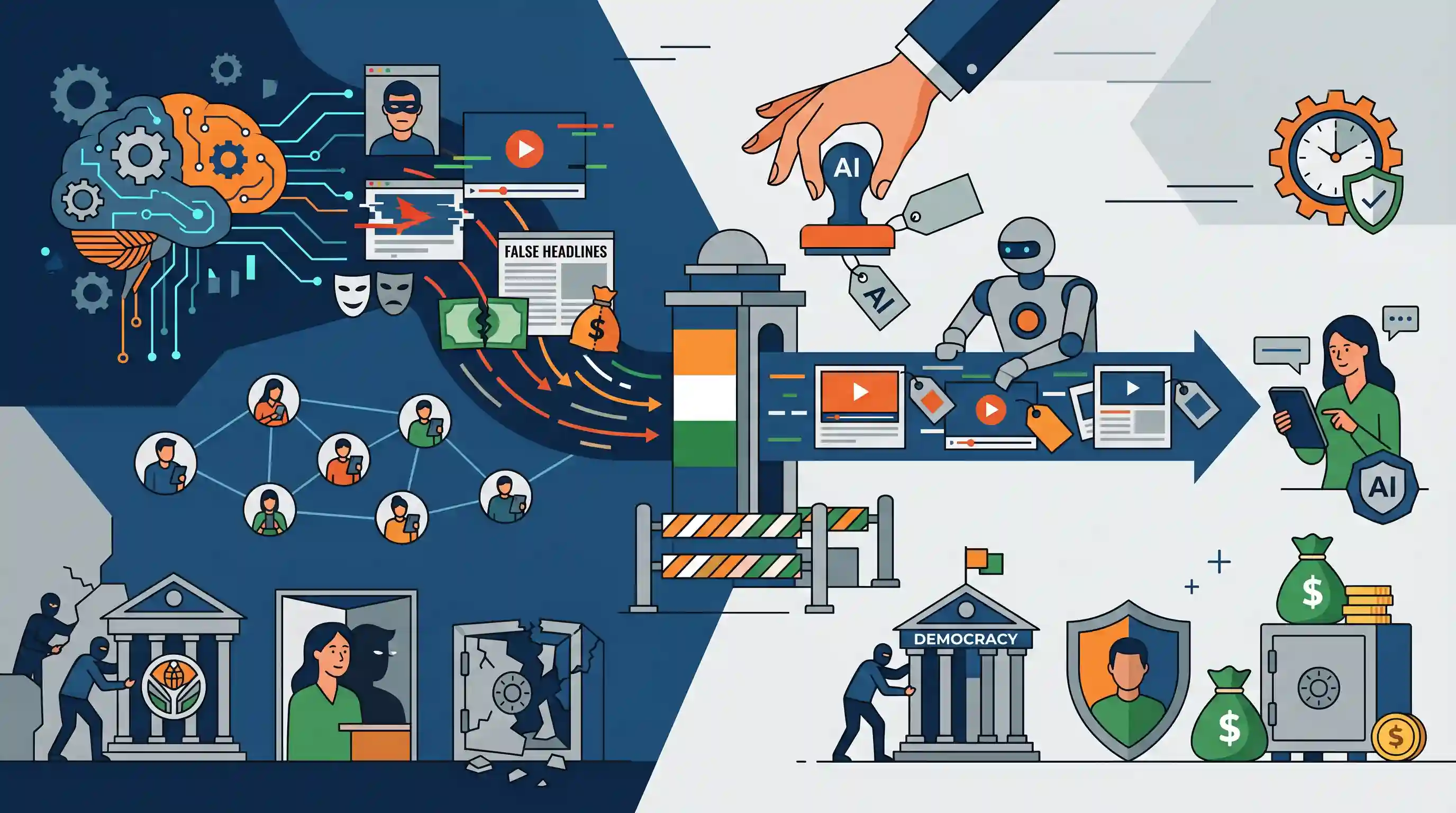
Deepfakes represent a sophisticated convergence of technology and cyber threat, challenging the integrity of elections, societal harmony, and individual rights. Understanding the regulatory response is crucial for analyzing the balance between technological innovation and national security/governance.
Summary
India is preparing to mandate the labelling of AI-generated content on social media platforms to combat the escalating threat of deepfakes. Deepfakes—highly realistic, synthetically altered images, audio, or video—pose severe risks to democratic processes, individual privacy, and financial security. By enforcing clear watermarking and labelling requirements, the government aims to empower users to identify synthetic media and curb the spread of malicious misinformation. These regulations are expected to be enforced via updates to the IT Rules, reflecting a broader global trend of establishing guardrails for artificial intelligence.
Key Points
- India is looking to introduce a regulatory mandate requiring social media platforms to clearly label AI-generated content, including deepfakes.
- The move comes in response to the growing menace of deepfakes, which are increasingly being used for political misinformation, financial fraud, identity theft, and non-consensual intimate imagery.
- Mandatory labelling or watermarking is intended to help internet users easily distinguish between authentic media and synthetic, AI-generated content.
- The new mandates are likely to be incorporated through amendments to the existing IT Rules, aligning with global efforts such as the EU AI Act and self-regulatory measures by major tech platforms.
Important Terms
IT Rules, 2021 (2026 Amendments)

India's regulatory framework for social media; 2026 amendments mandate AI content labelling and 2-3 hour takedown timelines for deepfakes.
UPSC context
GS-II/III: Key for digital governance, intermediary accountability, and cybersecurity policy questions.
EU AI Act
The first comprehensive global law on AI, categorizing systems by risk levels (unacceptable, high, limited, minimal) to ensure safety and transparency.
UPSC context
GS-II: International benchmark for AI regulation; useful for comparative policy analysis.
Ministry of Electronics and Information Technology (MeitY)
The nodal Indian ministry responsible for IT policy, cybersecurity, and digital governance; the primary enforcer of deepfake regulations.
UPSC context
GS-II: Institutional framework for technological governance and internal security challenges.
Synthetically Generated Information (SGI)
Legal term for AI-created or modified audio-visual content that appears indistinguishable from reality; used in Indian law to define deepfakes.
UPSC context
GS-III: Science & Tech terminology for describing AI-led misinformation and legal definitions.
Deepfakes
AI-powered synthetic media used to manipulate images or voices; poses risks to privacy, financial security, and democratic processes.
UPSC context
GS-III: Internal Security; critical for discussing misinformation and modern cyber-threats.
Safe Harbour Protection
Legal immunity for social media platforms under Section 79 of the IT Act, conditional on complying with government takedown and due diligence rules.
UPSC context
GS-III: Cybersecurity and Legal framework; governs the relationship between State and Big Tech.
Prelims Trap
Section 79 of the IT Act grants unconditional immunity to social media platforms against third-party deepfake content.
Safe Harbour is conditional. Intermediaries lose this immunity and face direct liability if they fail to follow IT Rules due diligence or ignore takedown mandates.
Static Concepts Connected
What is 'Safe Harbour' protection for digital platforms in India?
- Section 79 IT Act: Grants conditional legal immunity to intermediaries for third-party information, data, or communication links they host or transmit.
- Due Diligence: Immunity applies only if the platform acts merely as a conduit and observes due diligence guidelines prescribed by the Centre.
- Loss of Protection: Immunity is lost if the platform modifies the transmission or ignores government/court orders to remove unlawful synthetic content.
How do Generative Adversarial Networks (GANs) create deepfakes?
- Dual Networks: Employs two competing artificial neural networks operating together: a 'generator' and a 'discriminator'.
- Adversarial Training: The generator creates synthetic media, while the discriminator tries to detect the fake. Both improve iteratively until the fake is indistinguishable from reality.
- Synthetic Output: Produces hyper-realistic video, images, or audio that closely mimics authentic human expressions, voice patterns, and movements.
Cross-Topic Patterns
The Brussels Effect in Tech Law
India's regulatory alignment with the EU AI Act reflects how the EU sets de facto global tech standards, mirroring the GDPR's historical influence on India's DPDP Act.
Internal Security & Cognitive Warfare
Deepfakes transcend pure tech regulation; they are potent tools for non-state actors to manipulate elections, incite riots, and wage asymmetric cognitive warfare against the state.

Expect a GS3 Mains question evaluating the inadequacy of IT Rules 2021 in tackling deepfakes vs the need for a dedicated Digital India Act.
Linked PYQs · 5
Linked PYQs · 5
- 2024MainsGS3
Social media and encrypting messaging services pose a serious security challenge. What measures have been adopted at various levels to address the security implications of social media? Also suggest any other remedies to address the problem.
- 2016MainsGS3
Use of Internet and social media by non-state actors for subversive activities is a major security concern. How have these been misused in the recent past? Suggest effective guidelines to curb the above threat.
- 2023MainsGS3
Introduce the concept of Artificial Intelligence (AI). How does Al help clinical diagnosis? Do you perceive any threat to privacy of the individual in the use of Al in healthcare?
- 2024PrelimsGS1
Consider the following statements: I. It is expected that Majorana 1 chip will enable quantum computing. II. Majorana 1 chip has been introduced by Amazon Web Services (AWS). III. Deep learning is a subset of machine learning. Which of the statements given above are correct?
- 2020PrelimsGS1
With the present state of development, Artificial Intelligence can effectively do which of the following? 1. Bring down electricity consumption in industrial units 2. Create meaningful short stories and songs 3. Disease diagnosis 4. Text-to-Speech Conversion 5. Wireless transmission of electrical energy Select the correct answer using the code given below:
