Media Framing of Climate Change through a Public Health Lens in India
Source:The Hindu ↗
Why It Matters
The study highlights the crucial role of media in bridging the gap between abstract climate science and actionable public understanding. Emphasizing public health implications such as extreme heat and air pollution helps make climate change relatable, thus catalyzing stronger public engagement and policy actions for adaptation and mitigation.
Summary
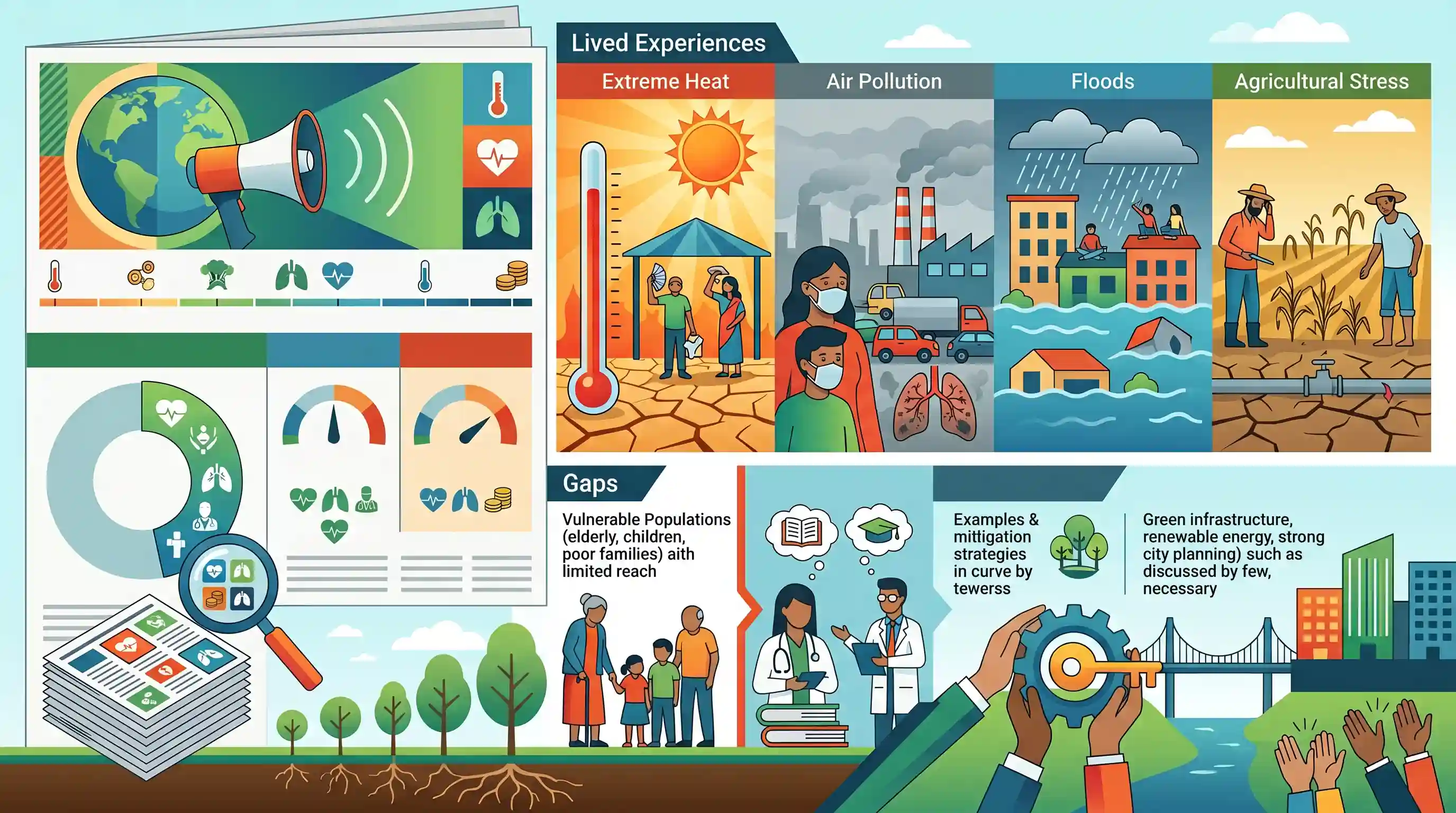
A study published in The Lancet Planetary Health journal analyzed media coverage of climate change as a health issue from 2012 to 2023 across India, the U.S., and China. It found that while fewer than 0.1% of over 22.5 million articles substantively linked climate change to health, India outperformed the others. In a validated sample, 46.4% of Indian articles framing the issue used a public health lens. The Indian media successfully connected climate impacts to "lived experiences" like extreme heat, urban air pollution, floods, and agricultural stress. However, across all three countries, significant gaps remain, notably the lack of engagement with vulnerable populations, public health experts, and evidence-based adaptation and mitigation strategies. Reframing climate change as a public health issue is vital for strengthening public engagement and policy action.
Key Points
- A decadal analysis (2012–2023) across India, the U.S., and China revealed extremely low overall media coverage (< 0.1%) substantively linking climate change and public health.
- India led the three nations, with 46.4% of its climate-health articles framing the issue through a public health lens, compared to 31.3% in the U.S. and 17% in China.
- Indian media focus prominently highlighted 'lived experiences,' including heatwaves, urban air quality, extreme weather events like floods, and agricultural stress/food insecurity.
- Despite India's relative success, a major gap remains globally in featuring medical experts, vulnerable populations, and evidence-based adaptation or mitigation strategies in news coverage.
Important Terms
Planetary Health

An interdisciplinary field focusing on the interdependent relationship between human health and the Earth's natural systems, aiming to protect the health of civilization within environmental limits.
UPSC context
Relevant for GS2 (Health) and GS3 (Environment); links ecological stability directly to human survival and socioeconomic wellbeing.
The Lancet Planetary Health
A high-impact medical journal published by The Lancet that focuses on how environmental changes like climate change and pollution affect human health outcomes globally.
UPSC context
Frequently cited in GS3 (Environment) and GS2 (Health) as an authoritative source for evidence-based climate-health statistics.
Vulnerable Populations
Groups at disproportionate risk from climate change impacts due to socioeconomic disadvantages, age (children/elderly), gender, or geographic location, with limited capacity to adapt.
UPSC context
Key for GS1 (Social Issues) and GS2 (Social Justice); central to discussions on climate equity and inclusive adaptation.
Climate Change Adaptation
Adjustments in natural or human systems in response to actual or expected climatic stimuli to moderate harm or exploit beneficial opportunities.
UPSC context
Core GS3 topic; tested through the National Action Plan on Climate Change (NAPCC) and disaster resilience strategies.
Climate Change Mitigation
Interventions to reduce the sources or enhance the sinks of greenhouse gases, such as transitioning to renewable energy or increasing forest cover.
UPSC context
Vital for GS3; concerns India's "Panchamrit" targets, Net Zero by 2070, and international climate agreements like the Paris Accord.
Indian Institute of Management Bangalore (IIM-B)
A premier Indian management institute that conducts interdisciplinary research on policy, communication, and sustainability, often collaborating on global climate-health studies.
UPSC context
Relevant for GS2 (Institutions); illustrates the role of Indian academic leadership in global sustainability and public policy discourse.
Prelims Trap
"Developed nations like the US lead India in mainstreaming the climate-health nexus in media coverage."
Less than 0.1% of articles make this link globally. Surprisingly, India significantly outperformed the US and China in adopting a public health framing.
Static Concepts Connected
What is India's National Programme on Climate Change and Human Health (NPCCHH)?
- Nodal Agency: Spearheaded by the National Centre for Disease Control (NCDC) under the Ministry of Health and Family Welfare.
- Health Action Plans: Mandates states to develop State Action Plans on Climate Change and Human Health (SAPCCHH) focusing on adaptation and mitigation.
- Surveillance: Strengthens health data networks (like IDSP) to track and predict climate-sensitive diseases, including vector-borne and water-borne illnesses.
How does the 'One Health' approach address climate-driven risks?
- Interconnectedness: Acknowledges that human health is inextricably linked to the health of animals, plants, and shared ecosystems.
- Climate Nexus: Addresses how climate change alters vector habitats and accelerates zoonotic disease spillover (e.g., Nipah, Dengue).
- AMR & Food Safety: Focuses on secondary environmental health threats like antimicrobial resistance (AMR) spreading through water systems and agricultural runoff.
Cross-Topic Patterns
Heat Action Plans & Lived Experiences
The media's focus on extreme heat directly connects to the NDMA's push for localized, health-centric Heat Action Plans (HAPs) that treat heatwaves as a medical emergency.
Air Pollution as a Fundamental Right
Urban air quality is increasingly framed by the judiciary and NCAP as a fundamental public health crisis (Article 21 right to health) rather than just an environmental violation.

Mains GS-3 2026 is highly likely to feature a question merging climate change impacts directly with public health infrastructure readiness.
Linked PYQs · 4
Linked PYQs · 4
- 2024MainsGS3
Flooding in urban areas is an emerging climate-induced disaster. Discuss the causes of this disaster. Mention the features of two such major floods in the last two decades in India. Describe the policies and frameworks in India that aim at tackling such floods.
- 2023MainsGS1
Discuss the consequences of climate change on the food security in tropical countries.
- 2019MainsGS3
Vulnerability is an essential element for defining disaster impacts and its threat to people. How and in what ways can vulnerability to disasters be characterized? Discuss different types of vulnerability with reference to disasters.
- 2016MainsGS1
Major cities of India are becoming more vulnerable to flood conditions. Discuss.
