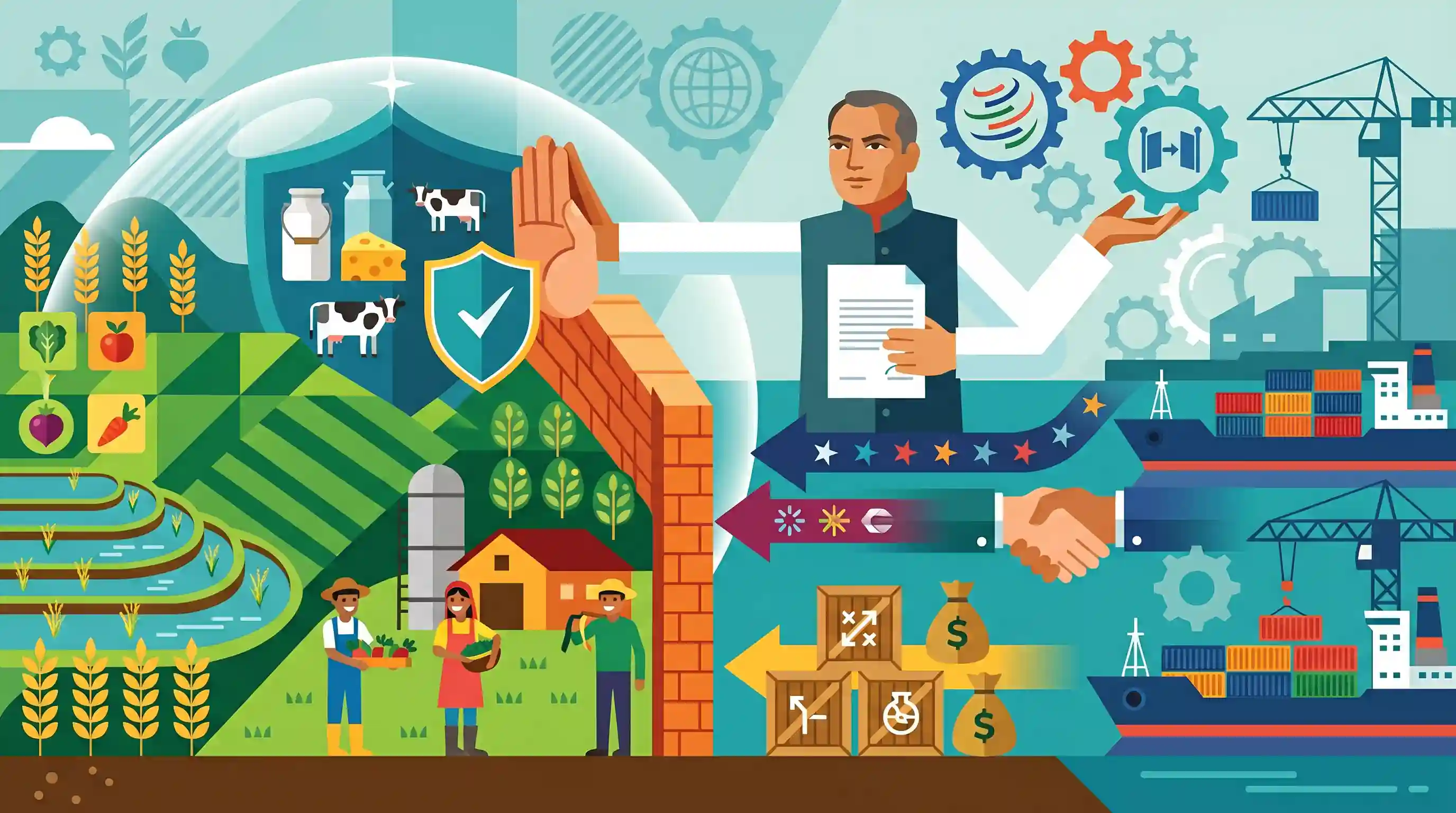
Piyush Goyal assures complete protection for dairy and farm sectors
Source:Indian Express ↗
Why It Matters
The livelihoods of millions of small and marginal farmers depend on India's agriculture and dairy sectors. Trade agreements that open these markets to heavily subsidized foreign goods can severely impact local rural economies. Understanding how India negotiates bilateral trade partnerships while safeguarding vulnerable domestic sectors is highly relevant for economic policy, international relations, and agricultural topics in the UPSC syllabus.
Summary
Union Minister Piyush Goyal has stated that India's agriculture and dairy interests, along with the welfare of its farmers, are fully safeguarded in the context of the US trade deal. Historically, the United States has pressed for increased access to India's vast agricultural and dairy markets, raising concerns among domestic producers about competing with heavily subsidized American products. By ensuring these sectors are protected in bilateral negotiations, the Indian government underscores its commitment to balancing international trade relations and economic integration with the imperative of protecting the livelihoods and food security of millions of domestic farmers.
Key Points
- Union Minister Piyush Goyal asserted that India's agricultural and dairy sectors are completely protected under the US trade deal framework.
- The United States has historically sought greater market access for its agricultural and dairy products in India, presenting a recurring point of friction in bilateral trade negotiations.
- The protection of domestic farmers and the local dairy industry remains a non-negotiable priority for the Indian government to ensure rural livelihood and food security.
- The negotiations highlight India's broader strategy to balance global economic integration with the necessity of shielding vulnerable domestic sectors from highly subsidized foreign competition.
Important Terms
India-US Interim Trade Agreement

A framework agreement reducing tariffs on Indian exports to 18% while providing India preferential market access, intended as a precursor to a comprehensive Bilateral Trade Agreement.
UPSC context
GS II: Bilateral agreements. Tests understanding of 'reciprocity' and 'strategic autonomy' in trade diplomacy.
Negative List
A specific roster of sensitive sectors (e.g., dairy, cereals, pulses) excluded from tariff concessions to prevent domestic market disruption from cheap, subsidized imports.
UPSC context
GS III: Indian Economy. Tests knowledge of trade safeguards and protection of domestic livelihoods.
Agricultural Protectionism
The use of high import tariffs (often >35%) and non-tariff barriers to shield domestic farmers from international competition and global price volatility.
UPSC context
GS III: Issues related to subsidies. Tests the rationale for high agri-tariffs in developing nations.
Sanitary and Phytosanitary (SPS) Measures
WTO-governed regulations ensuring food safety and animal/plant health; often used as 'technical barriers' when requirements (like India’s dairy certificate) are challenged as unscientific.
UPSC context
GS II/III: WTO norms. Tests ability to distinguish between legitimate health safeguards and trade barriers.
Agreement on Agriculture (AoA)
A WTO treaty aiming to reform trade in the sector and make it fairer; India often utilizes 'Special and Differential Treatment' to protect its smallholder-driven agriculture.
UPSC context
GS III: WTO and Indian Agriculture. Core topic regarding subsidy 'boxes' and food security.
Prelims Trap
The WTO 'Peace Clause' provides permanent blanket immunity from challenges against all agricultural subsidies.
The Peace Clause is an interim mechanism protecting only public stockholding programs for food security purposes. It does not permanently shield all agricultural subsidies.
Static Concepts Connected
What are the "Boxes" of agricultural subsidies under the WTO Agreement on Agriculture?
- Amber Box: Trade-distorting subsidies (e.g., MSP) subject to reduction commitments. Developing nations face a 'de minimis' limit of 10% of total agricultural production value.
- Green Box: Subsidies causing minimal trade distortion, such as environmental protection, pest control, and agricultural research. They face no spending limits.
- Blue Box: Amber Box subsidies tied to conditions designed to limit overall agricultural production. Currently, no limits apply to this category.
How do Sanitary and Phytosanitary (SPS) measures function as Non-Tariff Barriers?
- SPS Agreement: A WTO agreement allowing nations to set scientific standards protecting human, animal, or plant life/health from imported risks.
- India's Dairy Barrier: India strictly mandates that imported dairy must originate from cattle not fed animal-derived 'blood meal', acting as an SPS barrier that effectively restricts US dairy market access.
Cross-Topic Patterns
Dairy sector as the ultimate FTA dealbreaker
From exiting RCEP to stalling US and EU deals, protecting India's 80 million smallholder dairy farmers from highly subsidized foreign imports remains the definitive red line in India's trade negotiations.
MSP regime vs. WTO obligations
The US-India friction bridges domestic agriculture (MSP, National Food Security Act) and international trade (WTO AoA limits), making public stockholding for food security a recurring theme in global diplomacy.

Expect a 2026 prelims question testing the intersection of WTO’s Agreement on Agriculture, the Peace Clause, and India's MSP framework.
Linked PYQs · 3
Linked PYQs · 3
- 2015PrelimsGS1
The terms 'Agreement on Agriculture', 'Agreement on the Application of Sanitary and Phytosanitary Measures' and 'Peace Clause' appear in the news frequently in the context of the affairs of the
- 2023MainsGS3
What are the direct and indirect subsidies provided to farm sector in India? Discuss the issues raised by the World Trade Organization (WTO) in relation to agricultural subsidies.
- 2018MainsGS3
How would the recent phenomena of protectionism and currency manipulations in world trade affect macroeconomic stability of India?
