Administrative Reforms and Credibility Gap in Governance
Source:Indian Express ↗
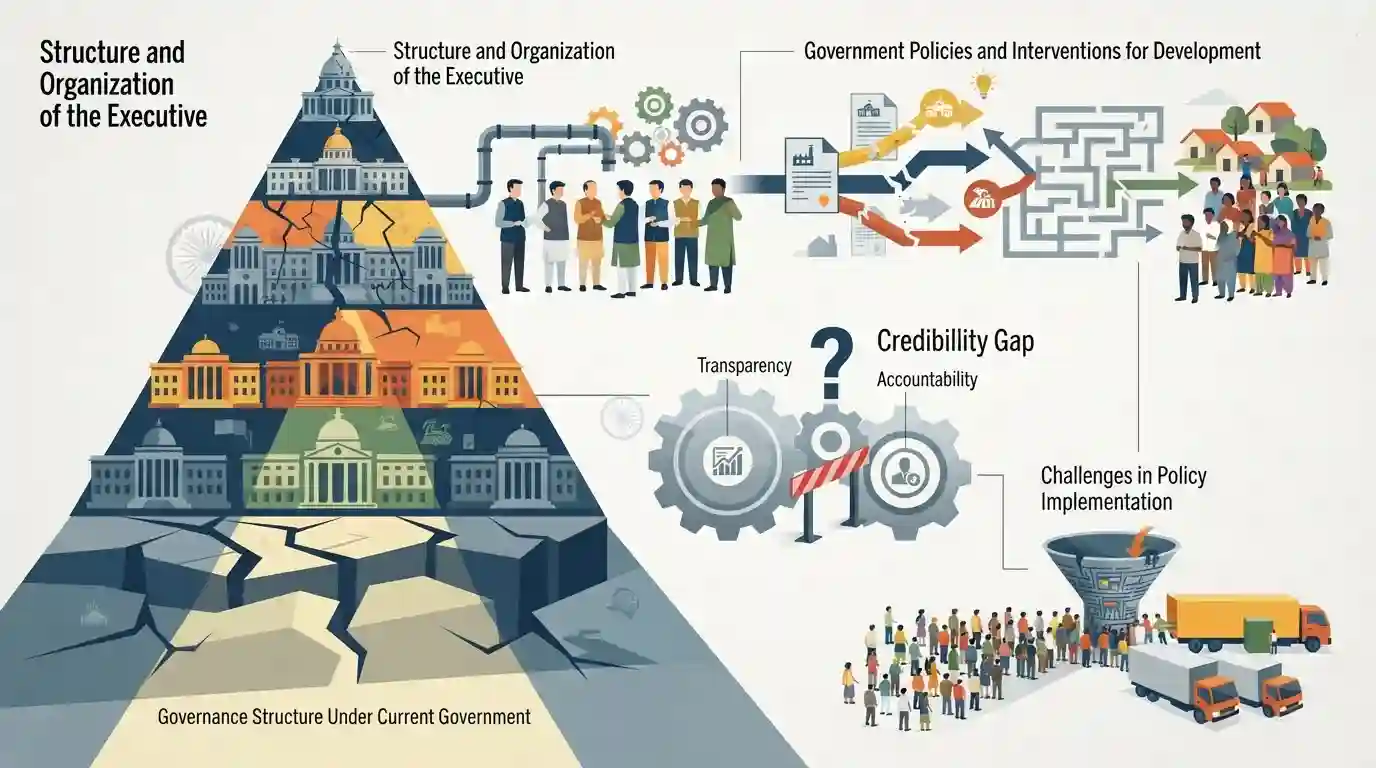
Why It Matters
Crucial for understanding the structural challenges, policy implementation bottlenecks, and institutional credibility issues in India's civil services and administrative framework.
Summary
The article examines the persistence of a credibility gap in India's administrative reforms, highlighting challenges in policy implementation, institutional accountability, and governance structure under the current government framework.
Key Points
- Administrative reforms in India often face a credibility gap between stated intent and actual policy implementation on the ground.
- Institutional quality, transparency, and accountability remain critical for successful public administration and governance outcomes.
- Overcoming structural bottlenecks requires aligning digital transformations and structural changes with genuine administrative intent.
Important Terms
Administrative Reforms 3.0

A policy initiative aimed at overhauling official interactions with citizens and businesses, addressing persistent bureaucratic bottlenecks, regulatory compliance burdens, and structural governance challenges.
UPSC context
UPSC Mains GS Paper II: Important aspects of governance, transparency, and accountability, and civil services reforms.
Credibility Gap
The discrepancy between formal policy announcements on paper and actual on-ground implementation outcomes, often caused by institutional rigidities, compliance burdens, and lack of presumptive trust.
UPSC context
UPSC Mains GS Paper II: Government policies and interventions for development and critical appraisal of administrative efficiency.
Second Administrative Reforms Commission (2nd ARC)
A multi-stakeholder body that previously outlined structural reforms for Indian administration, including fixed tenures for senior civil servants and independent oversight mechanisms.
UPSC context
UPSC Mains GS Paper II: Structure, organization, and functioning of the Executive and civil services accountability.
Government of India
The supreme executive organ of the Union of India, responsible for formulating administrative policies, steering governance frameworks, and executing legislative enactments.
UPSC context
UPSC Mains GS Paper II: Functions and responsibilities of the Union and the states, structure and organization of the executive.
Prelims Trap
Digital transformations and e-governance drives automatically eliminate structural friction and compliance burdens in public administration.
Aspirants often assume that the introduction of e-governance portals automatically eliminates compliance burdens and institutional friction on the ground.
Static Concepts Connected
What are the key institutional mechanisms and committees tasked with civil services and administrative reforms in independent India?
- First ARC: Appointed in 1966, it recommended the creation of Lokpal and Lokayukta, streamlining secretariat procedures, and decentralisation of financial powers.
- Second ARC: Constituted in 2005, it focused on citizen-centric administration, crisis management, ethics in governance, and strengthening local governance.
- Recent Reforms: Focuses on systemic issues like lateral entry, mission Karmayogi (capacity building), and performance appraisal systems.
Cross-Topic Patterns
E-Governance vs. Structural Bureaucratic Reform
While digitisation reduces physical touchpoints, complex compliance burdens and structural friction show that e-governance cannot substitute for deep structural capacity building in the bureaucracy.
Executive Pronouncements vs. Bureaucratic Realities
Policy intent such as 'minimum government, maximum governance' often collides with archaic civil service rules, highlighting the gap between executive pronouncements and bureaucratic outputs.

Expect a GS-2 analytical question on why digital transformation in public administration has not fully closed the implementation credibility gap.
Linked PYQs · 3
Linked PYQs · 3
- 2024MainsGS2
The Doctrine of Democratic Governance makes it necessary that the public perception of the integrity and commitment of civil servants becomes absolutely positive. Discuss.
- 2020MainsGS2
Institutional quality is a crucial driver of economic performance". In this context suggest reforms in Civil Service for strengthening democracy.
- 2019MainsGS2
Implementation of Information and Communication Technology (ICT) based Projects/Programmes usually suffers in terms of certain vital factors. Identify these factors, and suggest measures for their effective implementation.
