Administrative Reforms and Civil Services Accountability in India
Source:Indian Express ↗
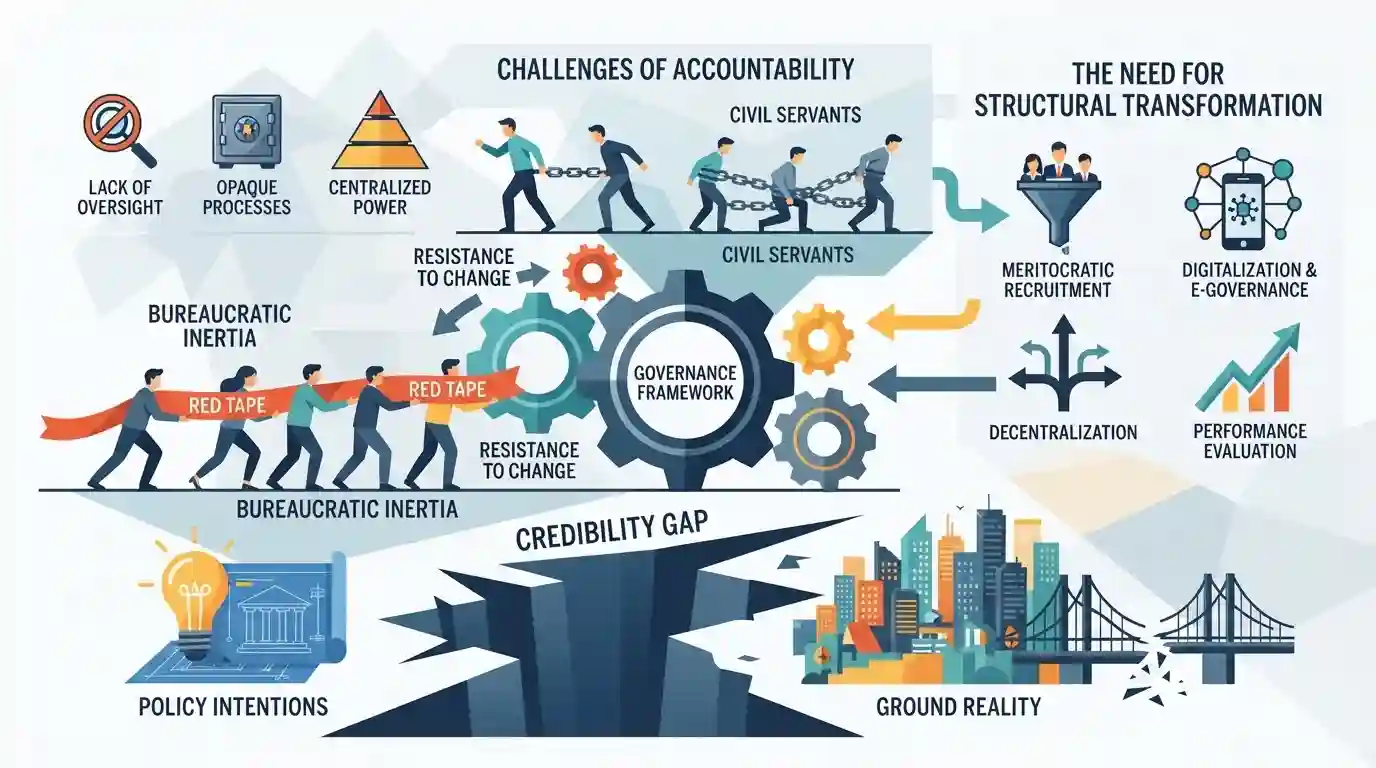
Why It Matters
Directly relevant to GS Paper 2 syllabus under 'Structure, organization and functioning of the Executive and the Ministries and Departments of the Government; pressure groups and formal/informal associations and their role in the Polity.'
Summary
The article discusses the persistent credibility gap in India's administrative reforms under the current governance framework, highlighting the challenges of bureaucratic inertia, institutional accountability, and the need for genuine structural transformations in the civil services.
Key Points
- Administrative reforms in India often face a credibility gap between stated intent and ground implementation.
- Effective governance requires strengthening institutional accountability, transparency, and professional autonomy within the civil services.
- Bureaucratic inertia and resistance to structural changes impede systemic transformation despite policy initiatives.
Important Terms
Administrative Reforms

Systemic inertia, structural bottlenecks, and resistance to change within the bureaucracy that hinder the implementation of effective policy transformations and public service delivery improvements.
UPSC context
GS Paper II (Governance, Constitution, Polity - Civil Services and Structural Reforms). Critical for questions on bureaucratic bottlenecks and modernization.
Credibility Gap
The divergence between stated administrative reform goals and actual institutional performance, caused by bureaucratic resistance, colonial legacy mindsets, and insufficient devolution of powers.
UPSC context
GS Paper II (Governance and Accountability). Tests candidates' analytical understanding of why reform policies fail at the implementation stage.
Mission Karmayogi
A comprehensive national capacity-building initiative for civil servants shifting focus from a rules-based framework to a roles-based competency approach via digital learning platforms.
UPSC context
GS Paper II (Role of Civil Services in a Democracy). Evaluates recent governance interventions, capacity building, and bureaucratic skill enhancement.
Prelims Trap
policy initiatives automatically overcome bureaucratic inertia and ensure effective ground implementation.
Aspirants often assume that passing statutory acts or setting up digital portals automatically translates to structural administrative reform, overlooking persistent ground-level bureaucratic inertia.
Static Concepts Connected
What are the major structural committees and commissions on civil services reform in independent India?
- First ARC:: Constituted in 1966, recommended greater autonomy, decentralization, and the separation of policy formulation from execution in government departments.
- Second ARC:: Constituted in 2005 under Veerappa Moily, emphasized citizen-centric administration, ethics in governance, RTI, and civil service neutrality.
- Surinder Nath Committee:: Submitted its report in 2004, focusing on result-oriented performance, simplification of procedures, and domain expertise.
Cross-Topic Patterns
Administrative Reforms + Ease of Doing Business
Civil service reforms directly impact the ease of doing business and regulatory certainty, linking administrative accountability to private investment flows and economic growth.
Governance Reform + Welfare Delivery Efficiency
Bureaucratic inertia and the implementation deficit directly undermine welfare delivery schemes like PM-KISAN or MGNREGA at the grassroots.

Bureaucratic accountability and civil service reform will likely be tested via structural governance or ethics case studies.
Linked PYQs · 3
Linked PYQs · 3
- 2024MainsGS2
The Doctrine of Democratic Governance makes it necessary that the public perception of the integrity and commitment of civil servants becomes absolutely positive. Discuss.
- 2017MainsGS2
Initially Civil Services in India were designed to achieve the goals of neutrality and effectiveness, which seems to be lacking in the present context. Do you agree with the view that drastic reforms are required in Civil Services? Comment.
- 2020MainsGS2
Institutional quality is a crucial driver of economic performance". In this context suggest reforms in Civil Service for strengthening democracy.
