India abstains from UNGA vote on ICJ climate advisory opinion
Source:The Hindu ↗
Why It Matters
This development is crucial for understanding India's negotiating stance in global environmental diplomacy. It highlights the friction between legalistic approaches to international obligations (via the ICJ) and negotiated political settlements (via the UNFCCC and Paris Agreement), while underscoring India's core demand for equity and climate finance from the developed world.
Summary
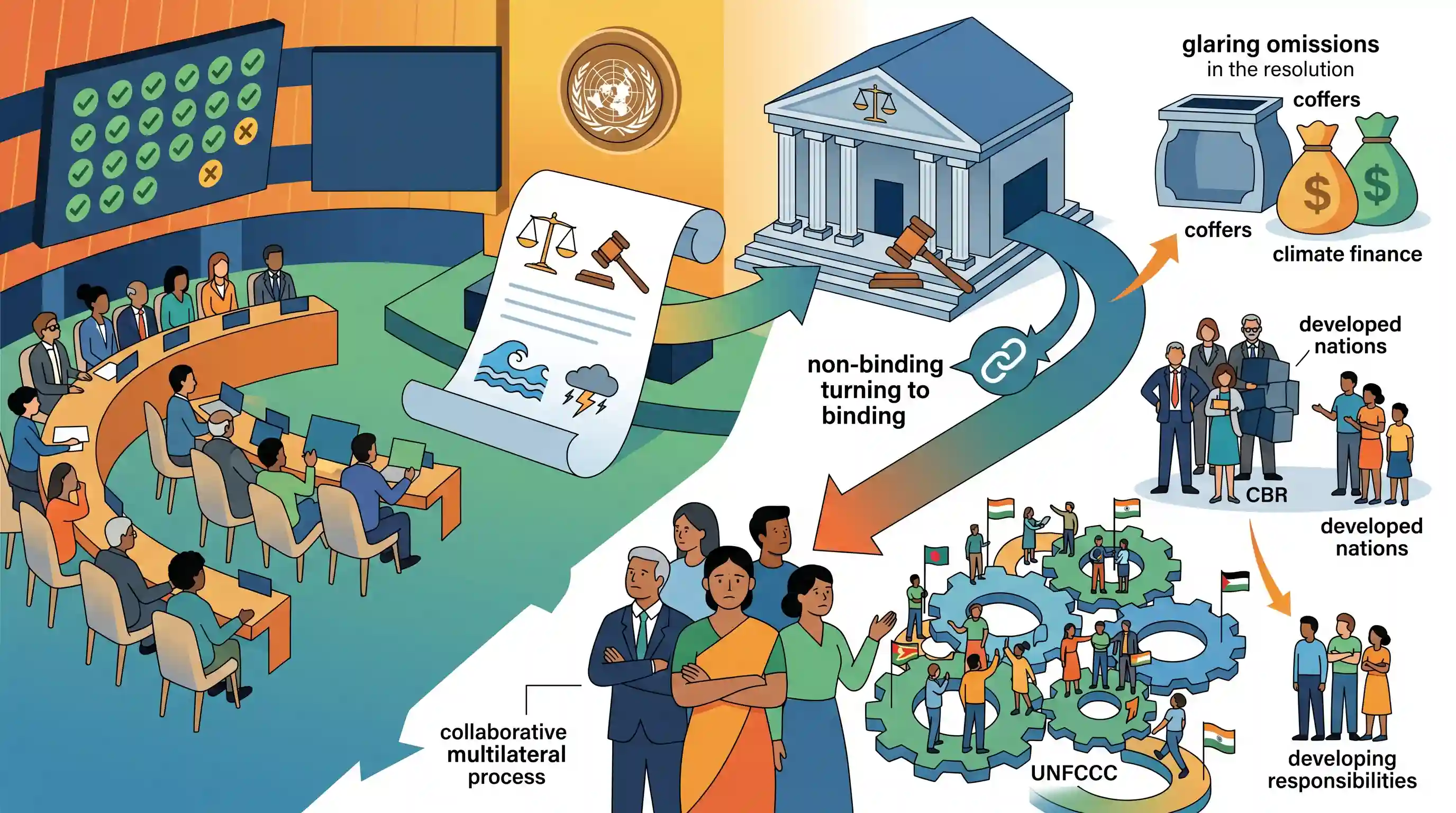
India abstained from a UN General Assembly (UNGA) resolution regarding an International Court of Justice (ICJ) advisory opinion on states' obligations concerning climate change. While the resolution passed overwhelmingly, India argued that it risks undermining the multilateral UN Framework Convention on Climate Change (UNFCCC) process. India expressed concerns that the text attempts to elevate a non-binding advisory opinion to a binding mandate, imposes specific mitigation pathways, and shifts obligations onto developing nations. Furthermore, India highlighted the glaring omission of "climate finance" in the resolution, reaffirming that global climate action must be based on consensus and the principle of Common But Differentiated Responsibilities (CBDR).
Key Points
- A UNGA resolution calling on countries to comply with their climate change obligations based on a forthcoming ICJ advisory opinion was passed with 161 votes in favour.
- India abstained from the vote alongside the US, UK, and Russia, asserting that the UNFCCC is the sole legitimate forum for negotiating global climate action.
- India's Permanent Representative to the UN argued that the resolution attempts to elevate a non-binding advisory opinion to a quasi-binding status, which undermines the Paris Agreement.
- India objected to the resolution's prescriptive approach to mitigation pathways and the conspicuous absence of the term "climate finance" in the text.
- India reiterated the importance of the principle of Common But Differentiated Responsibilities (CBDR), emphasizing that developed nations must lead in emission cuts and provide financial and technological support to developing countries.
Important Terms
Common But Differentiated Responsibilities (CBDR)

UNFCCC principle recognizing that all states share responsibility for environmental protection, but developed nations bear a greater burden due to historical emissions and superior financial/technological capacity.
UPSC context
GS Paper III (Environment); key to India's climate diplomacy and arguments for equity in global emission reduction.
International Court of Justice (ICJ)
The principal judicial organ of the UN that settles legal disputes between states and provides non-binding advisory opinions on legal questions referred by authorized UN organs.
UPSC context
GS Paper II (International Institutions); relevant for understanding the legal enforcement vs. advisory role of global bodies.
UN Framework Convention on Climate Change (UNFCCC)
The 1992 international treaty and core multilateral framework for global climate negotiations, emphasizing consensus-based action and sustainable development for developing nations.
UPSC context
GS Paper III (Environmental Agreements); the primary forum for India's multilateral climate engagement.
Paris Agreement
A 2015 legally binding treaty aiming to limit global warming, characterized by its 'bottom-up' approach where countries set their own voluntary targets.
UPSC context
GS Paper III (Climate Change); central to discussions on global temperature targets and national policy sovereignty.
Climate Finance
Financial resources provided by developed countries to help developing nations implement mitigation and adaptation actions, a core pillar of climate justice.
UPSC context
GS Paper III (Environment & Economy); vital for India's transition to a green economy and achievement of its NDCs.
Nationally Determined Contributions (NDCs)
Voluntary climate action plans submitted by each country under the Paris Agreement, detailing efforts to reduce national emissions and adapt to climate impacts.
UPSC context
GS Paper III (Climate Change); tests knowledge of India's specific pledges (Panchamrit) and the 'bottom-up' treaty structure.
Prelims Trap
UNGA resolutions adopting ICJ advisory opinions on climate change become legally binding on all UN member states.
ICJ advisory opinions are non-binding by nature. Even if the UNGA overwhelmingly adopts a resolution based on it, it remains a political recommendation, not enforceable law.
Static Concepts Connected
What is the Advisory Jurisdiction of the International Court of Justice (ICJ)?
- Eligible entities: The UN General Assembly, UN Security Council, and authorized specialized agencies can request the ICJ to give an advisory opinion on any legal question.
- Non-binding nature: Unlike judgments in contentious cases between states, advisory opinions carry no binding legal force, though they possess immense moral and legal authority.
- State limitation: Individual states cannot request advisory opinions from the ICJ; only specific UN organs and agencies hold this right.
How does the CBDR principle function under the UNFCCC framework?
- Core premise: It acknowledges that while all countries share responsibility for environmental protection, their obligations differ based on historical contribution to emissions and respective capabilities.
- Developed country obligations: Developed countries (Annex I) are mandated to take the lead in emission cuts and provide climate finance and technology transfers to developing nations.
- Protecting development space: It ensures the Global South can prioritize poverty eradication and economic development while undertaking nationally determined climate actions without top-down prescriptive mandates.
Cross-Topic Patterns
Breaking traditional North-South climate blocs
India abstained alongside the US, UK, and Russia. This demonstrates how sovereign emission and legal liability concerns often override traditional Global South vs. Global North alignments in non-UNFCCC legal venues.
Shifting climate debates to international courts
Developing island states (like Vanuatu) are increasingly utilizing the ICJ and ITLOS advisory opinions to bypass deadlocked UNFCCC negotiations, attempting to create top-down customary international law for climate reparations.

ICJ's advisory jurisdiction, UNGA's voting powers, and UNFCCC mandate overlaps form a high-probability multi-statement 2026 prelims Q.
Linked PYQs · 3
Linked PYQs · 3
- 2025MainsGS3
Write a review on India's climate commitments under the Paris Agreement (2015) and mention how these have been further strengthened in COP26 (2021). In this direction, how has the first Nationally Determined Contribution intended by India been updated in 2022?
- 2025PrelimsGS1
Consider the following statements : Statement I: Article 6 of the Paris Agreement on climate change is frequently discussed in global discussions on sustainable development and climate change. Statement II: Article 6 of the Paris Agreement on climate change sets out the principles of carbon markets. Statement III : Article 6 of the Paris Agreement on climate change intends to promote inter-country non-market strategies to reach their climate targets. Which one of the following is correct in respect of the above statements?
- 2022PrelimsGS1
With reference to the United Nations General Assembly, consider the following statements: 1. The UN General Assembly can grant observer status to the non-member States. 2. Inter-governmental organisations can seek observer status in the UN General Assembly. 3. Permanent Observers in the UN General Assembly can maintain missions at the UN headquarters. Which of the statements given above are correct?
