Decline in India Bond Yields Ahead of Monetary Policy Review
Source:Indian Express ↗
Why It Matters
Bond yield dynamics are a core component of the UPSC Economics syllabus. Yields reflect inflation expectations, fiscal health, and monetary policy stances. Understanding the interplay between domestic policies (RBI actions) and global cues (US Fed actions) is essential for answering questions on capital flows, exchange rates, and the economy's cost of borrowing.
Summary
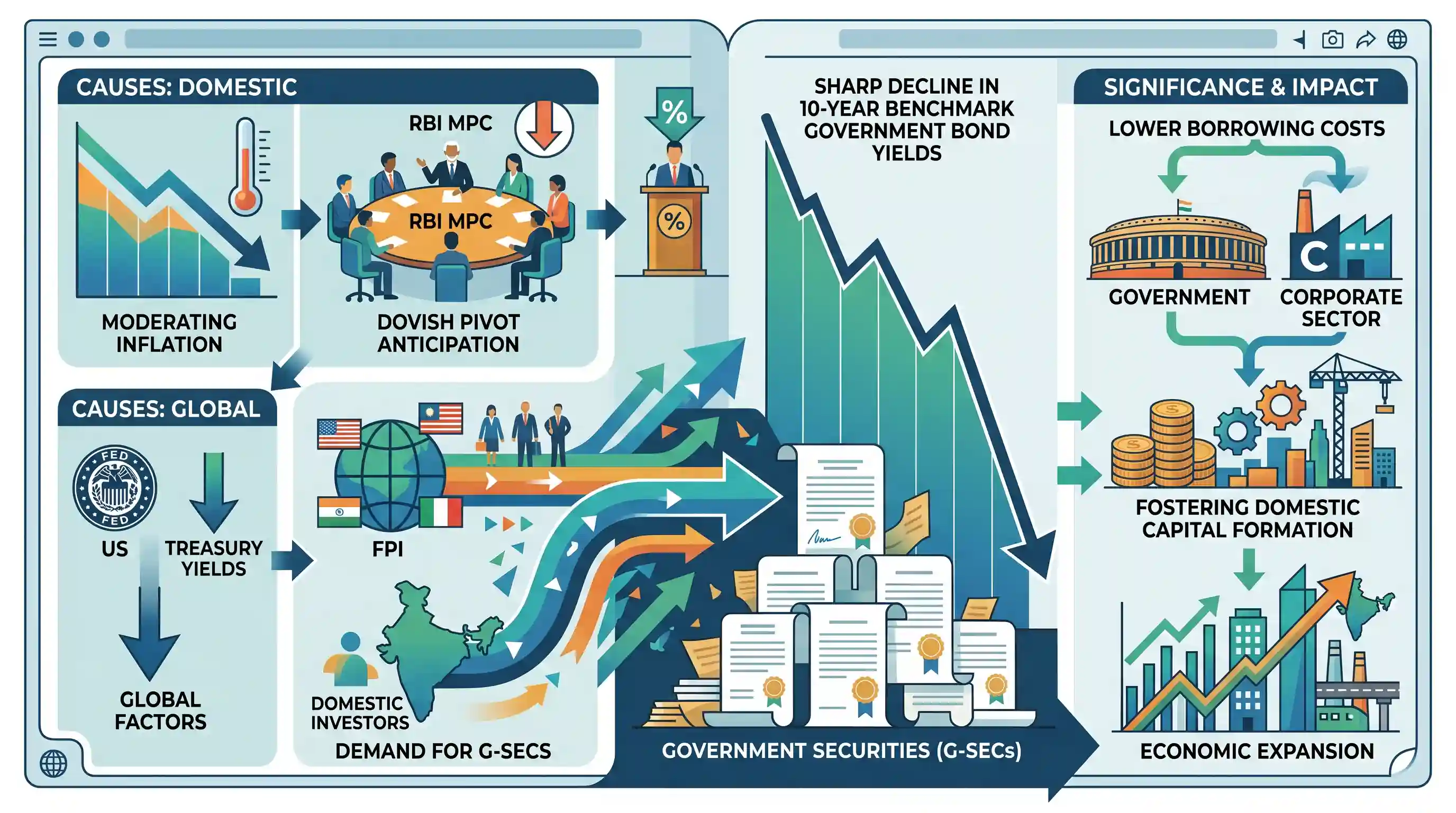
This article discusses the reasons behind the sharp decline in India's 10-year benchmark government bond yields ahead of the Reserve Bank of India's (RBI) monetary policy review. The drop in yields reflects a surge in demand for government securities, driven by market anticipation of a dovish pivot or rate cut by the RBI's Monetary Policy Committee due to moderating domestic inflation. Favorable global factors, especially falling US Treasury yields and anticipated US Federal Reserve rate cuts, have also shifted investor sentiment, bringing in foreign inflows. This decline in yields is significant as it signals lower borrowing costs for the government and the corporate sector, fostering domestic capital formation and economic expansion.
Key Points
- The decline in 10-year bond yields signals market expectations of an RBI repo rate cut or a shift to a 'neutral' monetary policy stance.
- Bond yields and prices share an inverse relationship; heightened demand for government securities (G-Secs) pushes prices up and yields down.
- Easing domestic retail inflation and comfortable banking system liquidity have boosted investor appetite for domestic government bonds.
- Global cues, notably falling US Treasury yields and anticipated rate cuts by the US Federal Reserve, significantly increased the attractiveness of Indian debt to Foreign Portfolio Investors (FPIs).
- Lower benchmark bond yields reduce the cost of borrowing for both the Union government and corporate borrowers, promoting capital formation and economic growth.
Important Terms
Bond Yield

The annual return an investor receives on a bond, calculated as the fixed coupon payment divided by its market price. Yields and bond prices share an inverse relationship.
UPSC context
GS-III: Core concept for understanding debt markets, government borrowing costs, and the transmission of monetary policy to the economy.
Monetary Policy Committee (MPC)
A six-member statutory body under the RBI Act, 1934, responsible for determining the policy repo rate to maintain price stability while supporting economic growth.
UPSC context
GS-III: Crucial for topics on inflation management (4% +/- 2% target) and the institutional framework of India’s monetary policy.
Government Securities (G-Secs)
Tradable debt instruments issued by the Central or State Governments to finance fiscal deficits; they are considered risk-free "gilt-edged" securities due to sovereign backing.
UPSC context
GS-III: Essential for understanding fiscal policy, government budgeting, and RBI’s Open Market Operations (OMOs) for liquidity management.
US Federal Reserve (Fed)
The central bank of the United States. Its interest rate decisions significantly influence global capital flows, emerging market bond yields, and currency stability.
UPSC context
GS-III: Relevant for understanding global macroeconomic linkages and "spillover effects" of external policies on India’s financial stability.
Foreign Portfolio Investment (FPI)
Investments by non-residents in Indian financial assets like stocks and bonds. It represents passive ownership and is more volatile than Foreign Direct Investment (FDI).
UPSC context
GS-III: Important for capital account management, Balance of Payments (BoP), and understanding market volatility driven by global sentiment.
Dovish Pivot
A shift in a central bank's policy outlook from prioritizing inflation control (hawkish) toward supporting economic growth through lower interest rates and easier liquidity.
UPSC context
GS-III: Tests understanding of central bank signaling, policy cycles, and their impact on market expectations and capital formation.
10-year Benchmark Bond
The standard 10-year government bond that serves as the primary reference for pricing other long-term debt and assessing the economy's long-term interest rate outlook.
UPSC context
GS-III: A key barometer of sovereign credit health and investor sentiment regarding future inflation and interest rate trajectories.
Prelims Trap
A surge in demand for government securities pushes bond prices up and consequently increases their yields.
Bond prices and yields share a strict inverse relationship. High demand pushes the bond's trading price up, which lowers the effective yield since the fixed coupon becomes a smaller percentage of the higher price.
Static Concepts Connected
How do bond yields respond to RBI repo rate cuts?
- Inverse relationship: Bond prices and yields move in opposite directions. Higher prices mathematically equate to lower yields for new buyers.
- Rate cut effect: If RBI cuts the repo rate, older bonds with higher fixed interest rates become highly attractive, increasing their demand and price, thereby lowering their yield.
- Borrowing costs: A fall in the benchmark 10-year G-Sec yield acts as a reference point, directly lowering the borrowing costs for both the government and corporate entities.
What determines FPI inflows into Indian government securities?
- Interest differential: FPIs seek arbitrage. When the US Fed cuts rates, the gap between US and Indian interest rates widens, making Indian debt more lucrative.
- Real returns: Moderating domestic retail inflation protects the real rate of return on Indian bonds, attracting foreign capital seeking inflation-beating yields.
- Currency stability: A stable Rupee ensures that foreign investors do not lose their yield gains to currency depreciation when they eventually repatriate their funds.
Cross-Topic Patterns
Monetary Stance + Fiscal Deficit
While RBI rate cuts lower yields, an expansionary fiscal policy (high government borrowing) increases G-Sec supply. This oversupply can push yields back up, threatening to crowd out private investment.
US Fed Cycles + Rupee Stability
Anticipated rate cuts by the US Federal Reserve weaken the Dollar Index, easing depreciation pressure on the Rupee and helping the RBI manage imported inflation without hiking domestic rates.

Expect a 2026 Prelims question linking US Fed rate cuts, RBI's 'neutral' stance, and their combined effect on bond yields and FPI flows.
Linked PYQs · 4
Linked PYQs · 4
- 2021PrelimsGS1
Indian Government Bond Yields are influenced by which of the following? 1. Actions of the United States Federal Reserve 2. Actions of the Reserve Bank of India 3. Inflation and short-term interest rates Select the correct answer using the code given below.
- 2025PrelimsGS1
Which of the following are the sources of income for the Reserve Bank of India? I. Buying and selling Government bonds II. Buying and selling foreign currency III. Pension fund management IV. Lending to private companies V. Printing and distributing currency notes Select the correct answer using the code given below.
- 2022PrelimsGS1
In India, which one of the following is responsible for maintaining price stability by controlling inflation?
- 2024MainsGS3
What are the causes of persistent high food inflation in India? Comment on the effectiveness of the monetary policy of the RBI to control this type of inflation.
