Radcliffe Line Boundary Delay Origins of Bengal Inclusion Day
Source:hindustan-times ↗
Why It Matters
This piece of regional history illustrates the direct impact of the Mountbatten administration's decisions regarding the Radcliffe Line on the ground in Bengal. It is highly relevant for WBCS Prelims candidates studying the Modern Indian History and the specific geographical/historical context of West Bengal's border districts.
Summary
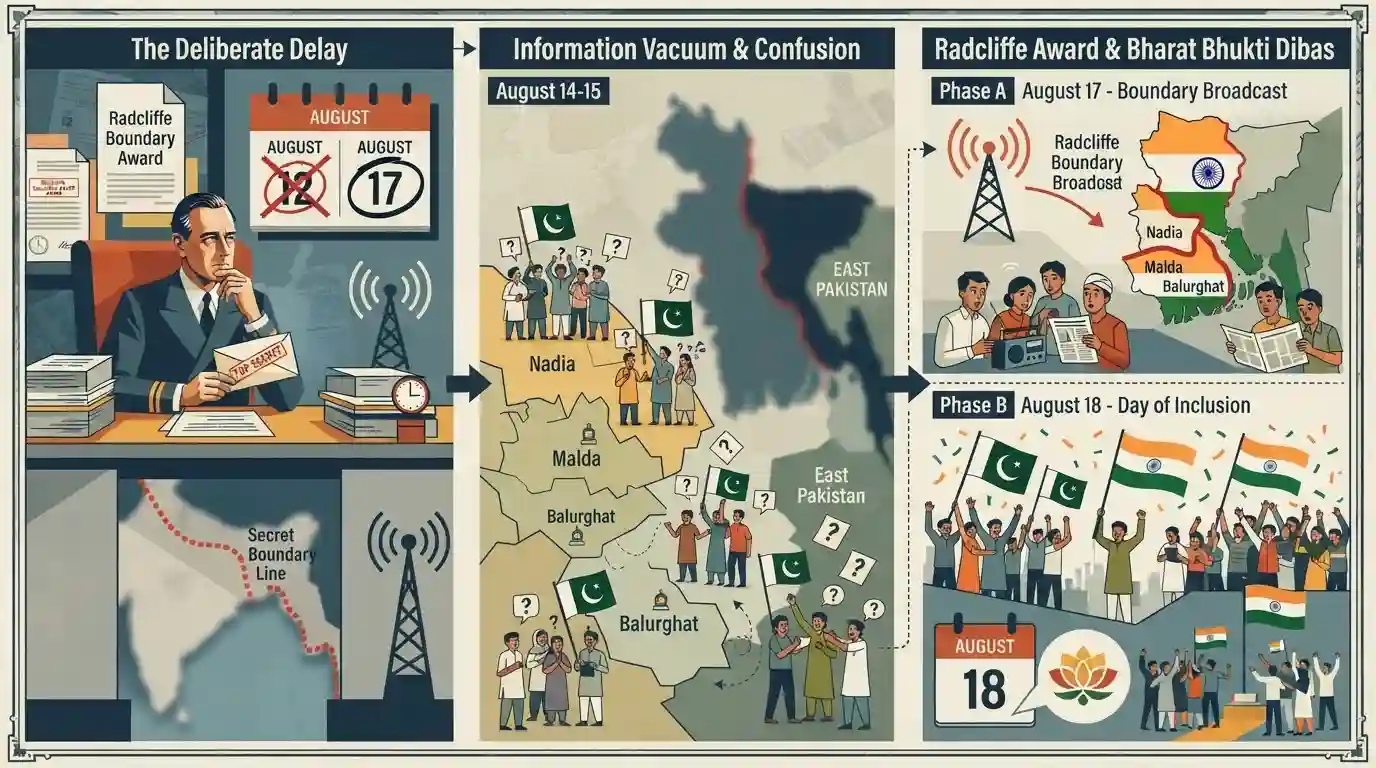
The article explores the historical origins of 'Bharat Bhukti Dibas' (Day of Inclusion), celebrated on August 18 in West Bengal districts like Nadia, Malda, and Balurghat. During the Partition in 1947, Lord Mountbatten deliberately delayed the publication of the Radcliffe Line boundary award from August 12 to August 17 to prevent unrest during the Independence Day ceremonies. This information vacuum led locals in several border towns to mistakenly hoist Pakistani flags on August 14-15. When the official demarcations were broadcast on August 17, confirming these areas as part of India, residents raised the Indian tricolour on August 18, an event still commemorated today.
Key Points
- Certain parts of Bengal, including Nadia, Malda, and Balurghat, initially hoisted Pakistani flags on August 14 and 15, 1947, due to a lack of clarity regarding the final border demarcation.
- Although Sir Cyril Radcliffe signed the boundary report on August 12, Lord Mountbatten deliberately delayed its publication until August 17 to avoid derailing Independence Day ceremonies and escalating communal violence.
- The Radcliffe award placed the majority of Murshidabad, Nadia, and Malda within India, resolving the three-day limbo.
- The Indian tricolour was hoisted in these districts on August 18, a date now observed locally as 'Bharat Bhukti Dibas' (Day of Inclusion) with commemorative events like boat races on the Churni River.
Important Terms
Radcliffe Line

The boundary demarcated in August 1947 dividing the Bengal and Punjab provinces between India and Pakistan. Its delayed announcement left many border residents confused about their citizenship for days.
UPSC context
Tested in WBCS History and Geography; evaluates knowledge of Partition mechanics, West Bengal's borders, and post-independence territorial consolidation.
Boundary Commission Award
The formal boundary decision drafted by Sir Cyril Radcliffe. Lord Mountbatten deliberately delayed its public release until August 17, 1947, attempting to avoid communal unrest during the Independence Day celebrations.
UPSC context
Important for WBCS History Paper III. Tests understanding of the Mountbatten Plan's execution and the socio-political realities of Partition.
Indian Independence Act 1947
The British legislation that formally partitioned British India into the independent dominions of India and Pakistan, legally mandating the dissolution and division of the Bengal and Punjab provinces.
UPSC context
A staple in WBCS Polity and History papers. Tests the legal mechanics of the transfer of power and constitutional history.
Muslim League
The political party led by Muhammad Ali Jinnah that successfully demanded the creation of a separate Muslim-majority nation (Pakistan), directly precipitating the partition of Bengal and Punjab.
UPSC context
Crucial for WBCS Paper III (Indian National Movement). Tests knowledge of communal politics, the two-nation theory, and partition catalysts.
All India Radio
India's national public radio broadcaster. In 1947, it was through its August 17 evening broadcast that border residents in Bengal finally learned the precise boundary lines determining their citizenship.
UPSC context
Relevant to WBCS History and Current Affairs. Tests awareness of mass media's historical role during pivotal post-independence events.
Prelims Trap
The Radcliffe Line boundaries were officially published and enforced on August 15, 1947.
Aspirants often assume borders were officially finalized on Independence Day. The award was signed August 12, but Mountbatten deliberately withheld publication until August 17.
Static Concepts Connected
What was the composition of the 1947 Bengal Boundary Commission?
- Chairman: Sir Cyril Radcliffe, who concurrently chaired the Punjab Boundary Commission despite having no prior knowledge of India's geography.
- INC Nominees: Justice Bijan Kumar Mukherjee and Justice Charu Chandra Biswas.
- League Nominees: Justice Abu Saleh Mohamed Akram and Justice S.A. Rahman.
How did the Radcliffe Award partition the undivided Nadia district?
- West Bengal: The Hindu-majority subdivisions of Krishnanagar Sadar and Ranaghat were allocated to India (West Bengal).
- East Pakistan: The Muslim-majority subdivisions of Kushtia, Chuadanga, and Meherpur were awarded to East Pakistan.
Cross-Topic Patterns
Radcliffe anomalies & border enclaves
The rushed Radcliffe demarcations created numerous territorial anomalies, directly causing the Indo-Bangladesh enclave (Chhitmahal) dispute resolved decades later by the 100th Constitutional Amendment Act in 2015.
Riverine borders & cartographic challenges
The Boundary Commission frequently relied on local rivers (like Mathabhanga and Ichamati) to draw the line, establishing shifting riverine boundaries that heavily complicate modern-day BSF border management.

Expect a chronological sequence question in WBCS linking the Mountbatten Plan, Independence Act, Radcliffe signing, and its publication.
Linked PYQs · 5
Linked PYQs · 5
- 2022WBCS_PRELIMSGS1
The 'Radcliffe Line' lies between
- 2023WBCS_PRELIMSGS1
After the partition of Bengal, the two new provinces which came into existence were
- 2015WBCS_PRELIMSGS1
West Bengal has international boundaries on
- 2017WBCS_PRELIMSGS1
The Indian Independence Act was passed in
- 2018WBCS_PRELIMSGS1
The "Break down plan" in 1946 for transfer of power to India had been proposed by
