Fragile Israel Lebanon Ceasefire and Regional West Asian Dynamics
Source:The Hindu ↗
Why It Matters
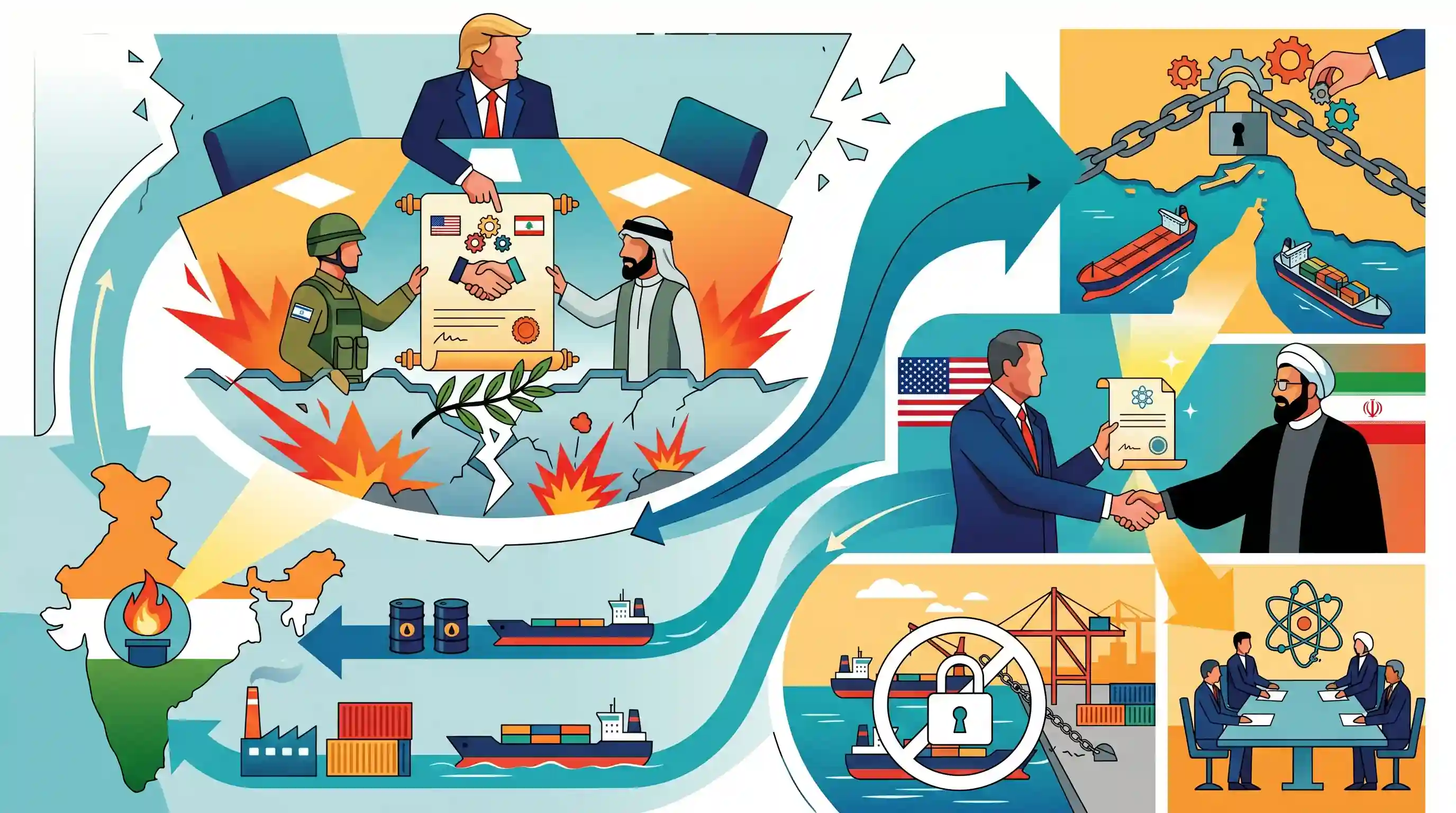
Understanding the interconnected nature of West Asian conflicts (Israel-Lebanon-Gaza) and U.S.-Iran relations is crucial for UPSC aspirants. It highlights how regional stability directly impacts global energy security, particularly concerning chokepoints like the Strait of Hormuz, which is vital for India's energy imports.
Summary
A delicate ceasefire agreement between Israel and Lebanon, heavily influenced by U.S. President-elect Donald Trump, provides temporary relief in West Asia but remains highly fragile due to ongoing Israeli operations in Gaza and southern Lebanon. The truce is intricately linked to broader U.S. geopolitical objectives, notably an effort to secure a preliminary agreement with Iran. By removing the obstacle of the Lebanese conflict, the U.S. hopes to finalize a Memorandum of Understanding with Iran to reopen the critical Strait of Hormuz and lift sanctions on Iranian ports, which could pave the way for renewed talks on Iran's nuclear program.
Key Points
- Israel and Lebanon reached a fragile ceasefire agreement influenced by U.S. President-elect Donald Trump, temporarily pausing hostilities with Hezbollah.
- The truce remains incomplete as Israel continues its bombardment of Gaza and maintains deep incursions into southern Lebanon.
- A major catalyst for the ceasefire was U.S. ambition to unblock negotiations with Iran, which had suspended talks in protest over the escalating war in Lebanon.
- The U.S. and Iran are negotiating an MoU to reopen the Strait of Hormuz to international shipping and lift the U.S. blockade on Iranian ports.
- This diplomatic maneuvering aims to set the stage for subsequent negotiations regarding Iran's controversial nuclear program.
Important Terms
Hezbollah

A Lebanon-based Shia militant group and political party founded in 1982 with Iranian support. It is a major military and political actor in West Asian geopolitics.
UPSC context
GS Paper II (International Relations). Tests knowledge of regional non-state actors and the Iran-Israel proxy conflict affecting India’s interests.
Strait of Hormuz
A narrow, strategic maritime chokepoint connecting the Persian Gulf and the Gulf of Oman, facilitating roughly 20-30% of the world’s daily oil trade.
UPSC context
GS Paper I (Geography) & II (Energy Security). Tests knowledge of maritime trade routes and India’s vulnerability to supply disruptions.
West Asia
A geopolitical region including the Middle East and Levant, critical for India's energy imports, trade corridors, and housing a 9 million-strong Indian diaspora.
UPSC context
GS Paper II (International Relations). Relates to India’s "Link West" policy and managing stability in the "extended neighborhood."
JCPOA (Iran Nuclear Deal)
The 2015 agreement between Iran and P5+1 powers to limit Iran’s nuclear program in exchange for lifting economic sanctions; currently fragile after U.S. withdrawal.
UPSC context
GS Paper II (International Agreements). Tests global non-proliferation dynamics and their impact on India’s strategic projects like Chabahar Port.
Memorandum of Understanding (MoU)
A formal, typically non-binding document outlining the intentions and preliminary terms of an agreement between parties before a final, legally enforceable contract is signed.
UPSC context
GS Paper II (Diplomacy/Governance). Tests understanding of diplomatic instruments and the process of building bilateral or multilateral cooperation.
Economic Sanctions
Coercive economic measures, such as trade restrictions or asset freezes, used to influence a state's behavior or enforce international norms without military force.
UPSC context
GS Paper II (International Relations). Tests how third-party sanctions impact India’s trade, energy security, and strategic autonomy.
Prelims Trap
"The Strait of Hormuz connects the Persian Gulf to the Red Sea."
Aspirants frequently confuse Middle Eastern maritime chokepoints. Hormuz connects the Persian Gulf to the Gulf of Oman, whereas Bab-el-Mandeb connects the Red Sea to the Gulf of Aden.
Static Concepts Connected
What are the key geographical markers of the Israel-Lebanon border conflict?
- Blue Line: A UN-demarcated line established in 2000 to confirm Israel's withdrawal from Lebanon. It acts as a de facto boundary, not a formally recognized international border.
- Litani River: Lebanon's longest river entirely within its borders. The area south of it serves as a critical, contested buffer zone governed by UN Security Council Resolution 1701.
- Shebaa Farms: A small, highly contested strip of land situated at the intersection of the Lebanon, Syria (Golan Heights), and Israel borders.
What are the vital maritime chokepoints in the Middle East?
- Strait of Hormuz: Connects the Persian Gulf to the Gulf of Oman and Arabian Sea. Bordered by Iran and Oman, it facilitates roughly 20% of global petroleum liquids transit.
- Bab-el-Mandeb: Connects the Red Sea to the Gulf of Aden. Bordered by Yemen on the Arabian Peninsula, and Djibouti and Eritrea in the Horn of Africa.
Cross-Topic Patterns
Iran sanctions and India's INSTC
Lifting U.S. sanctions on Iranian ports directly revitalizes India’s investments in Chabahar port, a critical connectivity node for the International North-South Transport Corridor (INSTC) bypassing Pakistan.
Nuclear diplomacy and Arab-Israeli relations
U.S. efforts to pacify the Iran-Hezbollah axis reflect a broader attempt to revive JCPOA-style nuclear negotiations while safeguarding Israel-Arab normalization frameworks like the Abraham Accords.

Expect a multi-statement Prelims question pairing Middle Eastern chokepoints (Hormuz) and buffer zones (Blue Line/Litani) with map logic.
Linked PYQs · 4
Linked PYQs · 4
- 2018MainsGS2
In what ways would the ongoing US-Iran Nuclear Pact Controversy affect the national interest of India? How should India respond to this situation?
- 2012MainsGS2
How have the US sanctions against Iran affected India's bilateral relations with Iran?
- 2025MainsGS2
"Energy security constitutes the dominant kingpin of India's foreign policy, and is linked with India's overarching influence in Middle Eastern countries.” How would you integrate energy security with India's foreign policy trajectories in the coming years?
- 2018MainsGS2
“India’s relations with Israel have, of late, acquired a depth and diversity, which cannot be rolled back.” Discuss.
