Integrating Internal Migrants into National Climate Policies
Source:The Hindu ↗
Why It Matters
The intersection of climate change, internal migration, and social protection is a critical emerging area for civil services. Understanding how climate policy must address the structural vulnerabilities of migrant labor is highly relevant for GS1 (Society/Migration), GS2 (Welfare/Governance), and GS3 (Environment/Disaster Management).
Summary
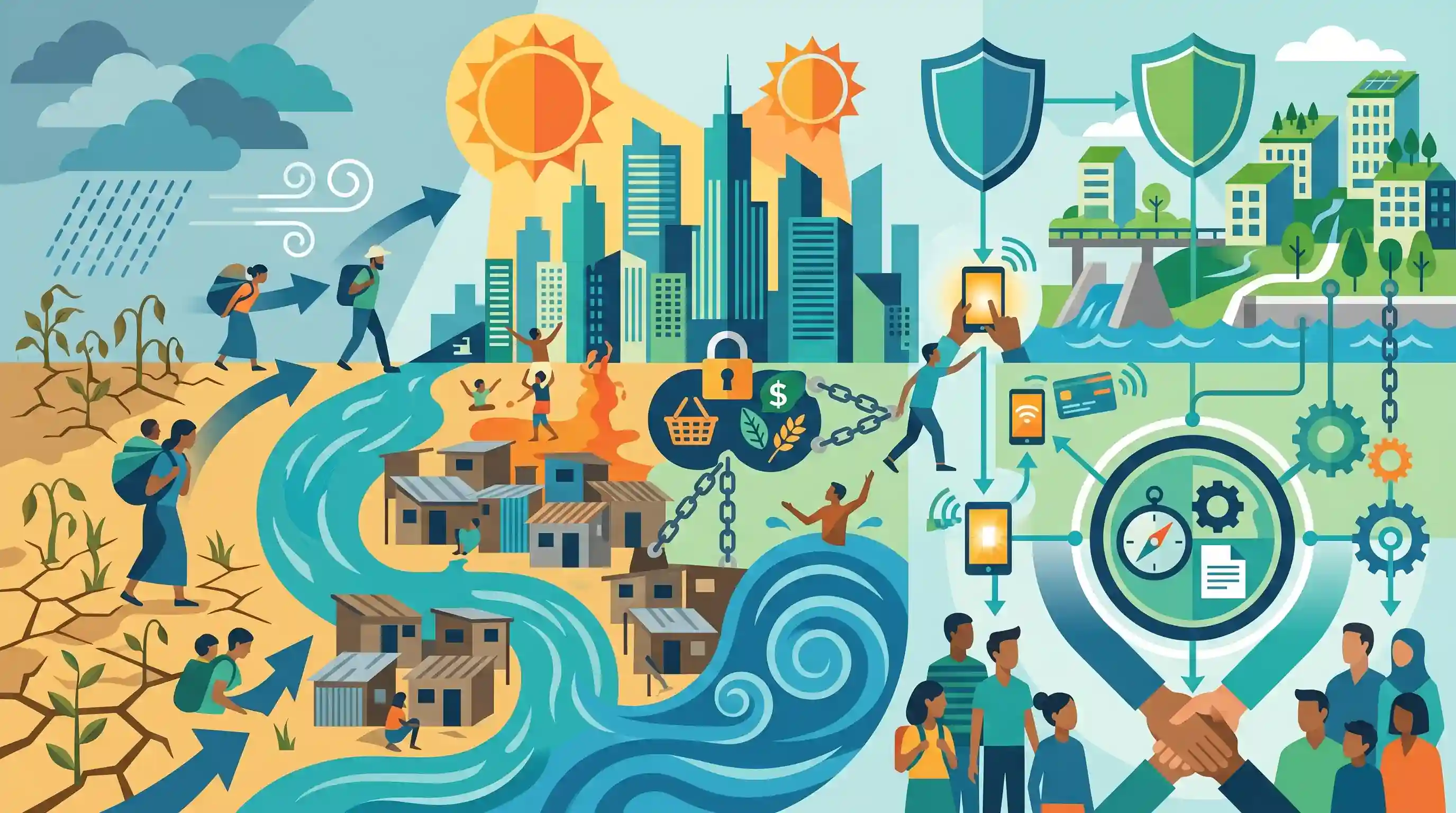
The article argues for the urgent integration of internal migrants into India's climate action frameworks. As climate change exacerbates distress migration, vulnerable populations move to urban areas where they often reside in informal, high-risk settlements exposed to extreme weather events like floods and heatwaves. Because social protection benefits are frequently geographically tied, migrants lack adequate safety nets during climate shocks. The piece advocates for portable welfare schemes, climate-resilient urban housing, and the explicit inclusion of migrant populations in State and National Action Plans on Climate Change to ensure inclusive adaptation strategies.
Key Points
- Climate change acts as a risk multiplier, accelerating both distress migration from rural/coastal areas and intensifying the vulnerability of migrants in urban destinations.
- Migrant workers often inhabit informal urban settlements that are highly susceptible to climate-induced disasters, such as extreme heatwaves and urban flooding.
- A critical policy gap exists wherein State Action Plans on Climate Change (SAPCC) and national frameworks inadequately account for the specific needs of internal migrants.
- Lack of portable social protection schemes exacerbates the marginalization of migrants during climate shocks, denying them safety nets like food security and healthcare.
- Effective climate policy must treat migration not merely as a failure of adaptation but as a strategic coping mechanism, requiring proactive integration into urban planning and disaster resilience frameworks.
Important Terms
National Action Plan on Climate Change (NAPCC)

Launched in 2008, it is India’s comprehensive strategy for climate adaptation and mitigation, comprising eight core national missions focusing on solar energy, water, agriculture, and sustainable habitats.
UPSC context
GS Paper III: Environment; tested for knowledge of India's institutional framework for addressing climate change.
State Action Plan on Climate Change (SAPCC)
Context-specific sub-national frameworks prepared by Indian states to address local climate vulnerabilities through regional adaptation and mitigation measures, aligned with the NAPCC.
UPSC context
GS Paper II/III: Governance and Environment; tests understanding of federal climate action and decentralized governance.
Distress Migration
Forced movement of people, often from rural to urban areas, triggered by the loss of livelihoods or safety due to environmental shocks like droughts or floods.
UPSC context
GS Paper I/II: Population and Social Justice; relevant for urbanization challenges and welfare for vulnerable sections.
Portable Welfare Schemes
Social protection programs that delink benefits from a fixed geographical location, allowing migrants to access entitlements like food or healthcare regardless of where they reside.
UPSC context
GS Paper II: Social Justice; tests knowledge of welfare initiatives and governance reforms to protect mobile populations.
Climate-resilient Urban Housing
Housing infrastructure designed with materials and layouts to withstand extreme weather events such as urban flooding and heatwaves through sustainable and adaptive architectural choices.
UPSC context
GS Paper III: Disaster Management and Urbanization; focuses on sustainable infrastructure and mitigating urban risks.
Prelims Trap
"The National Action Plan on Climate Change (NAPCC) includes a dedicated national mission for climate-induced internal migration."
India's NAPCC features original missions (Solar, Habitat, Water, etc.), but none explicitly address internal climate migrants. Migration remains largely absent from current climate frameworks.
Static Concepts Connected
What are the 8 original missions under the NAPCC?
- Solar & Energy: National Solar Mission and National Mission for Enhanced Energy Efficiency.
- Habitat & Water: National Mission on Sustainable Habitat and National Water Mission.
- Ecosystem & Agriculture: National Mission for Sustaining the Himalayan Ecosystem, Green India, and Sustainable Agriculture.
- Strategic Knowledge: National Mission on Strategic Knowledge for Climate Change.
How does the ONORC scheme enable nationwide welfare portability?
- Biometric Authentication: Relies on Aadhaar seeding and electronic Point of Sale (ePoS) devices at Fair Price Shops for beneficiary verification.
- Centralized IT Portals: Uses the Annavitran portal for intra-state and the IM-PDS portal for inter-state portability of foodgrain distribution.
- Universal Entitlement: Ensures beneficiaries under the National Food Security Act (NFSA) can claim their entitled rations anywhere in India.
Cross-Topic Patterns
Urban Heat Islands + Informal settlements
Migrants in urban slums face a "double vulnerability" as concrete density and lack of green cover amplify heatwaves, linking distress migration directly to Urban Heat Island (UHI) mitigation strategies.
Labor codes + Climate-induced displacement
While the Occupational Safety Code absorbs older migrant labor laws, climate-driven displacement challenges standard definitions of "migrant worker," pushing the need for climate-resilient welfare portability like ONORC.

Expect a GS-3 Mains question directly linking climate-induced distress migration to urban infrastructure failures (floods/heat) in 2026.
Linked PYQs · 4
Linked PYQs · 4
- 2024MainsGS1
Why do large cities tend to attract more migrants than smaller towns? Discuss in the light of conditions in developing countries.
- 2023MainsGS1
Does urbanization lead to more segregation and/or marginalization of the poor in Indian metropolises?
- 2019MainsGS2
Performance of welfare schemes that are implemented for vulnerable sections is not so effective due to absence of their awareness and active involvement at all stages of policy process. Discuss.
- 2024MainsGS3
Flooding in urban areas is an emerging climate-induced disaster. Discuss the causes of this disaster. Mention the features of two such major floods in the last two decades in India. Describe the policies and frameworks in India that aim at tackling such floods.
