PM launches HPV Vaccination Campaign and Development Projects
Source:The Hindu ↗
Why It Matters
While primarily a political speech, the article contains critical governance and security markers for UPSC aspirants. The launch of the HPV vaccination campaign is highly relevant to GS2 (Health) concerning disease prevention. Mentions of OROP link to armed forces welfare (GS2). Additionally, the political rhetoric draws upon significant internal security themes (Maoism/LWE under GS3) and historical entities (Muslim League under GS1), which are recurring topics in UPSC examinations.
Summary
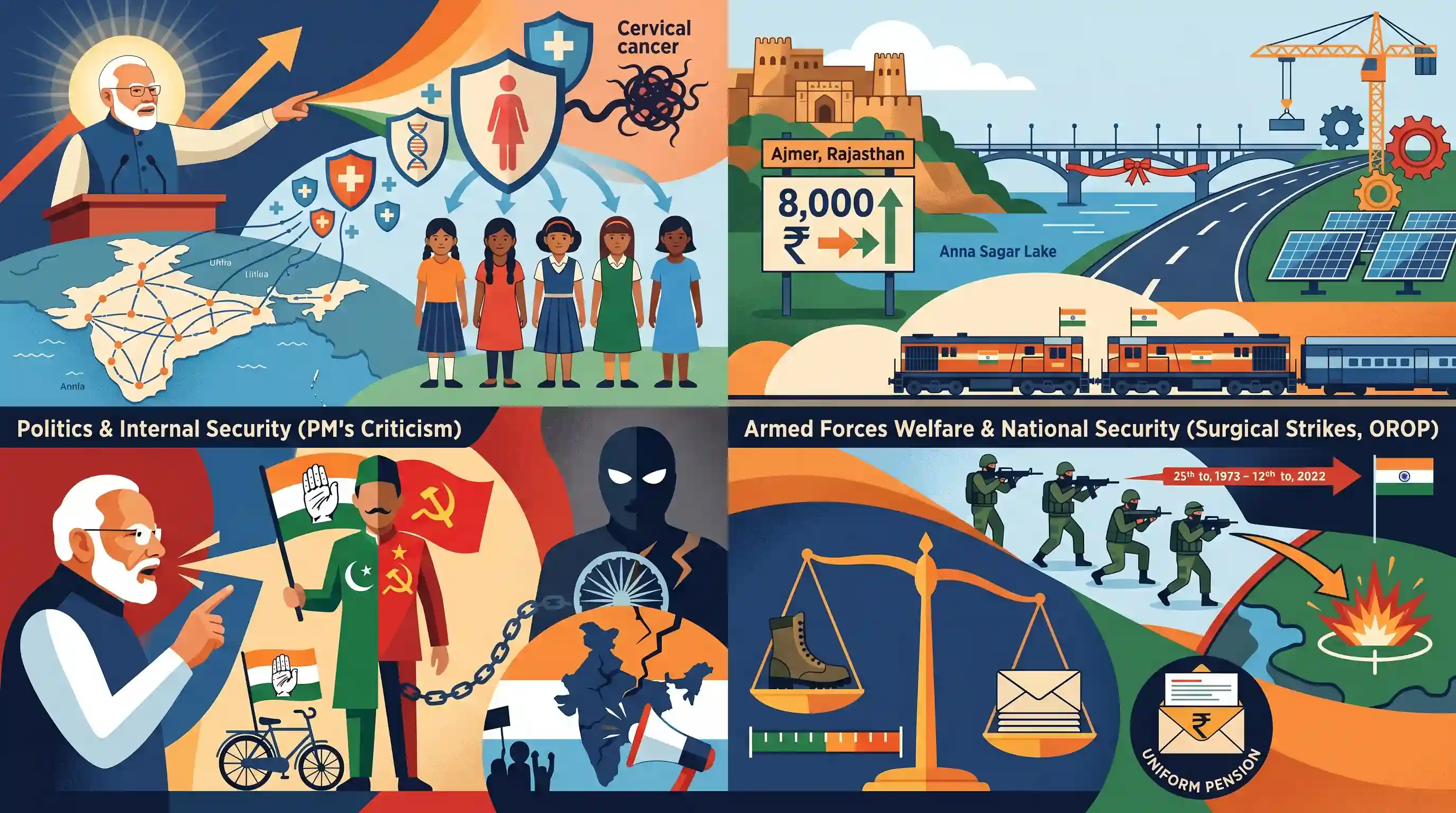
Prime Minister Narendra Modi launched a nationwide Human Papillomavirus (HPV) vaccination campaign targeting 14-year-old girls to prevent cervical cancer, alongside ₹8,000 crore worth of infrastructure projects in Ajmer, Rajasthan. During the event, the PM severely criticized the Indian National Congress (INC), labeling it a 'Muslim League-Maoist Congress' and accusing it of aligning with anti-national elements to defame the country. He underscored his government's commitment to national security and armed forces welfare by highlighting the successful implementation of the One Rank One Pension (OROP) scheme and previous surgical strikes.
Key Points
- PM Narendra Modi launched an immunization campaign in Ajmer, Rajasthan, to provide Human Papillomavirus (HPV) vaccines to adolescent girls aged 14 to combat cervical cancer.
- The PM inaugurated various development projects worth ₹8,000 crore, covering drinking water, national highways, and railway electrification.
- In a sharp political attack, the PM referred to the Indian National Congress as the 'Muslim League-Maoist Congress', alleging the party attempts to defame India on global platforms.
- The speech highlighted government achievements such as the implementation of the One Rank One Pension (OROP) scheme and cross-border surgical strikes, contrasting them with the opposition's stance on national security.
Important Terms
One Rank One Pension (OROP)

The payment of a uniform pension to military personnel retiring at the same rank with the same length of service, irrespective of their date of retirement.
UPSC context
GS-2/GS-3: Welfare schemes for vulnerable sections and security/defense personnel management.
Human Papillomavirus (HPV)
A group of viruses that cause various conditions; high-risk strains (specifically types 16 and 18) are the primary cause of cervical cancer.
UPSC context
GS-2/GS-3: Issues relating to health and science & technology developments.
Cervical Cancer
A preventable cancer in the cervix caused by persistent high-risk HPV infection; it is a leading cause of cancer deaths among Indian women.
UPSC context
GS-2: Social sector/Health; tests knowledge of disease burden and public health interventions.
Maoists
Armed insurgents (also called Naxalites) following Mao Zedong's ideology who seek to overthrow the state through protracted guerrilla warfare.
UPSC context
GS-3: Internal security challenges and the role of non-state actors in Left-Wing Extremism (LWE).
All India Muslim League
A political party established in 1906 that advocated for Muslim interests in British India, ultimately leading the movement for Pakistan's creation.
UPSC context
GS-1: Modern Indian History; tests understanding of the freedom struggle and communal politics.
Prelims Trap
"The Human Papillomavirus (HPV) vaccine is administered to infants under the Universal Immunization Programme."
HPV vaccines are administered to adolescent girls (typically 9-14 years) prior to potential exposure, unlike most standard UIP vaccines given during infancy.
Static Concepts Connected
What is the mechanism and target of HPV vaccines in India?
- Target Disease: Protects against high-risk Human Papillomavirus strains (primarily 16 & 18) which are responsible for nearly 70% of global cervical cancer cases.
- VLP Technology: Uses Virus-Like Particles (VLPs) which are recombinant, non-infectious, and lack viral DNA, making the immunization highly safe without the risk of disease.
- Indigenous Development: 'Cervavac', developed by the Serum Institute of India (SII) with DBT support, is India's first indigenous quadrivalent HPV vaccine.
How was the All India Muslim League founded and what were its initial goals?
- Formation: Founded in 1906 in Dhaka by prominent leaders including Nawab Salimullah, Aga Khan, and Mohsin-ul-Mulk.
- Core Demand: Advocated for separate electorates for Muslims, a demand successfully realized in the 1909 Morley-Minto Reforms.
- Initial Objective: Initially aimed to foster loyalty to the British government while protecting and advancing Muslim political rights in British India.
Cross-Topic Patterns
Women's Health & Demographic Dividend
The nationwide HPV vaccine rollout directly links preventive public health to women's economic participation, as reducing the immense cervical cancer burden is crucial to maximizing the female demographic dividend.
Ideological Extremism vs State Stability
Political rhetoric often conflates distinct historical threats; UPSC expects you to distinguish between religious communalism (Muslim League) and left-wing ideological armed insurgency (Maoism) regarding state stability.

Expect a multi-statement question on indigenous vaccines like Cervavac, focusing on Virus-Like Particle (VLP) technology and HPV strains.
Linked PYQs · 5
Linked PYQs · 5
- 2022MainsGS3
Naxalism is a social, economic and developmental issue manifesting as a violent internal security threat. In this context, discuss the emerging issues and suggest a multilayered strategy to tackle the menace of Naxalism.
- 2020MainsGS3
What are the determinants of left-wing extremism in Eastern part of India? What strategy should Government of India, civil administration and security forces adopt to counter the threat in the affected areas?
- 2022MainsGS3
The increase in life expectancy in the country has led to newer health challenges in the community. What are those challenges and what steps need to be taken to meet them?
- 2013PrelimsGS1
With reference to Indian History, the Members of the Constituent Assembly from the Provinces were
- 2014PrelimsGS1
The Partition of Bengal made by Lord Curzon in 1905 lasted until
