Integrating ancient Indic philosophy into modern public administration
Source:Indian Express ↗
Why It Matters
This provides critical fodder for GS Paper 4 (Ethics) regarding the philosophical basis of governance and the contributions of Indian moral thinkers. It also offers unique perspectives for GS Paper 2 (Governance) and Essays on integrating civilizational values with modern democracy.
Summary
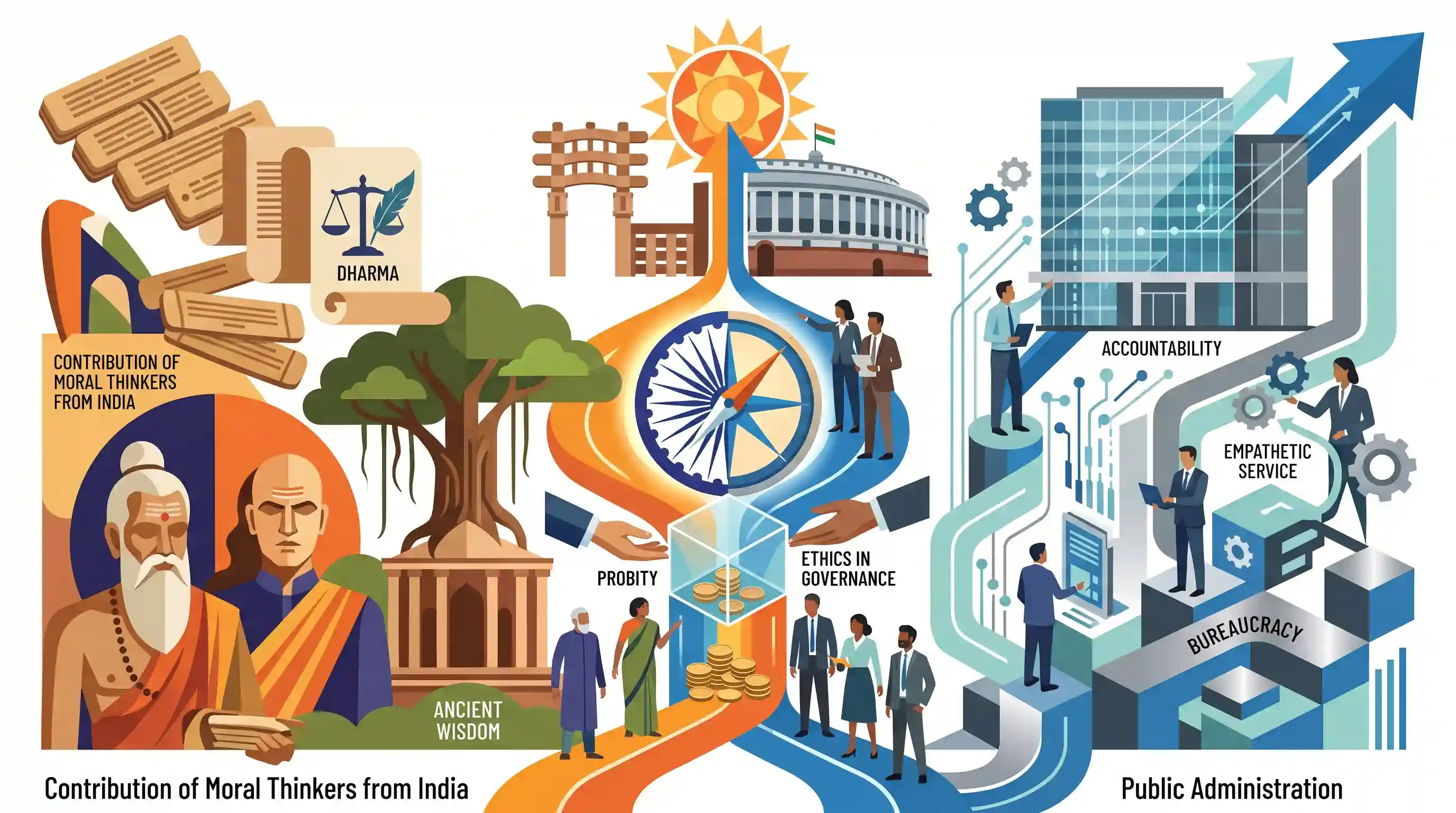
The article discusses the potential of integrating ancient Indic philosophies and civilizational wisdom into modern governance frameworks. It argues that principles derived from traditional texts, such as Kautilya's Arthashastra and the concept of 'Dharma' (righteousness and duty), offer valuable ethical guidance for contemporary public administration. By balancing modern institutional mechanisms with indigenous moral thought, the piece suggests that India can develop a more accountable, empathetic, and culturally rooted model of good governance. This synthesis of "the old and the new" is presented as a pathway to improving probity and ethical decision-making within the bureaucracy.
Key Points
- Advocates for the integration of traditional Indic wisdom and philosophical thought into modern administrative and governance frameworks.
- Highlights the contemporary relevance of Kautilya's 'Arthashastra' for prioritizing citizen welfare, accountability, and robust statecraft.
- Emphasizes the role of 'Dharma' (righteous duty) as an ethical compass for civil servants to maintain integrity and probity.
- Argues that blending modern institutional mechanics with India's civilizational ethos can foster a more empathetic and accountable bureaucracy.
- Suggests that indigenous concepts of justice and administration can aid in designing a holistic 'Code of Ethics' for public servants.
Prelims Trap
Kautilya's concept of Dharma and Ashoka's Dhamma represent identical pacifist approaches to ancient Indian statecraft.
Ashokan Dhamma focuses on broad social harmony and pacifism, while Kautilya's Dharma encompasses practical statecraft, realpolitik, and Rajadharma, which strictly permits force for state protection.
Static Concepts Connected
What differentiates a Code of Ethics from a Code of Conduct in public administration?
- Code of Ethics: Broad, value-based guidelines (e.g., empathy, integrity) serving as a moral compass. Usually aspirational and not strictly legally enforceable.
- Code of Conduct: Specific, rule-based directives (e.g., asset declaration, refusing gifts) governing actual behavior. Legally enforceable with concrete penalties for violation.
How does Kautilya's Arthashastra define the principle of 'Yogakshema' in governance?
- Core Meaning: Translates directly to the welfare, security, and prosperity of the people, framing statecraft fundamentally as a tool for public good rather than personal power.
- Ruler's Duty: Enshrined in the maxim 'Prajasukhe sukham rajnah'—in the happiness of the subjects lies the ruler's happiness, deeply mirroring modern welfare-state ideals.
Cross-Topic Patterns
Ancient statecraft + GS4 Probity
UPSC frequently links ancient texts like Arthashastra or Thirukkural with modern civil service values, emphasizing that governance ethics are not purely Western imports.
Constitutional Morality + Rajadharma
The Supreme Court often invokes 'Rajadharma' as a civilizational parallel to constitutional morality, highlighting an administrator's absolute duty to impartial justice and citizen welfare.

Expect a GS-4 Mains question comparing Kautilya’s 'Yogakshema' with Western public life frameworks like the Nolan principles.
Linked PYQs · 2
Linked PYQs · 2
- 2024MainsGS4
“The 'Code of Conduct' and 'Code of Ethics' are the sources of guidance in public administration. There is code of conduct already in operation, whereas code of ethics is not yet put in place. Suggest a suitable model for code of ethics to maintain integrity, probity and transparency in governance.”
- 2024MainsGS2
The Doctrine of Democratic Governance makes it necessary that the public perception of the integrity and commitment of civil servants becomes absolutely positive. Discuss.
