Criminalization of Politics and Institutional Failure in West Bengal
Source:Indian Express ↗
Why It Matters
The article offers a compelling case study on the intersection of gender-based violence, political patronage, and institutional failure. It is highly relevant for GS-1 (Society: issues related to women), GS-2 (Governance: institutional frameworks, criminalization of politics), and GS-4 (Ethics: impunity and probity in governance).
Summary
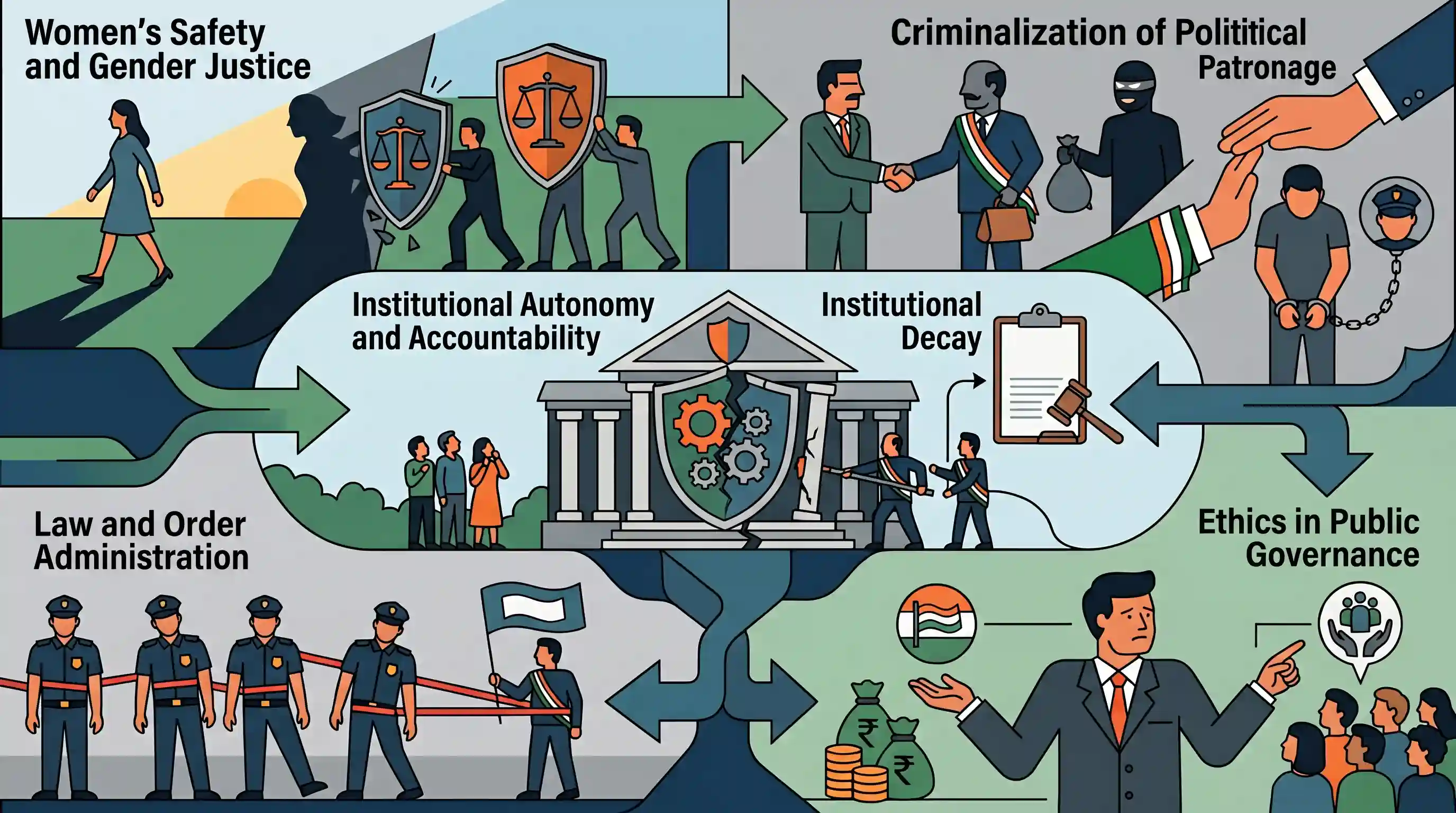
A recent editorial discusses the systemic crisis of women's safety and institutional decay in West Bengal, following consecutive instances of gender-based violence in educational and medical institutions. It highlights how crimes are often politicized, with political patronage shielding the accused and undermining law and order. Institutional safeguards, such as Internal Complaints Committees (ICCs), are rendered ineffective by partisan influence. The editorial calls for the state government to move beyond political defensive posturing, confront the culture of impunity, and undertake structural reforms to rebuild credible institutional guardrails for citizens' safety.
Key Points
- The alleged rape of a 24-year-old student at South Calcutta Law College highlights the ongoing crisis of women's safety in West Bengal.
- The incident follows the horrific rape and murder at RG Kar Medical College, exposing the systemic vulnerabilities in institutional spaces across the state.
- Crimes are increasingly hijacked by partisan politics, with accused individuals often leveraging affiliations with student political wings like the Trinamool Chhatra Parishad for patronage and impunity.
- Institutional safeguards, such as Internal Complaints Committees, are rendered largely performative due to political interference and a lack of functional autonomy.
- The editorial urges the state government to abandon conspiracy narratives, confront the entrenched culture of impunity, and rebuild robust institutional guardrails to ensure justice and safety.
Important Terms
RG Kar Medical College and Hospital

A premier state-run medical institution in Kolkata, recently the site of a brutal 2024 rape-murder case that triggered nationwide protests and highlighted institutional safety failures.
UPSC context
GS Paper 2: Governance, Health; GS Paper 4: Ethics. Used as a case study for institutional accountability and public outcry against administrative decay.
Internal Complaints Committees (ICCs)
Mandatory statutory bodies established under the POSH Act, 2013, to receive and redress complaints of sexual harassment in workplaces with ten or more employees.
UPSC context
GS Paper 1: Social Empowerment; GS Paper 2: Statutory/Regulatory Bodies. Tests knowledge of legal mechanisms for women's protection and their implementation challenges.
Trinamool Chhatra Parishad (TMCP)
The student wing of the All India Trinamool Congress (TMC), influential in West Bengal’s educational institutions and often cited in debates regarding politicization of campus administration.
UPSC context
GS Paper 2: Political Parties and Pressure Groups. Relevant for understanding the role of student organizations in state governance and criminalization of politics.
South Calcutta Law College
A prominent educational institution in Kolkata that became a focal point of public anger following a 2025 gang-rape incident involving individuals with alleged political patronage.
UPSC context
GS Paper 4: Ethics and Human Interface. Serves as a case study for the breakdown of safety protocols and political interference in educational institutions.
Trinamool Congress (TMC)
The ruling political party in West Bengal since 2011, led by Mamata Banerjee; currently under scrutiny for institutional accountability and the handling of gender-based violence cases.
UPSC context
GS Paper 2: Federalism, State Governance, and Electoral Politics. Important for analyzing the impact of dominant-party systems on law and order administration.
Criminalization of Politics
The infiltration of criminal elements into the political system, where political power is allegedly used to provide immunity to perpetrators and subvert legal processes.
UPSC context
GS Paper 2: Salient features of the RPA, 1951; Governance. A core theme regarding electoral reforms and the integrity of democratic institutions.
Prelims Trap
"Internal Complaints Committees (ICCs) under the PoSH Act hold criminal jurisdiction and can award sentences to offenders."
ICCs possess powers of a civil court for inquiry (summoning, evidence gathering) but cannot issue criminal sentences; they recommend departmental action and facilitate FIRs.
Static Concepts Connected
What are the statutory powers and composition of ICCs under the PoSH Act, 2013?
- Civil Court powers: The ICC has the same powers as a civil court under the Code of Civil Procedure for summoning witnesses and demanding document discovery.
- Composition mandate: Must have a Presiding Officer (senior female employee), not less than two employee members, and one external member (NGO/legal expert), with 50% women overall.
- Applicability threshold: An ICC must be constituted by an employer at every workplace with 10 or more employees. Organizations with fewer employees fall under the Local Complaints Committee (LCC).
Which landmark judicial interventions address the criminalisation of politics and institutional autonomy?
- Lily Thomas (2013): Struck down Section 8(4) of the Representation of the People Act, ensuring automatic disqualification of lawmakers upon conviction leading to a sentence of two or more years.
- Prakash Singh (2006): Mandated police reforms, including State Security Commissions and fixed tenures for police chiefs, to insulate law enforcement from partisan political pressure.
Cross-Topic Patterns
PoSH Act + GS4 Work Culture
The politicization of statutory bodies highlights the critical gap between legal mandates and actual administrative ethics, forming a classic framework for GS4 case studies.
Gender Violence + Police Reforms
Shielding perpetrators through political patronage connects the Prakash Singh directives on operational police autonomy directly to the grassroots crisis in gender violence response.

Expect a GS2 question in 2026 assessing why statutory safeguards like the PoSH Act fail without administrative ethics and police autonomy.
Linked PYQs · 4
Linked PYQs · 4
- 2014MainsGS1
How does patriarchy impact the position of a middle class working woman in India?
- 2020MainsGS2
Institutional quality is a crucial driver of economic performance". In this context suggest reforms in Civil Service for strengthening democracy.
- 2024MainsGS4
“The 'Code of Conduct' and 'Code of Ethics' are the sources of guidance in public administration. There is code of conduct already in operation, whereas code of ethics is not yet put in place. Suggest a suitable model for code of ethics to maintain integrity, probity and transparency in governance.”
- 2025MainsGS2
Discuss the 'corrupt practices' for the purpose of the Representation of the People Act, 1951. Analyze whether the increase in the assets of the legislators and/or their associates, disproportionate to their known sources of income, would constitute 'undue influence' and consequently a corrupt practice.
