India West Asia diplomacy shifts to pragmatic multi-alignment
Source:Indian Express ↗
Why It Matters
West Asia is deeply intertwined with India's core national interests, including energy security, maritime trade, and the welfare of a large diaspora. Understanding India's diplomatic evolution from non-alignment to pragmatic multi-alignment in this volatile region is a high-yield topic for Mains GS2 (International Relations).
Summary
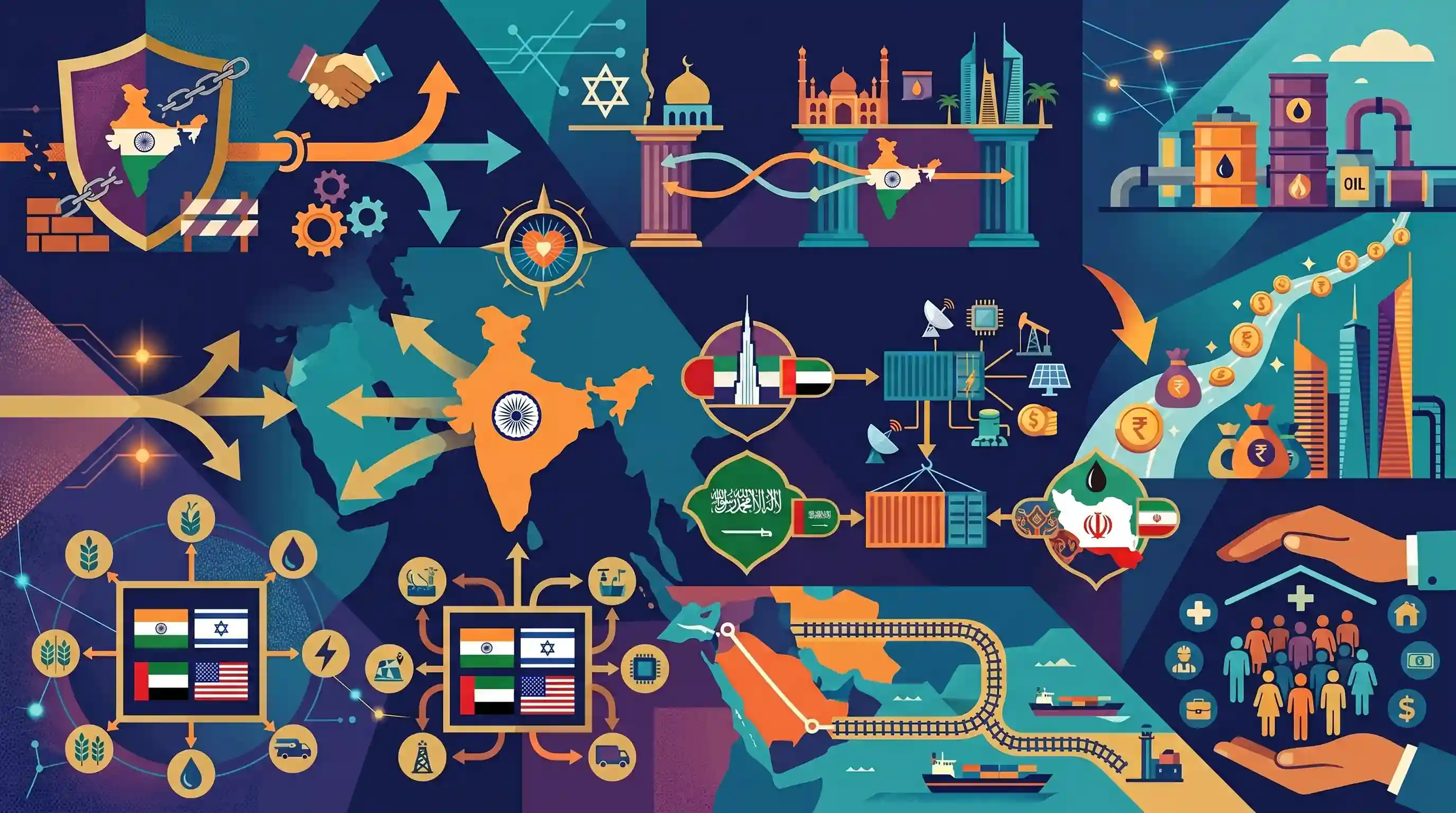
The article highlights the dramatic success of India's recent diplomatic strategies in West Asia, illustrating a shift from cautious ideological posturing to pragmatic, multi-aligned engagement. By abandoning historical constraints, India has successfully navigated severe regional fault lines—such as the Arab-Israeli conflict and the Iran-Saudi rivalry—to forge deep strategic partnerships across the board. Key achievements include the 'de-hyphenation' of Israel and Palestine, upgrading ties with the UAE and Saudi Arabia from transactional trade to comprehensive strategic and economic partnerships, and maintaining a vital link with Iran. Furthermore, India's proactive role in novel frameworks like the I2U2 and the India-Middle East-Europe Economic Corridor (IMEEC) positions it as an indispensable economic and security partner in the region. This dynamic 'Look West' approach ultimately secures India's critical energy needs, attracts massive Gulf investments, and safeguards the welfare of millions of Indian expatriates.
Key Points
- De-hyphenation Policy: India has successfully decoupled its relationship with Israel from its historic stance on Palestine and ties with the Arab world, allowing it to independently maximize bilateral partnerships.
- Strengthened Gulf Ties: Strategic relations with regional heavyweights like the UAE and Saudi Arabia have evolved beyond traditional energy trade and diaspora remittances to include technology, defense, and sovereign wealth investments.
- Pragmatic Multi-alignment: New Delhi has managed to balance complex regional fault lines, maintaining robust ties simultaneously with Iran, Israel, and Saudi Arabia despite their mutual rivalries.
- Minilateral Formations: India's participation in new frameworks like the I2U2 grouping and the proposed India-Middle East-Europe Economic Corridor (IMEEC) solidifies its role as a key geopolitical anchor in trans-regional connectivity.
- Energy and Economic Security: The Middle East remains the foundational pillar of India's energy security, with diplomatic efforts directly securing reliable oil supplies and safeguarding the interests of the massive Indian diaspora.
Important Terms
India-Middle East-Europe Economic Corridor (IMEEC)

A multimodal infrastructure project connecting India to Europe via the Arabian Gulf through ship and rail networks, aiming for economic integration and secure supply chains.
UPSC context
GS Paper II (IR) — Key connectivity project, strategic counter to China’s BRI, and integration with the G7-led PGII initiative.
Abraham Accords
US-brokered normalization agreements signed in 2020 between Israel and several Arab states (UAE, Bahrain, Sudan, Morocco) to establish full diplomatic relations and promote regional economic cooperation.
UPSC context
GS Paper II (IR) — Significant shift in West Asian geopolitics allowing India to deepen ties with both Arab nations and Israel simultaneously.
International North-South Transport Corridor (INSTC)
A 7,200 km multi-mode network of ship, rail, and road routes connecting India to Russia and Europe via Iran, significantly reducing transit time and costs.
UPSC context
GS Paper II (IR) — Strategic connectivity bypassing Pakistan, vital for energy security and deepening trade links with Central Asian republics and Russia.
I2U2
A minilateral grouping comprising India, Israel, the UAE, and the US, focusing on joint investments in water, energy, transportation, space, health, and food security.
UPSC context
GS Paper II (IR) — Termed the “West Asian Quad,” it reflects India’s shift toward geoeconomic partnerships and multi-aligned diplomacy in the Middle East.
Organisation of Islamic Cooperation (OIC)
An international organization of 57 member states aiming to be the collective voice of the Muslim world, safeguarding Islamic interests while promoting peace and harmony.
UPSC context
GS Paper II (IR) — Important for India’s relations with the Islamic world, especially regarding the Kashmir issue and protecting its large expatriate diaspora.
Prelims Trap
The I2U2 grouping serves as a maritime security and defense framework for the Middle East.
I2U2 is strictly an economic grouping focused on joint investments in six civilian areas (water, energy, transport, space, health, food security), lacking a defense mandate.
Static Concepts Connected
What distinguishes the geographic routing and strategy of IMEEC from INSTC?
- IMEEC Routing: Connects India to Europe via UAE, Saudi Arabia, Jordan, Israel, and the Mediterranean, bypassing Iran.
- INSTC Routing: Connects India to Russia and Europe via Iran (Chabahar port) and the Caucasus, avoiding the Suez Canal.
- Strategic Underpinning: IMEEC leverages Arab-Israeli normalization (Abraham Accords), whereas INSTC relies on the traditional India-Iran-Russia partnership.
What is India's 'De-hyphenation' policy regarding Israel and Palestine?
- Independent Engagement: Treating relations with Israel and Palestine as mutually exclusive and independent, ending the zero-sum approach.
- Standalone Diplomacy: High-level diplomatic visits to Israel are no longer automatically clubbed with visits to Ramallah (Palestine).
- Unchanged Core Stance: Despite deeper defense/tech ties with Israel, India continues to officially back a negotiated Two-State solution.
Cross-Topic Patterns
Gulf Remittances & BoP
India's massive crude oil import bill is structurally buffered by incoming diaspora remittances from the Gulf, stabilizing the Current Account.
Abraham Accords & IMEEC
IMEEC's geographic viability directly rides on the Abraham Accords, demonstrating how regional diplomatic normalization enables trans-continental infrastructure projects.

Expect a 2026 multi-statement Prelims question contrasting IMEEC/INSTC routes, or a Mains question on 'multi-alignment' in West Asia.
Linked PYQs · 5
Linked PYQs · 5
- 2025MainsGS2
"Energy security constitutes the dominant kingpin of India's foreign policy, and is linked with India's overarching influence in Middle Eastern countries.” How would you integrate energy security with India's foreign policy trajectories in the coming years?
- 2018MainsGS2
“India’s relations with Israel have, of late, acquired a depth and diversity, which cannot be rolled back.” Discuss.
- 2017MainsGS2
The question of India's Energy Security constitutes the most important part of India's economic progress. Analyze India's energy policy cooperation with West Asian countries.
- 2025PrelimsGS1
India is one of the founding members of the International North-South Transport Corridor (INSTC), a multimodal transportation corridor, which will connect
- 2025PrelimsGS1
Consider the following countries : I. United Arab Emirates II. France III. Germany IV. Singapore V. Bangladesh How many countries amongst the above are there other than India where international merchant payments are accepted under UPI?
