Vidisha Model KVK Foundation Laid for Organic Farming and Research
Source:global-agriculture ↗
Why It Matters
This event highlights Madhya Pradesh's central role in India's agricultural extension systems. The focus on reducing chemical fertilizers, establishing digital 'Agri Clinics', and boosting pulse/oilseed self-reliance aligns closely with state-level development goals and core economic geography topics often tested in State Services.
Summary
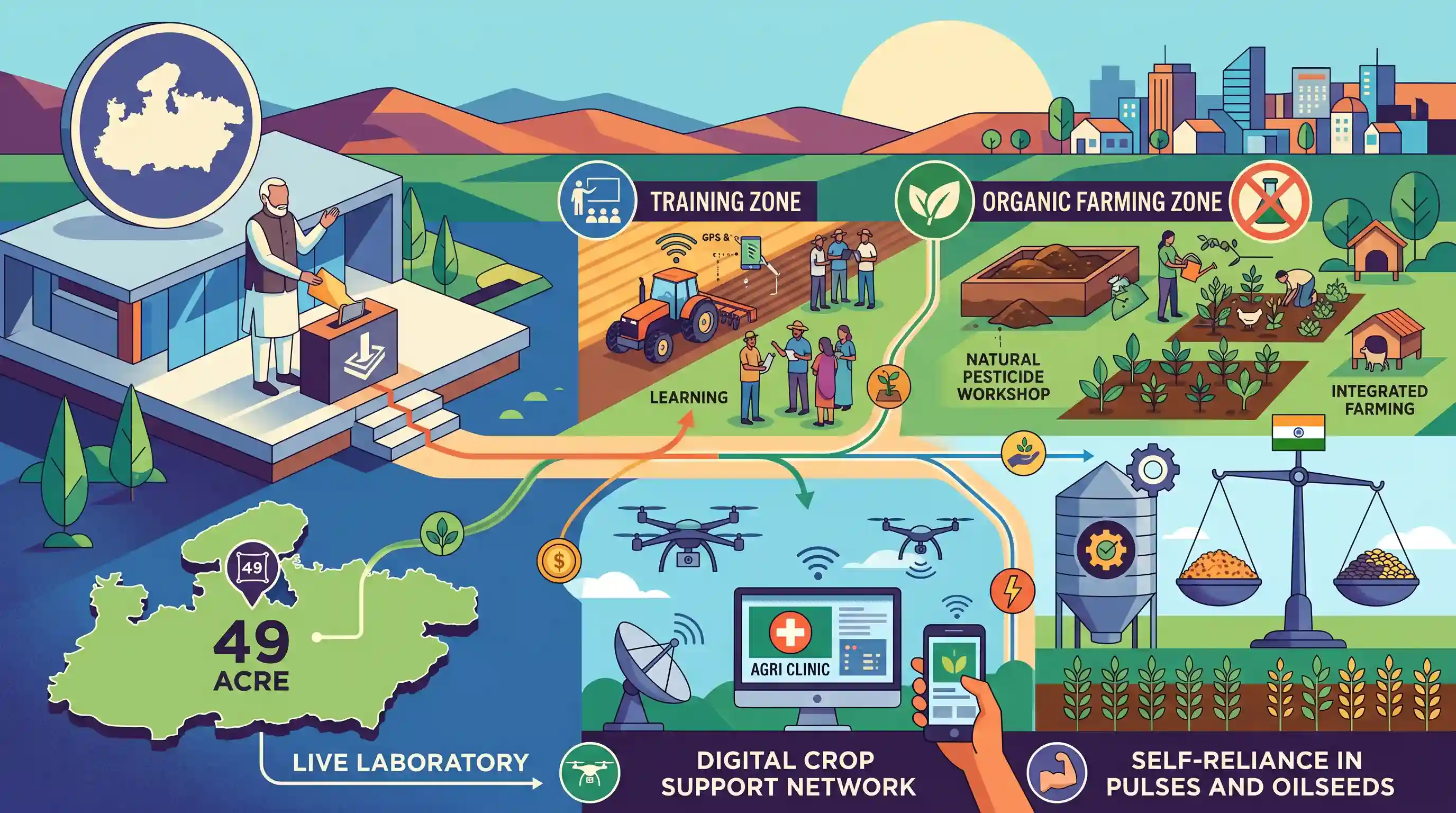
Union Minister of Agriculture and Farmers' Welfare Shri Shivraj Singh Chouhan laid the foundation for a state-of-the-art model Krishi Vigyan Kendra (KVK) in Berkhedi Jetu, Vidisha, Madhya Pradesh. Spanning 49 acres, this KVK will function as a 'live laboratory' to train farmers in modern agricultural techniques, promote organic farming, establish digital crop support networks like Agri Clinics, and drive India's mission toward self-reliance in pulses and oilseeds.
Key Points
- Union Agriculture Minister Shivraj Singh Chouhan performed the foundation stone laying ceremony ('Bhumi Pujan') for a model Krishi Vigyan Kendra (KVK) at Berkhedi Jetu in Vidisha, Madhya Pradesh.
- The model KVK will cover 49 acres and act as a 'live laboratory' or 'school for farmers', demonstrating practical agricultural practices starting from the current Kharif season.
- The KVK is designed to bridge the gap between research and fields, translating scientific work from 113 ICAR institutes and 1,700+ KVK scientists directly to local farmers.
- Key initiatives announced include a 'Khet Bachao Abhiyan' (Save the Field Campaign) to limit chemical fertilizer usage, establishment of 'Agri Clinics' (crop hospitals), custom hiring centres for farm machinery, and a national helpline (155261).
- To boost pulses and oilseed cultivation (pigeon pea, gram, lentil, black gram, sesame), the government is expanding missions and offering up to ₹25 lakh subsidy for setting up dal (pulse) mills.
Important Terms
Krishi Vigyan Kendra

A district-level agricultural extension center established by ICAR to bridge the gap between scientific research and farmers through localized training, technology demonstrations, and farm advisory services.
UPSC context
GS Paper III (Agriculture). Tests knowledge of agricultural extension systems, technology transfer, and institutional support to boost farm productivity.
Indian Council of Agricultural Research
An autonomous apex organization under the Ministry of Agriculture and Farmers Welfare responsible for coordinating, guiding, and managing research and education in agriculture, horticulture, fisheries, and animal sciences in India.
UPSC context
GS Paper III (Agriculture/Science & Tech). Tests understanding of India's premier institutional framework for agricultural research, innovation, and food security.
Khet Bachao Abhiyan
A month-long nationwide agricultural awareness campaign launched in June 2026 to promote soil health conservation, balanced fertilizer usage, natural farming practices, and scientific crop management to protect farmland from degradation.
UPSC context
GS Paper III (Agriculture/Environment). Tests awareness of soil conservation initiatives, sustainable farming methods, and government policies reducing chemical input dependency.
Self-Reliance in Pulses Mission
A centrally sponsored scheme (Mission for Aatmanirbharta in Pulses) launched in 2025 to achieve complete domestic self-sufficiency in pulses by 2030-31 through productivity enhancement, area expansion, and assured procurement.
UPSC context
GS Paper III (Agriculture/Food Security). Tests understanding of cropping patterns, crop diversification, import substitution policies, and nutritional security strategies.
Bharat Vistaar - Kisan Sarathi
A digital agricultural extension ecosystem integrating Bharat VISTAAR (AI-driven multilingual Digital Public Infrastructure) with the Kisan Sarathi platform, enabling real-time, voice-enabled, scientific advisories and direct farmer-to-expert consultation in regional languages.
UPSC context
GS Paper III (E-technology in aid of farmers). Tests knowledge of digital public infrastructure (DPI) in agriculture, AI applications, and ICT-led extension services.
Soil Health Card Scheme
A scheme launched in 2015 to issue soil health cards to farmers, assessing 12 soil parameters every two years and recommending customized, balanced dosages of chemical and organic fertilizers.
UPSC context
GS Paper III (Agriculture). Tests understanding of soil nutrient management, sustainable farming inputs, and policies targeting balanced fertilizer consumption.
Prelims Trap
Krishi Vigyan Kendras (KVKs) are fully funded and administratively run exclusively by State Agricultural Universities.
KVKs are 100% funded by the Central Government (ICAR), though their host institutions can be State Agricultural Universities, NGOs, or ICAR institutes.
Static Concepts Connected
What is the origin, funding, and official mandate of Krishi Vigyan Kendras (KVKs)?
- Origin & Committee: Formulated by Dr. Mohan Singh Mehta Committee (1973), with the first pilot KVK established in Puducherry in 1974.
- Funding Structure: 100% financed by the Central Government through the Indian Council of Agricultural Research (ICAR).
- Core Mandate: Focuses on 'Technology Assessment and Demonstration for its Application and Capacity Development' (TADACD) via on-farm testing.
What is the ACABC Scheme and how does it support rural entrepreneurship?
- Joint Implementation: Implemented by the Ministry of Agriculture alongside NABARD and MANAGE to support agricultural graduates.
- Subsidy Support: Provides credit-linked back-ended composite subsidy (36% for general, 44% for SC/ST, women, and North-East regions).
Cross-Topic Patterns
DPI + Agricultural extension
Integrating AI platforms like Bharat-VISTAAR with physical KVKs shifts agricultural extension from traditional lab-to-land methods to multilingual, real-time Digital Public Infrastructure.
Pulses mission + Import substitution
Targeted subsidies for local dal mills under KVK guidance directly aim to address structural shortfalls in domestic pulse production and reduce India's import dependency.

UPSC 2026 may target agricultural extension systems, combining KVK operational mandates with AI-driven DPI like Bharat-VISTAAR.
Linked PYQs · 3
Linked PYQs · 3
- 2024MPPSC_PRELIMSGS1
UNNATI (Agri-GISl project of Madhya Pradesh Government is for :
- 2024MPPSC_PRELIMSGS1
In which district of Madhya Pradesh was the production of soybean initially started?
- 2020MPPSC_PRELIMSGS1
Main crop of Madhya Pradesh is
