US Unilateral Military Intervention Undermines Global Order
Source:Indian Express ↗
Why It Matters
This event serves as a critical case study for UPSC aspirants on the fragility of international law, the bypassing of multilateral institutions like the UN, and the weaponization of foreign policy. It highlights the geopolitical competition over energy resources and illustrates the complex diplomatic tightrope India must walk in response to unilateral actions by global superpowers.
Summary
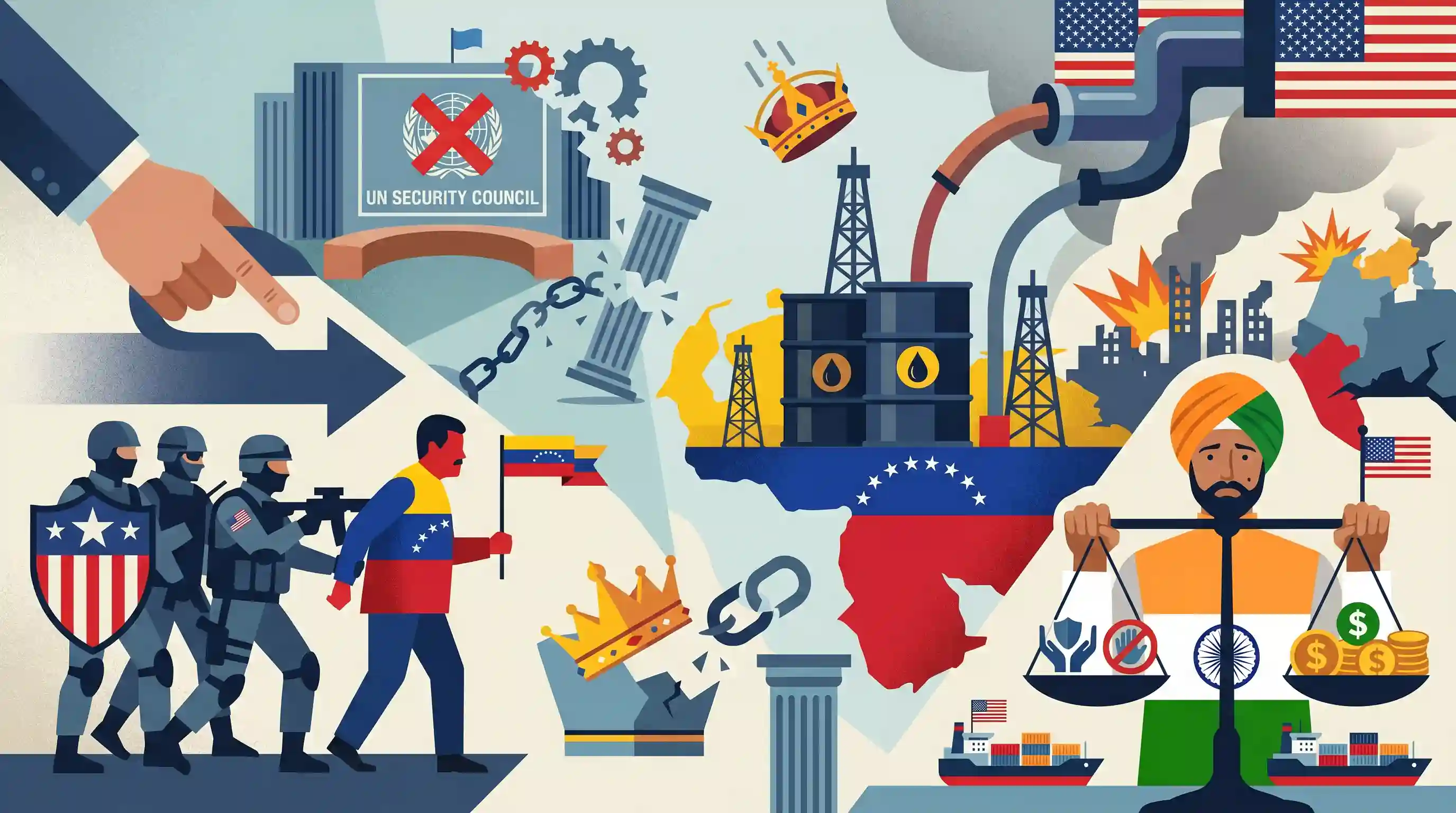
US President Donald Trump orchestrated a unilateral military operation to capture Venezuelan President Nicolas Maduro on drug trafficking charges, sparking international alarm. Executed without UN Security Council authorization, the move severely breaches Venezuela's sovereignty and sets a dangerous precedent that undermines the global rules-based order. Given Venezuela's status as possessing the world's largest proven oil reserves, there are apprehensions that the US seeks to replace an authoritarian regime with an extractive order run by its own oil companies, risking protracted conflict and regional destabilization. India reacted with 'deep concern', balancing its adherence to sovereignty principles against delicate, ongoing bilateral trade dynamics with Washington.
Key Points
- The US captured Venezuelan President Nicolas Maduro through a unilateral military operation, violating Venezuela's sovereignty without UN Security Council authorization.
- The intervention undermines the global rules-based order, indicating a shift towards unilateral regime change and interventionism.
- Venezuela holds the world's largest proven oil reserves, raising concerns that the US intends to establish an extractive order run by American oil companies, potentially causing regional destabilization.
- India responded cautiously, calling the sovereignty breach a 'matter of deep concern' while navigating its own complex trade and tariff negotiations with the US.
Important Terms
UN Security Council (UNSC)

The primary UN organ responsible for maintaining international peace and security; it possesses the unique authority to issue binding resolutions and authorize military force under Chapter VII.
UPSC context
GS-2 (International Institutions); tests mandate, Chapter VII powers, and the impact of P5 paralysis on global stability.
Sovereignty
The supreme and independent authority of a state to govern its territory and people without external interference, a core principle of international law (UN Charter Article 2).
UPSC context
GS-2 (International Relations); tests understanding of non-interference vs. the legality of unilateral military interventions.
Rules-based International Order
A system of laws, norms, and institutions established post-WWII to promote peace and predictable relations through multilateral cooperation and adherence to international law.
UPSC context
GS-2 (International Institutions); tests the transition from a multilateral system to a fragmented order.
National Security Strategy (NSS)
A formal US government document outlining strategic priorities; the 2025 version emphasizes 'America First,' economic nationalism, and selective global engagement over traditional alliances.
UPSC context
GS-2 (Policies of Developed Countries); tests how shifts in US priorities affect India’s interests and strategic autonomy.
Energy Security
The uninterrupted availability of energy sources at an affordable price; for India, this involves mitigating high import dependence on global oil markets.
UPSC context
GS-3 (Infrastructure/Energy); tests India’s economic vulnerability to global supply disruptions and regional instability.
Unilateralism
A foreign policy approach where a state acts independently without the support or consent of other states or international organizations, often bypassing multilateral frameworks.
UPSC context
GS-2 (International Relations); tests the debate between acting for national interest vs. maintaining collaborative international frameworks.
Monroe Doctrine
A 19th-century US policy opposing external interference in the Americas, recently updated as the 'Donroe Doctrine' to reassert an exclusive American sphere of influence.
UPSC context
GS-2 (Policies of Developed Countries); tests understanding of regional spheres of influence and their impact on international law.
Prelims Trap
Military intervention without UNSC approval is permitted under international law to capture indicted criminals.
The UN Charter strictly prohibits the use of force (Article 2(4)). The only legal exceptions are self-defense (Article 51) or explicit UN Security Council authorization.
Static Concepts Connected
What are the legal exceptions to the use of force under the UN Charter?
- General Prohibition: Article 2(4) prohibits the threat or use of force against the territorial integrity or political independence of any state.
- Self-Defense (Article 51): Article 51 allows the inherent right of individual or collective self-defense if an armed attack occurs against a UN Member.
- UNSC Authorization: Under Chapter VII, the UNSC can authorize military action to maintain or restore international peace and security.
What is Venezuela's status in the global oil economy?
- Largest Proven Reserves: Venezuela possesses the world's largest proven crude oil reserves, surpassing Saudi Arabia, primarily in the Orinoco Belt.
- OPEC Membership: It is a founding member of OPEC and currently the only South American country in the cartel (Ecuador withdrew).
- Production Paradox: Despite vast reserves, actual output remains severely low due to decades of underinvestment, domestic crises, and heavy US sanctions.
Cross-Topic Patterns
Extraterritoriality vs. State Sovereignty
The US transition from economic extraterritoriality (like CAATSA and secondary sanctions) to direct kinetic operations marks a severe escalation in challenging Westphalian state sovereignty.
Strategic Autonomy in Geopolitical Crises
India's measured 'deep concern' mirrors its response to the Russia-Ukraine war, balancing normative principles of sovereignty against pragmatic trade and strategic ties with a major power.

Prelims 2026 may test UN Charter exceptions (Art 51) against state sovereignty, alongside mapping questions on OPEC's Latin American members.
Linked PYQs · 5
Linked PYQs · 5
- 2025MainsGS2
"Energy security constitutes the dominant kingpin of India's foreign policy, and is linked with India's overarching influence in Middle Eastern countries.” How would you integrate energy security with India's foreign policy trajectories in the coming years?
- 2017MainsGS2
The question of India's Energy Security constitutes the most important part of India's economic progress. Analyze India's energy policy cooperation with West Asian countries.
- 2024PrelimsGS1
Consider the following statements : Statement-I : Recently, Venezuela has achieved a rapid recovery from its economic crisis and succeeded in preventing its people from fleeing/emigrating to other countries. Statement-II : Venezuela has the world's largest oil reserves. Which one of the following is correct in respect of the above statements?
- 2009PrelimsGS1
Other than Venezuela, which one among the following from South America is a member of OPEC?
- 2025PrelimsGS1
Consider the following countries : I. Bolivia II. Brazil III. Colombia IV. Ecuador V. Paraguay VI. Venezuela Andes mountains pass through how many of the above countries?
