Tribunal Reforms Bill and National Tribunals Commission Independence
Source:The Hindu ↗
ఇది ఎందుకు ముఖ్యం
Tribunals are a recurring topic in UPSC GS Paper 2 (Polity and Governance). This article highlights the latest legislative development (Tribunal Reforms Bill 2026) and the ongoing executive-judicial friction over judicial independence, delegated legislation, and the creation of an independent National Tribunals Commission (NTC). Understanding these nuances is critical for answering analytical mains questions on tribunal reforms.
సారాంశం
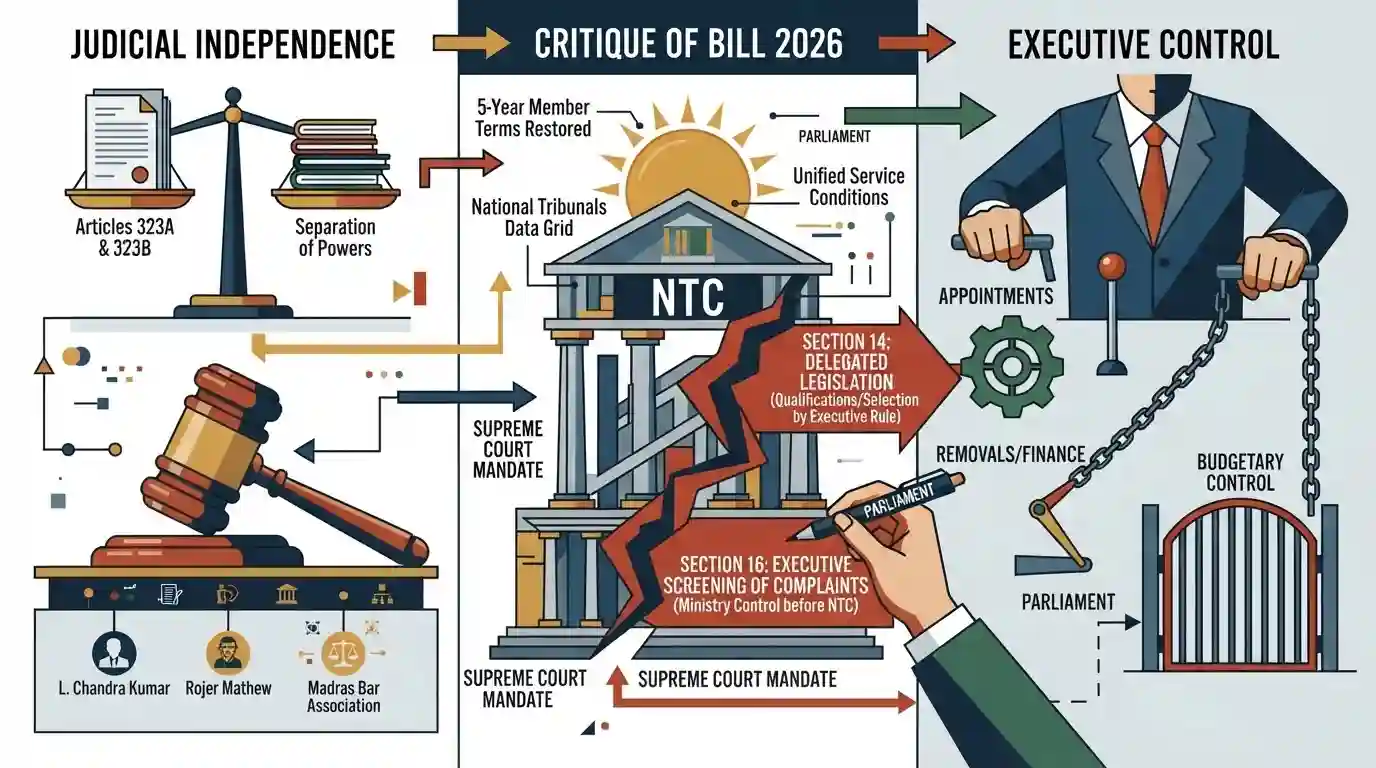
The article critiques the Tribunal Reforms Bill 2026, which was passed by Parliament to establish the National Tribunals Commission (NTC) following the Supreme Court's mandate in the Madras Bar Association (2025) case. While the Bill makes progress by restoring five-year member terms, creating a National Tribunals Data Grid, and unifying service conditions, it falls short of ensuring the NTC's institutional autonomy. Key issues include the delegation of qualifications and selection criteria to executive rule-making (Section 14), and a clause (Section 16) allowing ministries to screen complaints before they are sent to the NTC. The editorial argues that for tribunals to remain independent, the NTC must be insulated from executive control over finance, appointments, and member removals.
ముఖ్య అంశాలు
- Tribunals are designed to offer speedy and specialized dispute resolution, but their decisions remain subject to judicial review by High Courts, which is a basic structure of the Constitution (S.P. Sampath Kumar 1987, L. Chandra Kumar 1997).
- A historical structural flaw in India's tribunal system is that they are administered by the parent ministries whose own executive decisions they are mandated to review, leading to a conflict of interest.
- In Rojer Mathew (2019), the Supreme Court recommended establishing an independent statutory body, the National Tribunals Commission (NTC), to oversee tribunal selection and administration. This was reaffirmed with a four-month establishment mandate in Madras Bar Association (2025).
- The Tribunal Reforms Bill 2026 was passed by Parliament to establish the NTC. On the positive side, it restores five-year terms for members, introduces uniform service conditions, and establishes a National Tribunals Data Grid.
- Despite these improvements, the Bill fails to grant the NTC sufficient institutional autonomy. Section 14 delegates the qualifications, selection manner, and salaries of tribunal members to executive rule-making, which violates the principle that defining who exercises judicial power is an essential legislative function.
- Furthermore, under Section 16, executive ministries will screen complaints against members before passing them to the NTC. The Centre also retains substantial influence over NTC appointments, administration, and finances.
ముఖ్యమైన పదాలు
Tribunal Reforms Bill 2026

A legislative proposal to overhaul India's tribunal framework by establishing uniform service conditions, restoring a five-year member tenure, and creating a central oversight body.
UPSC context
Vital for GS-II (Statutory Bodies), highlighting the ongoing friction between the executive and judiciary over tribunal independence.
National Tribunals Commission
A proposed independent apex statutory body meant to supervise tribunal appointments, handle disciplinary proceedings, evaluate performance, and maintain a centralized Data Grid.
UPSC context
Essential for GS-II (Polity), showing institutional mechanisms to insulate quasi-judicial bodies from executive interference, as mandated by the Supreme Court.
Finance Act 2017
An act that fundamentally restructured India's tribunal system by merging bodies and shifting administrative rule-making power for appointments directly to the central government.
UPSC context
Crucial for GS-II. Its passage as a Money Bill and rules granting executive control over tribunals sparked years of litigation.
Tribunals Reforms Ordinance 2021
An executive order that abolished several appellate tribunals and introduced restrictive age and tenure criteria (like a four-year term) for tribunal members.
UPSC context
Important for GS-II (Separation of Powers). The Supreme Court struck down key provisions, asserting they violated judicial independence.
Supreme Court of India
The apex judicial authority in India, empowered by the Constitution to interpret laws, review legislation, and safeguard constitutional principles like the separation of powers.
UPSC context
Relevant across GS-II. It consistently intervenes to protect tribunal autonomy from executive overreach, notably through the Madras Bar Association judgments.
ప్రిలిమ్స్ ఉచ్చు
State legislatures can establish administrative tribunals under Article 323A to resolve disputes concerning state public services.
Under Article 323A, administrative tribunals can be established ONLY by Parliament, even if they are for state public services. State legislatures have no power under Article 323A.
అనుసంధానమైన స్థిర భావనలు
How do Articles 323A and 323B differ regarding the establishment and structure of tribunals?
- Establishment Authority: Article 323A permits only Parliament to establish administrative tribunals, whereas Article 323B allows both Parliament and State Legislatures to establish tribunals for other specific matters.
- Subject Jurisdiction: Article 323A deals strictly with public services (Central, State, or local), while Article 323B covers specific subjects like taxation, land reforms, labor, and foreign exchange.
- Hierarchy of Tribunals: Article 323A does not contemplate a hierarchy of tribunals, whereas Article 323B explicitly allows for the creation of a hierarchical structure of tribunals.
What is the rule against delegation of 'essential legislative functions' under Indian administrative law?
- Essential Function Rule: The legislature cannot delegate its core policy-making power or the authority to define the essential features of an Act to the executive.
- Judicial Qualifications: Determining qualifications, tenure, and the selection process of members exercising judicial functions is an essential legislative task that cannot be entirely delegated to executive rule-making.
- Permissible Delegation: The executive can only be delegated the power to make ancillary, procedural, or fill-in-the-details rules to implement the broad policy laid down by the legislature.
అంతర-అంశ నమూనాలు
Separation of Powers vs. Executive Efficiency
The executive's control over tribunal appointments highlights the structural tension between Article 50 (separation of judiciary and executive) and the executive's push for specialized, faster administrative adjudication.
Judicial Review vs. Parallel Judiciaries
The shift from S.P. Sampath Kumar to L. Chandra Kumar shows how the Supreme Court uses the Basic Structure doctrine to prevent the creation of parallel, executive-dominated judicial systems bypassing High Courts.

Expect a multi-statement Prelims question contrasting Articles 323A/323B with judicial review limits under the L. Chandra Kumar ruling.
అనుసంధాన PYQలు · 3
అనుసంధాన PYQలు · 3
- 2025MainsGS2
Comment on the need of administrative tribunals as compared to the court system. Assess the impact of the recent tribunal reforms through rationalization of tribunals made in 2021.
- 2019MainsGS2
“The Central Administrative Tribunal which was established for redressal of grievances and complaints by or against central government employees, nowadays is exercising its powers as an independent judicial authority.” Explain.
- 2018PrelimsGS1
How is the National Green Tribunal (NGT) different from the Central Pollution Control Board (CPCB)? 1. The NGT has been established by an Act whereas the CPCB has been created by an executive order of the Government. 2. The NGT provides environmental justice and helps reduce the burden of litigation in the higher courts whereas the CPCB promotes cleanliness of streams and wells, and aims to improve the quality of air in the country. Which of the statements given above is/are correct?
