AI Data Centres and Labour Unions: The Blue-Collar Alliance
Source:The Hindu ↗
Why It Matters
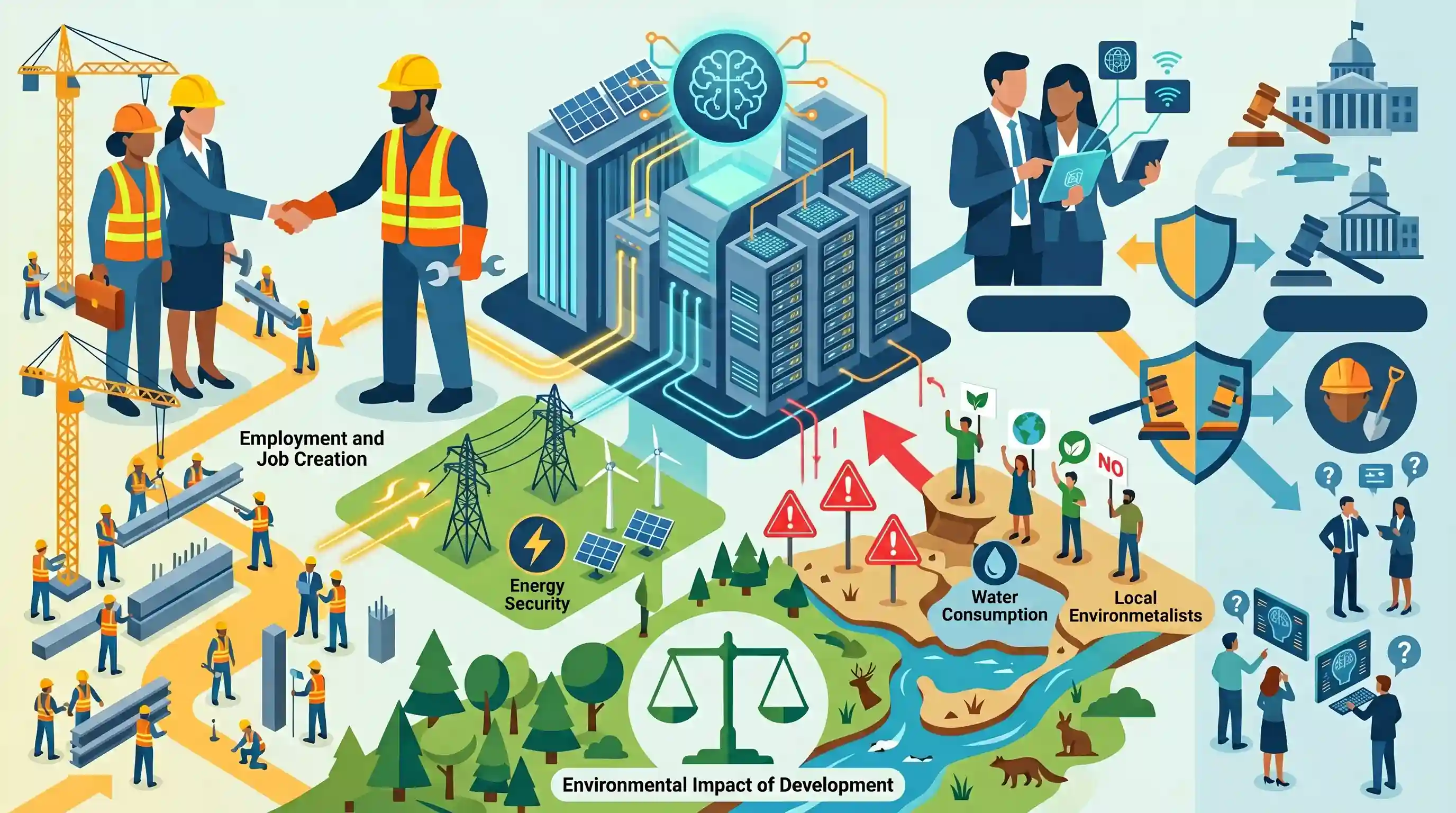
It illustrates the complex trade-offs of the AI revolution, pitting the environmental costs of massive digital infrastructure (energy and water depletion) against economic benefits (job creation), relevant for questions on technology, employment, and sustainable development.
Summary
The massive infrastructure requirements of the generative AI boom have led tech giants like Google, Meta, Microsoft, and Amazon to form strategic alliances with blue-collar labor unions. While local communities and environmentalists increasingly oppose new data centres due to their immense energy and water consumption, trade unions strongly support these projects for the thousands of high-paying construction jobs they create. This alliance provides tech companies with a crucial political and public relations counterweight against regulatory backlash, highlighting a unique paradox where AI—often feared for replacing white-collar jobs—is currently sparking a significant boom in blue-collar employment.
Key Points
- Tech giants are forming strategic alliances with blue-collar labor unions to advocate for the rapid expansion of AI data centres.
- Local communities and environmentalists are increasingly opposing data centre construction due to their immense energy and water consumption, noise, and strain on utility grids.
- The construction of these facilities generates thousands of high-paying union jobs, providing tech companies with a powerful political and PR shield against regulatory and community backlash.
- This dynamic presents a unique paradox: while Artificial Intelligence is widely feared for potentially displacing white-collar jobs, its physical infrastructure demands are currently driving a major boom in blue-collar employment.
Important Terms
North America’s Building Trades Unions (NABTU)

An umbrella federation of 14 construction unions representing over 3 million workers; it acts as a powerful pressure group securing labor standards in large-scale infrastructure projects.
UPSC context
GS II: Pressure Groups; GS III: Employment and Infrastructure. Tests the role of labor organizations in modern economic transitions.
OpenAI
A leading AI research laboratory and developer of Generative AI; its massive compute requirements are a primary driver for the current global data center construction boom.
UPSC context
GS III: Science & Technology. Relevant for understanding the industrial impact of disruptive technologies and their infrastructure needs.
Microsoft
A global technology giant that has pioneered strategic labor alliances, providing AI literacy training to blue-collar workers to support its multi-billion dollar data center expansions.
UPSC context
GS III: Economy. Illustrates public-private partnerships and the synergy between technology capital and skilled labor in high-tech infrastructure.
Oracle
A major cloud and software corporation partnering with AI labs to build 'Stargate' scale data centers, representing the massive physical capital investment required for next-generation computing.
UPSC context
GS III: Infrastructure. Highlights the scale of private sector investment in the digital backbone of the global economy.
Amazon
A dominant 'hyperscaler' through its AWS division; its aggressive data center investments highlight the critical intersection of tech infrastructure, energy security, and environmental policy.
UPSC context
GS III: Energy Security and Environmental Impact. Useful for analyzing the ecological footprint of digital globalization.
A key AI infrastructure developer whose massive capital expenditure on data centers influences global land-use patterns and regional economic development through its Google Cloud services.
UPSC context
GS III: Investment Models. Relevant to discussions on how 'Big Tech' capital expenditure (Capex) drives regional industrial growth.
Meta
The parent company of Facebook and Instagram; it is investing heavily in massive AI compute clusters, sparking debates over local resource consumption and job creation potential.
UPSC context
GS III: Economy/Employment. Exemplifies the paradox of AI-driven automation vs. the demand for physical construction labor.
Prelims Trap
All data centres in India have been granted 'Infrastructure Status' to promote digital growth.
Infrastructure status is conditionally granted only to data centres with a minimum IT load of 5 MW, not universally.
Static Concepts Connected
What are the benefits of 'Infrastructure Status' for data centres?
- Credit access: Allows operators to borrow from banks at easier terms with access to longer-tenure funding.
- Foreign borrowing: Enables access to larger amounts of foreign borrowing under the External Commercial Borrowing (ECB) route.
- Eligibility threshold: Granted exclusively to data parks with a minimum capacity of 5 MW IT load.
How do AI data centres impact local ecology and utility grids?
- Water intensity: Training large AI models requires millions of litres of freshwater for server cooling, worsening stress in arid regions.
- Baseload strain: They require 24/7 uninterrupted power, acting as 'inflexible base loads' that strain grids and complicate renewable energy transitions.
Cross-Topic Patterns
Just Transition vs Digital Boom
The shift towards AI creates a paradox where blue-collar job creation is pitted against local resource depletion, mirroring coal-phaseout 'Just Transition' dilemmas.
Geography of Digital Infrastructure
Over 50% of India's data centre capacity is clustered in Mumbai due to submarine cable landings, creating regional vulnerabilities often tested in GS1/GS3.

AI’s resource footprint (water cooling, baseload power) + 'Infrastructure Status' criteria will likely form a multi-statement Prelims Q.
Linked PYQs · 3
Linked PYQs · 3
- 2023MainsGS3
Introduce the concept of Artificial Intelligence (AI). How does Al help clinical diagnosis? Do you perceive any threat to privacy of the individual in the use of Al in healthcare?
- 2022MainsGS3
Economic growth in the recent past has been led by increase in labour productivity." Explain this statement. Suggest the growth pattern that will lead to creation of more jobs without compromising labour productivity.
- 2024MainsGS3
The world is facing an acute shortage of clean and safe freshwater. What are the alternative technologies which can solve this crisis? Briefly discuss any three such technologies citing their key merits and demerits.
