Economic Security Strategy for India Amid Global Protectionism
Source:Indian Express ↗
Why It Matters
This topic is highly relevant for Mains GS2 and GS3, as it addresses the direct impact of global protectionism on India's macroeconomic stability and foreign policy. Understanding the intersection of economics and national security (geoeconomics) is crucial for formulating answers on supply chain resilience, self-reliance, and India-US bilateral relations.
Summary
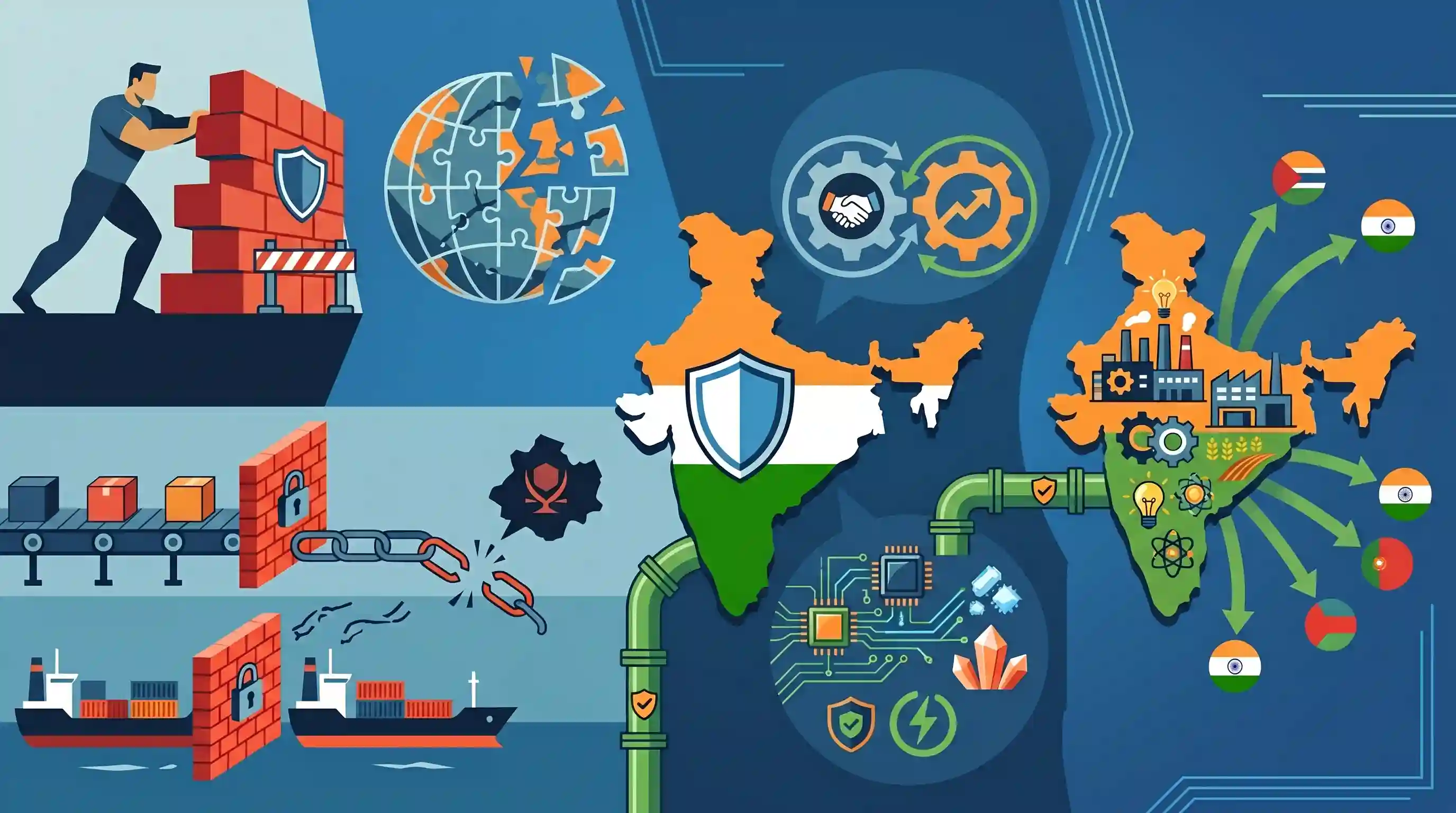
The article emphasizes the need for India to develop a comprehensive Economic Security Strategy in response to the global rise of protectionism, epitomized by the US 'America First' policy. As international trade moves away from multilateralism towards bilateralism and strategic decoupling, India faces challenges related to supply chain vulnerabilities and tariff barriers. To navigate this geoeconomic fragmentation, India must align its foreign policy with economic interests, secure critical technology and raw material supply chains, reduce dependence on adversarial nations, and promote 'Atmanirbhar Bharat' without retreating from global value chains. Capitalizing on 'friend-shoring' trends will be crucial for India's sustained economic growth and national security.
Key Points
- The resurgence of the 'America First' doctrine marks a global shift away from multilateral free trade towards protectionism and economic nationalism.
- India requires a dedicated 'Economic Security Strategy' to shield its economy from global supply chain disruptions and tariff wars.
- Foreign policy must increasingly integrate with geoeconomics, ensuring access to critical minerals, emerging technologies, and secure trade routes.
- Balancing 'Atmanirbhar Bharat' (self-reliance) with global integration is essential; India must avoid isolationism while building domestic capabilities.
- India has the opportunity to leverage 'friend-shoring' and position itself as a trusted node in global supply chains amid US-China strategic competition.
Important Terms
Economic Security Strategy

A policy framework aiming to protect national sovereignty by securing critical supply chains, aligning foreign policy with economic interests, and reducing vulnerabilities in technology and raw materials from adversarial nations.
UPSC context
GS Paper 3: Indian Economy and Internal Security; tests understanding of how trade and national security are increasingly intertwined.
Atmanirbhar Bharat
Meaning 'Self-Reliant India,' it is a government vision to bolster domestic industries and reduce import dependence across five pillars: Economy, Infrastructure, Technology-driven systems, Vibrant Demography, and Demand.
UPSC context
GS Paper 3: Industrial Policy and Growth; tests the balance between domestic self-sufficiency and global trade integration.
Friend-shoring
A trade strategy where a country sources raw materials and components from geopolitical allies or like-minded nations to minimize supply chain disruptions from adversarial states.
UPSC context
GS Paper 2 & 3: International Relations and Economy; tests knowledge of shifting global trade patterns and 'China Plus One' strategies.
Geoeconomic Fragmentation
A policy-driven reversal of global economic integration where nations move toward competing blocs due to strategic and security concerns rather than cost-efficiency, often hindering multilateralism.
UPSC context
GS Paper 3: Effects of Liberalization; tests analysis of how geopolitical tensions reshape global financial flows and trade rules.
Strategic Decoupling
The deliberate reduction of economic interdependence between nations (e.g., US and China) in sensitive sectors like high technology and critical minerals to mitigate national security risks.
UPSC context
GS Paper 2: Effect of policies of developed countries on India's interests; tests understanding of the US-China trade war dynamics.
Global Value Chains (GVCs)
The international distribution of various production stages—from design to final distribution—across multiple countries, allowing firms to leverage specific regional expertise and cost advantages.
UPSC context
GS Paper 3: Changes in industrial policy; tests understanding of India's participation in international manufacturing networks.
Prelims Trap
Atmanirbhar Bharat implies a return to import substitution and complete decoupling from global value chains.
Atmanirbhar Bharat aims for economic resilience and stronger integration into Global Value Chains (GVCs) by building domestic capacity, not a return to pre-1991 isolationism.
Static Concepts Connected
What are the key terms defining the modern restructuring of global supply chains?
- Friend-shoring: Routing supply chains through geopolitical allies and politically safe countries to minimize disruption risks.
- Near-shoring: Relocating production and manufacturing operations closer to the final consumer market to reduce transit vulnerabilities.
- Re-shoring: Bringing manufacturing processes and supply chain nodes back to the home country.
What are the three primary trade remedy measures permitted under WTO rules?
- Anti-dumping duties: Levied on imports priced below fair market value (dumped goods) to protect domestic manufacturers.
- Countervailing duties: Imposed to neutralize the negative effects of subsidies provided by a foreign government to its exporters.
- Safeguard measures: Temporary import restrictions utilized to protect a specific domestic industry from a sudden, unforeseen surge in imports.
Cross-Topic Patterns
Critical Minerals & Geoeconomic Diplomacy
The shift towards 'friend-shoring' integrates India's domestic PLI schemes with international frameworks like the Minerals Security Partnership (MSP) to secure semiconductor and EV supply chains.
Deglobalization & China Plus One
US protectionism accelerates the 'China Plus One' strategy, presenting a critical policy window for India to attract relocating manufacturing FDI through strategic bilateral FTAs and infrastructure upgrades.

Expect a 2026 prelims question linking 'Friend-shoring', the Minerals Security Partnership (MSP), and India's critical mineral dependency.
Linked PYQs · 2
Linked PYQs · 2
- 2025MainsGS3
What are the challenges before the Indian economy when the world is moving away from free trade and multilateralism to protectionism and bilateralism? How can these challenges be met?
- 2012MainsGS2
Discuss the likely negative impact of the protectionist measures proposed by the US on India's software industry.
