Tamil Nadu Political Realignment and Centre State Dynamics
Source:Indian Express ↗
Why It Matters
The article provides a practical example of how regional political compulsions shape national legislative majorities and Centre-State negotiations, making it highly relevant for studying federalism, coalition governments, and electoral reforms in Polity.
Summary
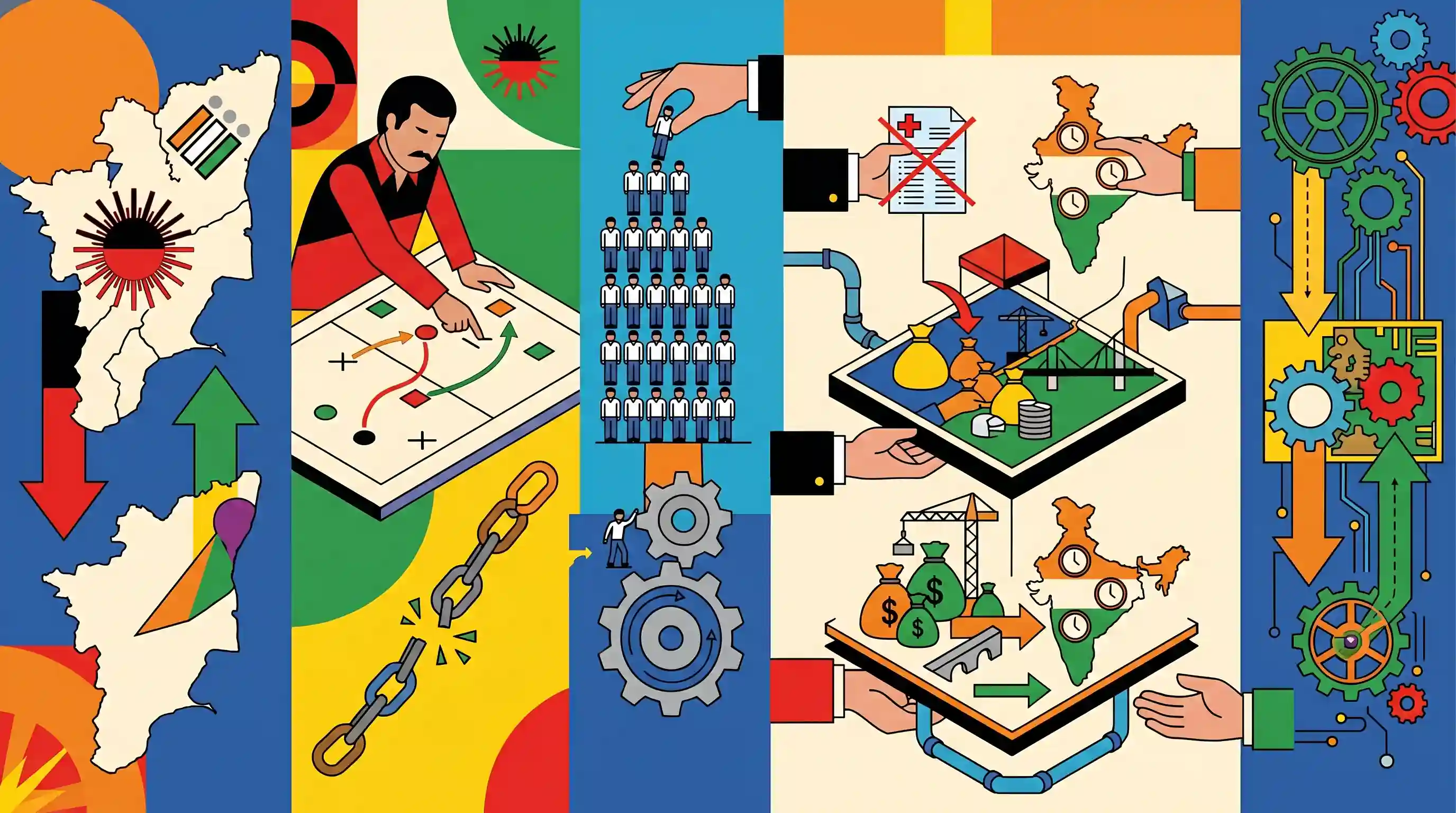
Following a defeat in the recent Tamil Nadu assembly elections where Thalapathy Vijay's TVK emerged as the single-largest party, the DMK is recalibrating its political strategy. The party has signaled its readiness to offer issue-based support to the BJP-led NDA government at the Centre, a significant departure from its previous staunch opposition. By leveraging its 22 Lok Sabha MPs, the DMK aims to negotiate favorable outcomes on key state issues such as NEET exemptions and infrastructure funding. Concurrently, this potential support could aid the BJP in advancing major national legislative agendas, notably 'One Nation, One Election'. This evolving dynamic underscores the transactional nature of Indian federalism and the pivotal role of regional parties in shaping national governance.
Key Points
- The DMK has indicated a willingness to offer issue-based support to the BJP-led Central government after losing the Tamil Nadu assembly elections to Thalapathy Vijay\'s TVK.
- This political realignment could provide the BJP with the backing of 22 DMK Lok Sabha MPs, helping it secure majorities for crucial legislation like the \'One Nation, One Election\' proposal.
- In exchange for support at the national level, the DMK expects the Centre to accommodate regional demands, including exemptions from NEET and funding for infrastructure.
- The shift reflects the fluid dynamics of coalition politics and how regional electoral outcomes directly influence Centre-State relations and national policymaking.
Important Terms
Tamilaga Vettri Kazhagam (TVK)

Regional party in Tamil Nadu founded by actor Vijay. It disrupted the state's long-standing DMK-AIADMK duopoly by becoming the single-largest party in the 2026 assembly elections.
UPSC context
GS II (Regional Parties); tests understanding of how new political forces shift traditional state-level duopolies and federal dynamics.
One Nation, One Election (ONOE)
A policy proposal to hold simultaneous elections for the Lok Sabha and all state assemblies to reduce costs and administrative burden. It involves significant constitutional amendments and federal consensus.
UPSC context
GS II (Electoral Reforms); examines constitutional challenges and the balance between administrative efficiency and federal diversity.
National Eligibility cum Entrance Test (NEET)
A unified national medical entrance exam. In Tamil Nadu, it is a persistent flashpoint for Centre-State friction, viewed as a threat to state autonomy and social justice in education.
UPSC context
GS II (Federalism); tests knowledge of the Concurrent List and the distribution of powers regarding education.
Dravida Munnetra Kazhagam (DMK)
A major Dravidian regional party in Tamil Nadu. Its shift toward 'issue-based support' for the NDA reflects a strategic pivot to maintain national relevance following state-level electoral setbacks.
UPSC context
GS II (Regional Political Parties); focuses on the role of influential regional players in national governance and coalition bargaining.
Waqf (Amendment) Bill
A 2024/25 legislative proposal to increase government oversight of Waqf properties. Its passage is a major national agenda requiring the support of regional parties in a coalition environment.
UPSC context
GS II (Parliamentary Processes); highlights the importance of regional support for sensitive national legislation involving secularism and property rights.
INDIA bloc
A broad coalition of opposition parties formed to challenge the NDA. Strains within the bloc, such as the DMK's distancing, reflect the challenges of maintaining multi-party unity.
UPSC context
GS II (Coalition Politics); explores the dynamics of opposition alliances and their impact on parliamentary stability.
Prelims Trap
State laws on Concurrent subjects override Central laws if passed by special majority in the Assembly.
False. Under Article 254(2), a state law on a Concurrent List subject only prevails over a Central law if reserved for and granted Presidential assent.
Static Concepts Connected
How does the Constitution resolve conflicts on Concurrent List subjects?
- General Rule: Under Article 254(1), if a State law contradicts a Central law on a Concurrent List subject (like Education), the Central law prevails.
- Presidential Exception: Under Article 254(2), the State law can prevail within that state if it was reserved for the President's consideration and received their assent.
- Parliamentary Override: Even after Presidential assent to a state law, Parliament can enact a new law adding to, amending, varying, or repealing the state law.
What characterizes 'Bargaining Federalism' in the Indian context?
- Definition: A term coined by Morris-Jones describing a system where Centre-State relations are driven by political negotiations and transactional leverage rather than strict constitutional demarcation.
- Mechanism: Regional parties use their Lok Sabha numbers to extract state-specific policy concessions or discretionary funding from the Union government in coalition setups.
Cross-Topic Patterns
ONOE + Article 368 majorities
Implementing 'One Nation, One Election' requires Constitutional amendments (like inserting Art 82A). Coalition dependencies make regional party support crucial to achieve the requisite special majorities in Parliament.
Political leverage + Article 282
Bargaining for state infrastructure funds in exchange for parliamentary support highlights how discretionary grants (Art 282) bypass standard Finance Commission devolution, acting as political tools in coalition eras.

Article 254 repugnancy mechanisms and Article 368 amendment thresholds for One Nation One Election will likely fuse into a 2026 prelims Q.
Linked PYQs · 4
Linked PYQs · 4
- 2024MainsGS2
Examine the need for electoral reforms as suggested by various committees with particular reference to "one nation one election" principle.
- 2017MainsGS2
Simultaneous election to the Lok Sabha and the State Assemblies will limit the amount of time and money spent in electioneering but it will reduce the government's accountability to the people." Discuss.
- 2022MainsGS2
“While the national political parties in India favour centralisation, the regional parties are in favour of State autonomy.” Comment.
- 2024MainsGS2
What changes has the Union Government recently introduced in the domain of Centre-State relations ? Suggest measures to be adopted to build the trust between the Centre and the States and for strengthening federalism.
