Sri Lanka Post Conflict Reconciliation and Ethnic Memory
Source:Indian Express ↗
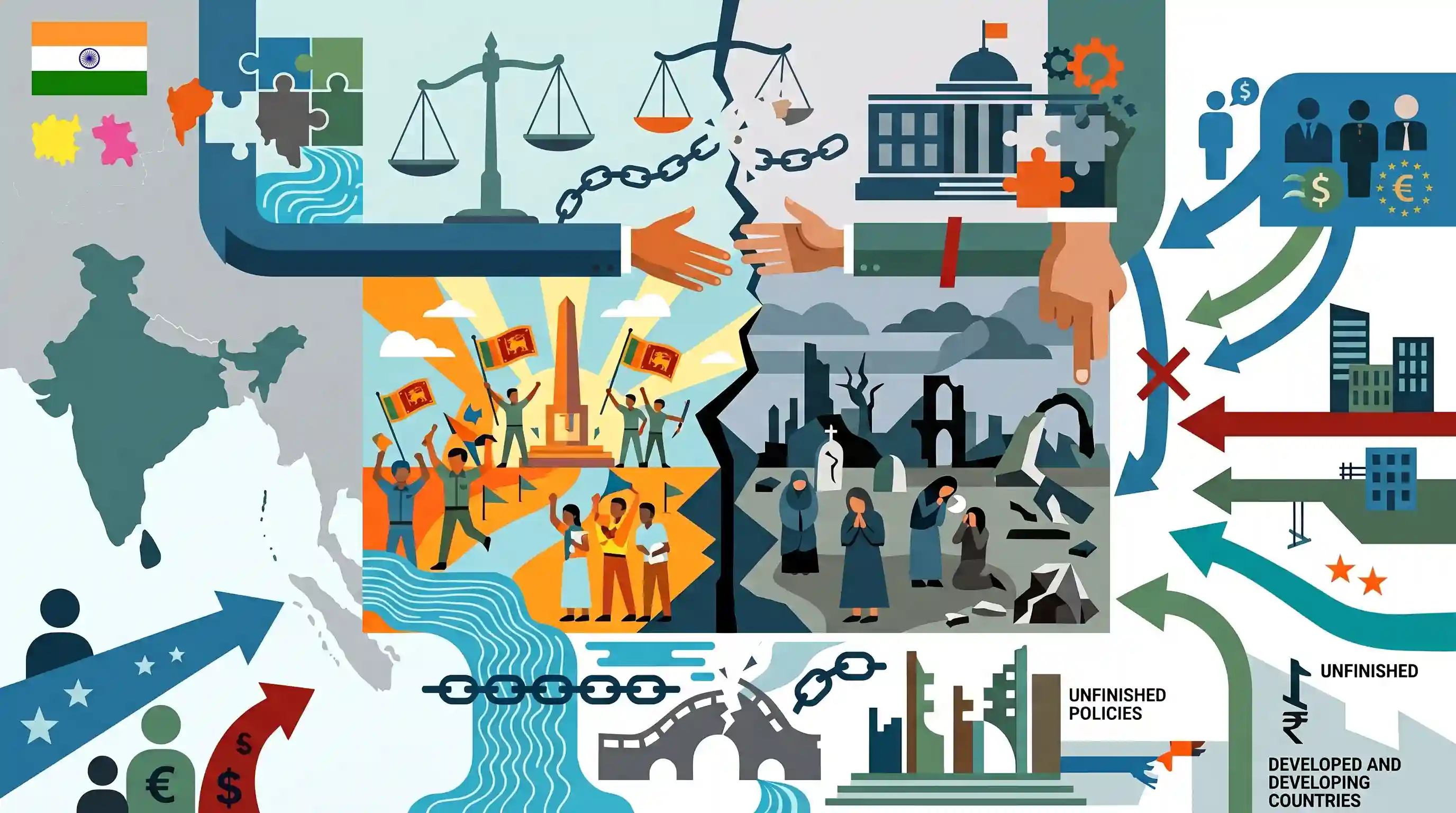
Why It Matters
Sri Lanka's internal ethnic stability directly impacts India's security and regional geopolitics. Understanding the socio-political undercurrents of the Tamil-Sinhalese divide is critical for analyzing India's foreign policy approach, its push for the 13th Amendment, and its stance on UNHRC resolutions concerning human rights in Sri Lanka.
Summary
The article discusses the lingering ethnic divisions in Sri Lanka long after the end of its decades-long civil war in 2009. It highlights the stark contrast in how the war's conclusion is remembered: as a heroic military triumph by the Sinhalese majority and as a period of profound grief and trauma by the Tamil minority. This divided national memory reflects the enduring failure of the state to achieve post-conflict reconciliation, ensure transitional justice, and address the root causes of the ethnic strife, such as power devolution under the 13th Amendment. Reconciling these polarized historical narratives remains a significant challenge for nation-building and lasting peace in Sri Lanka.
Key Points
- Sri Lanka continues to struggle with a deeply divided national memory regarding the end of its brutal civil war, which concluded in 2009.
- The Sinhalese majority largely views the war's end as a victory against terrorism, celebrating the military, while the Tamil minority mourns the massive civilian casualties, particularly on Mullivaikkal Remembrance Day.
- This divergence in memory underscores the lack of transitional justice, genuine reconciliation, and accountability for alleged human rights violations during the final phases of the conflict.
- The structural issues that fueled the ethnic conflict remain unresolved, including the non-implementation of the 13th Amendment, which promises devolution of power to Tamil-majority provinces.
- A unified national narrative is crucial for Sri Lanka's long-term stability and to rebuild trust between different ethnic communities.
Important Terms
13th Amendment to the Sri Lankan Constitution

A 1987 constitutional provision mandating the devolution of powers to nine provincial councils, aimed at resolving ethnic conflict by granting limited autonomy to Tamil-majority regions.
UPSC context
GS Paper 2 (International Relations); tests understanding of regional power-sharing and constitutional frameworks for ethnic reconciliation in India's neighborhood.
Indo-Sri Lanka Peace Accord (1987)
A 1987 bilateral agreement between India and Sri Lanka seeking to resolve the civil war through power devolution and the deployment of the Indian Peace Keeping Force.
UPSC context
GS Paper 2 (International Relations); relevant for India's neighborhood policy and historical role in South Asian ethnic conflicts.
Liberation Tigers of Tamil Eelam (LTTE)
A militant separatist organization that waged a decades-long insurgency (1983–2009) seeking an independent Tamil state in northern and eastern Sri Lanka.
UPSC context
GS Paper 2/3 (Internal Security/IR); critical for analyzing the history of South Asian insurgencies and their impact on Indian foreign policy.
UN Human Rights Council (UNHRC)
A UN body that has passed several resolutions urging Sri Lanka to ensure accountability for war crimes and achieve meaningful post-conflict ethnic reconciliation.
UPSC context
GS Paper 2 (International Institutions); tests India's stance on international accountability mechanisms and global human rights governance.
Prelims Trap
"The 13th Amendment was introduced to Sri Lanka following the 2009 UNHRC mandate on transitional justice."
The 13th Amendment stems from the 1987 Indo-Sri Lanka Accord, long before the 2009 war's end. It focuses on provincial devolution, not recent UNHRC justice mandates.
Static Concepts Connected
What is the 13th Amendment to the Sri Lankan Constitution?
- Origin: Enacted following the 1987 Indo-Sri Lanka Peace Accord signed by PM Rajiv Gandhi and President J.R. Jayewardene.
- Objective: To create Provincial Councils and ensure power-sharing, granting a degree of self-governance to the Tamil minority in the North and East.
- Key Subjects: It constitutionally mandates the devolution of powers over land, police, and finance to the provincial governments, though fully devolving police and land powers remains stalled.
What are the core mechanisms of Transitional Justice?
- Truth-seeking: Establishing truth via official bodies (like Truth and Reconciliation Commissions) to document human rights violations.
- Criminal Prosecution: Holding perpetrators accountable for massive violations through domestic, hybrid, or international tribunals.
- Reparations: Providing financial compensation, psychological support, and public apologies to victims.
- Institutional Reform: Transforming state institutions (military, police, judiciary) to prevent the recurrence of abuses and ensure civilian oversight.
Cross-Topic Patterns
Reconciliation delays and Chinese influence
Colombo’s resistance to Indian and Western pressure on Tamil reconciliation has historically pushed it closer to Beijing, seeking diplomatic cover and unconditional infrastructure funding.
Domestic politics shaping neighborhood policy
The unresolved Sri Lankan Tamil issue influences Tamil Nadu's domestic politics, continually intertwining with Indian foreign policy, the Katchatheevu island dispute, and the Palk Bay fishermen conflict.

Expect a multi-statement Prelims question mixing the 13th Amendment's 1987 origin, Katchatheevu history, and Tamil provincial devolution.
Linked PYQs · 1
Linked PYQs · 1
- 2022MainsGS2
India is an age-old friend of Sri Lanka.’ Discuss India's role in the recent crisis in Sri Lanka in the light of the preceding statement.
