Election Commission cleanup shrinks electorate across states and UTs
Source:Indian Express ↗
Why It Matters
The integrity of electoral rolls is fundamental to India's democratic process. For UPSC aspirants, understanding the mechanisms of electoral roll revision, the statutory backing under the Representation of the People Act, and the ECI's continuous efforts toward electoral reforms is critical for the Polity and Governance section (GS Paper 2).
Summary
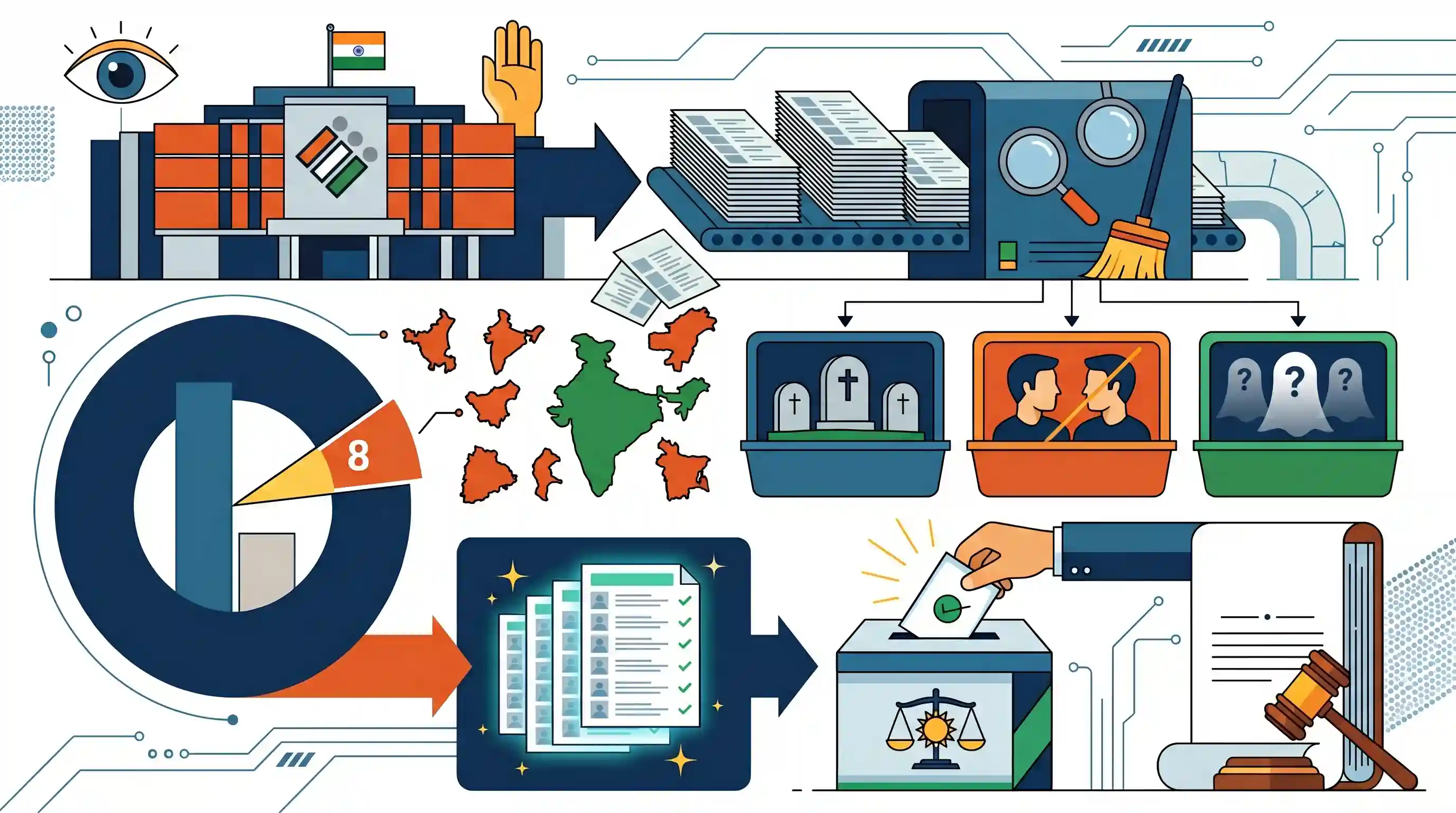
In a significant electoral roll cleanup by the Election Commission of India (ECI), the electorate shrank by 8% across nine states and Union Territories slated for the second phase of elections. Around 1.7 crore voters were removed from the lists to eliminate deceased, duplicate, and phantom entries. This extensive revision exercise underscores the ECI's ongoing efforts to ensure the accuracy and purity of electoral rolls, a foundational requirement for conducting free and fair elections in India under the Representation of the People Act, 1950.
Key Points
- The Election Commission of India (ECI) executed a major electoral roll cleanup, resulting in an 8% reduction of the electorate in nine states and Union Territories participating in the second phase of elections.
- Approximately 1.7 crore names were struck off the rolls to eliminate deceased, duplicate, or phantom voters, and account for shifted residences.
- The revision aims to establish 'pure' electoral rolls, which is crucial for the integrity of the democratic process and conducting free and fair elections.
- This exercise falls under the statutory framework of the Representation of the People Act, 1950, which deals with the preparation and revision of electoral rolls.
Important Terms
Representation of the People Act, 1950

A central law providing for seat allocation in legislatures, delimitation of constituencies, and the qualification/registration of electors on the voter lists.
UPSC context
GS Paper II: Polity and Elections; distinguishes pre-election preparation (1950) from the actual conduct of elections (1951).
Election Commission of India (ECI)
An autonomous constitutional body established under Article 324 to superintend, direct, and control elections to Parliament, State Legislatures, and the offices of President and Vice-President.
UPSC context
GS Paper II: Constitutional Bodies; crucial for topics on electoral integrity, independence of institutions, and Article 324.
Electoral Roll
An official list of all eligible citizens in a constituency who are entitled to vote; its purity is fundamental to the democratic principle of "one person, one vote."
UPSC context
GS Paper II: Electoral Reforms; tests understanding of voter inclusivity and the prevention of electoral fraud.
Phantom Entries (Ghost Voters)
Fake or duplicate names in the voter list, often including deceased persons or non-existent individuals, used to facilitate fraudulent voting or impersonation.
UPSC context
GS Paper II: Governance; relevant to challenges in maintaining roll integrity and the impact of "ghost voting" on mandates.
Special Intensive Revision (SIR)
A comprehensive, door-to-door verification exercise by the ECI to cleanse voter lists by removing deceased, shifted, or duplicate entries and adding new eligible voters.
UPSC context
GS Paper II: Current Affairs/Electoral Reforms; tests knowledge of specific administrative measures to ensure "error-free" elections.
Universal Adult Suffrage
The constitutional right of every adult citizen (aged 18+) to vote without discrimination based on religion, race, caste, or sex, as per Article 326.
UPSC context
GS Paper II: Indian Constitution; foundational concept for democracy and the primary objective of electoral roll maintenance.
Prelims Trap
The preparation, revision, and correction of electoral rolls are governed by the Representation of the People Act, 1951.
Preparation of electoral rolls falls exclusively under RPA 1950, not 1951. Aspirants often confuse the two Acts; RPA 1951 deals strictly with the conduct of elections and disqualifications.
Static Concepts Connected
How does RPA 1950 differ from RPA 1951 regarding electoral matters?
- RPA 1950 Scope: Deals with the allocation of seats, delimitation of constituencies, qualifications of voters, and preparation of electoral rolls.
- RPA 1951 Scope: Governs the actual conduct of elections, qualifications and disqualifications of MPs/MLAs, and corrupt practices.
What is the statutory role of the Electoral Registration Officer (ERO)?
- Appointment: Appointed by the ECI in consultation with the State Government for a specific assembly or parliamentary constituency.
- Core Mandate: Statutorily responsible for the preparation, revision, and correction of the constituency's electoral rolls.
- Judicial Bar: Civil courts are expressly barred from questioning an ERO's actions regarding the registration or deletion of electors.
Cross-Topic Patterns
Electoral Rolls + Aadhaar Voluntary Linking
The Election Laws (Amendment) Act 2021 allows EROs to request Aadhaar for authentication, sparking ongoing debates on privacy rights (Puttaswamy judgment) versus electoral purity.
Voter Base + Upcoming Post-2026 Delimitation
Cleaning phantom voters directly alters constituency demographics. This accurate electorate data becomes highly sensitive heading into the post-2026 delimitation exercise, which will influence seat allocation and federal dynamics.

Expect a multi-statement question testing the exact boundaries between RPA 1950 and 1951, particularly concerning ERO powers in 2026.
Linked PYQs · 5
Linked PYQs · 5
- 2017PrelimsGS1
Consider the following statements: 1. The Election Commission of India is a five-member body. 2. Union Ministry of Home Affairs decides the election schedule for the conduct of both general elections and bye-elections. 3. Election Commission resolves the disputes relating to splits/mergers of recognised political parties. Which of the statements given above is/are correct?
- 2017MainsGS2
To enhance the quality of democracy in India the Election Commission of India has proposed electoral reforms in 2016. What are the suggested reforms and how far are they significant to make democracy successful?
- 2024MainsGS2
Examine the need for electoral reforms as suggested by various committees with particular reference to "one nation one election" principle.
- 2022MainsGS2
Discuss the role of the Election Commission of India in the light of the evolution of the Model Code of Conduct.
- 2022MainsGS2
Discuss the procedures to decide the disputes arising out of the election of a Member of the Parliament or State Legislature under The Representation of the People Act, 1951. What are the grounds on which the election of any returned candidate may be declared void ? What remedy is available to the aggrieved party against the decision ? Refer to the case laws.
