Voter Base Shrinks During Second Phase of Electoral Roll Revision
Source:Indian Express ↗
Why It Matters
Maintaining accurate electoral rolls is critical to ensuring free and fair elections, preventing voter fraud, and upholding the constitutional right to vote (Article 326). Questions regarding the Election Commission's role in electoral reforms and the purification of electoral rolls frequently appear in GS Paper 2 and Prelims.
Summary
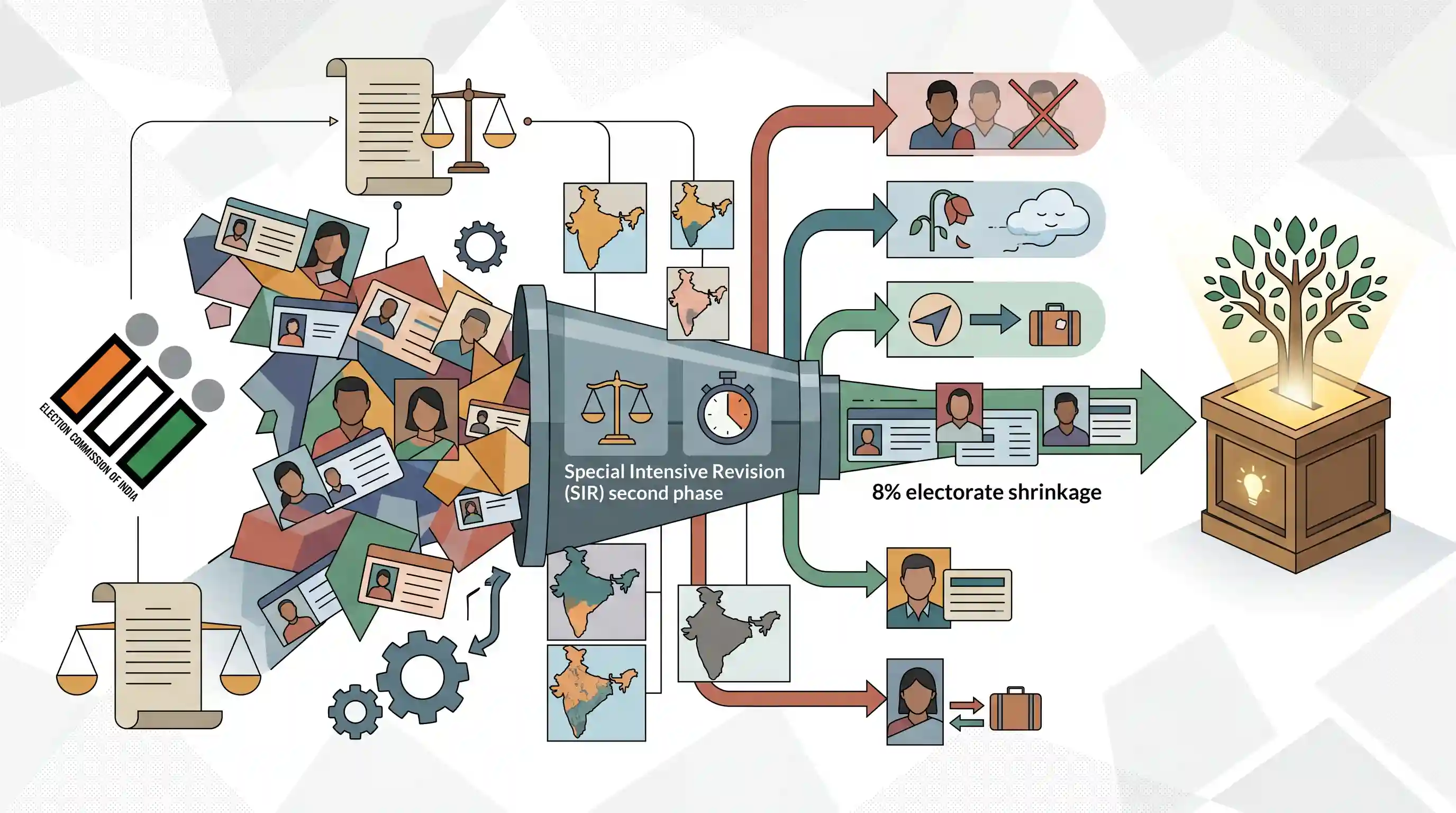
The Election Commission of India (ECI) conducted a major cleanup of electoral rolls under the Special Intensive Revision (SIR) second phase, resulting in an 8% shrinkage of the electorate across nine states and Union Territories. Approximately 1.7 crore voter names were removed to address duplicate entries, deceased individuals, and relocated voters. This purification exercise highlights ongoing administrative efforts toward electoral reform and maintaining the integrity of India's democratic process.
Key Points
- The Election Commission's Special Intensive Revision (SIR) second phase resulted in an 8% reduction in the electorate across nine states and UTs.
- Approximately 1.7 crore voters were removed from the electoral rolls in a major cleanup drive.
- The purification process targeted duplicate entries, as well as deceased or permanently relocated voters.
- This exercise aims to ensure the integrity and accuracy of the democratic electoral process under Article 324 and the Representation of the People Act, 1950.
Important Terms
Special Intensive Revision (SIR)

A comprehensive, door-to-door verification exercise by the ECI to update electoral rolls, involving house-to-house enumeration to remove duplicates, deceased, or relocated voters and ensure list accuracy.
UPSC context
GS II (Polity): Electoral reforms and governance. Tests understanding of administrative measures ensuring the integrity of the democratic process.
Representation of the People Act, 1950
The primary legislation governing the preparation/revision of electoral rolls (Section 21), delimitation of constituencies, and allocation of seats in Parliament and State Legislatures.
UPSC context
GS II (Polity): Statutory bodies and laws. Crucial for understanding the legal framework of the Indian electoral system.
Election Commission of India (ECI)
A permanent constitutional body (Article 324) mandated to direct and control the preparation of electoral rolls and conduct elections to Parliament, State Legislatures, and the President/Vice-President.
UPSC context
GS II (Polity): Constitutional bodies. Tests knowledge of institutional machinery and its role in free and fair elections.
Electoral Roll Purification
The administrative process of removing errors, duplicates, and 'ghost voters' from the voter list to maintain its integrity and uphold the principle of 'one person, one vote.'
UPSC context
GS II (Polity): Electoral reforms. Focuses on transparency, administrative efficiency, and preventing electoral fraud.
Booth Level Officer (BLO)
A grassroot-level official (typically a government employee) appointed by the ECI to conduct field-level verification, distribute voter forms, and maintain booth-level electoral records.
UPSC context
GS II (Governance): Election management. Highlights the execution of policies at the local level.
De-duplication
A technical or manual process to identify and remove multiple entries of a single individual across different polling stations or constituencies.
UPSC context
GS II (Governance): Technology and transparency in elections. Pertains to ensuring unique voter identity.
Prelims Trap
The ECI deletes duplicate voters and conducts roll revisions under the Representation of the People Act, 1951.
Preparation, revision (like SIR), and de-duplication of electoral rolls fall strictly under the Representation of the People Act, 1950. RPA 1951 governs the actual conduct of elections and candidate disqualifications.
Static Concepts Connected
What is the primary difference between the RPA 1950 and RPA 1951?
- RPA 1950: Focuses on the preparation of electoral rolls, delimitation of constituencies, and allocation of seats in Parliament and State Legislatures.
- RPA 1951: Regulates the actual conduct of elections, outlines disqualifications for MPs and MLAs, and provides a mechanism for resolving election disputes.
How does the Election Laws (Amendment) Act 2021 aid electoral roll purification?
- Aadhaar linking: It amended the RPA 1950 to allow Electoral Registration Officers to seek Aadhaar numbers voluntarily to authenticate entries and curb multiple enrollments across constituencies.
- Four qualifying dates: It expanded voter registration opportunities by introducing four qualifying dates (Jan 1, Apr 1, Jul 1, Oct 1) annually instead of just one.
Cross-Topic Patterns
Voter roll purification and Right to Privacy
Voluntary Aadhaar linking for voter de-duplication connects this administrative cleanup to constitutional debates over the Puttaswamy judgment, proportionality test, and the risk of algorithmic disenfranchisement.
Electorate shrinkage and post-2026 Delimitation
Mass deletions from electoral rolls intersect with southern states' ongoing demographic anxieties regarding potential loss of parliamentary representation in the upcoming post-2026 delimitation exercise.

A multi-statement question in 2026 will likely test the exact distinctions between RPA 1950 (electoral rolls) and RPA 1951.
Linked PYQs · 3
Linked PYQs · 3
- 2017PrelimsGS1
Right to vote and to be elected in India is a
- 2017MainsGS2
To enhance the quality of democracy in India the Election Commission of India has proposed electoral reforms in 2016. What are the suggested reforms and how far are they significant to make democracy successful?
- 2024MainsGS2
Examine the need for electoral reforms as suggested by various committees with particular reference to "one nation one election" principle.
