Global Delays in Updating NDCs Ahead of COP30 Climate Talks
Source:The Hindu ↗
Why It Matters
NDCs and the Paris Agreement are fundamental topics in UPSC GS3 (Environment) and Prelims. The progress of these climate talks, India's stance, and the geopolitical hurdles to climate action are highly probable areas for Mains questions on international environmental diplomacy and India's developmental vs. environmental balancing act.
Summary
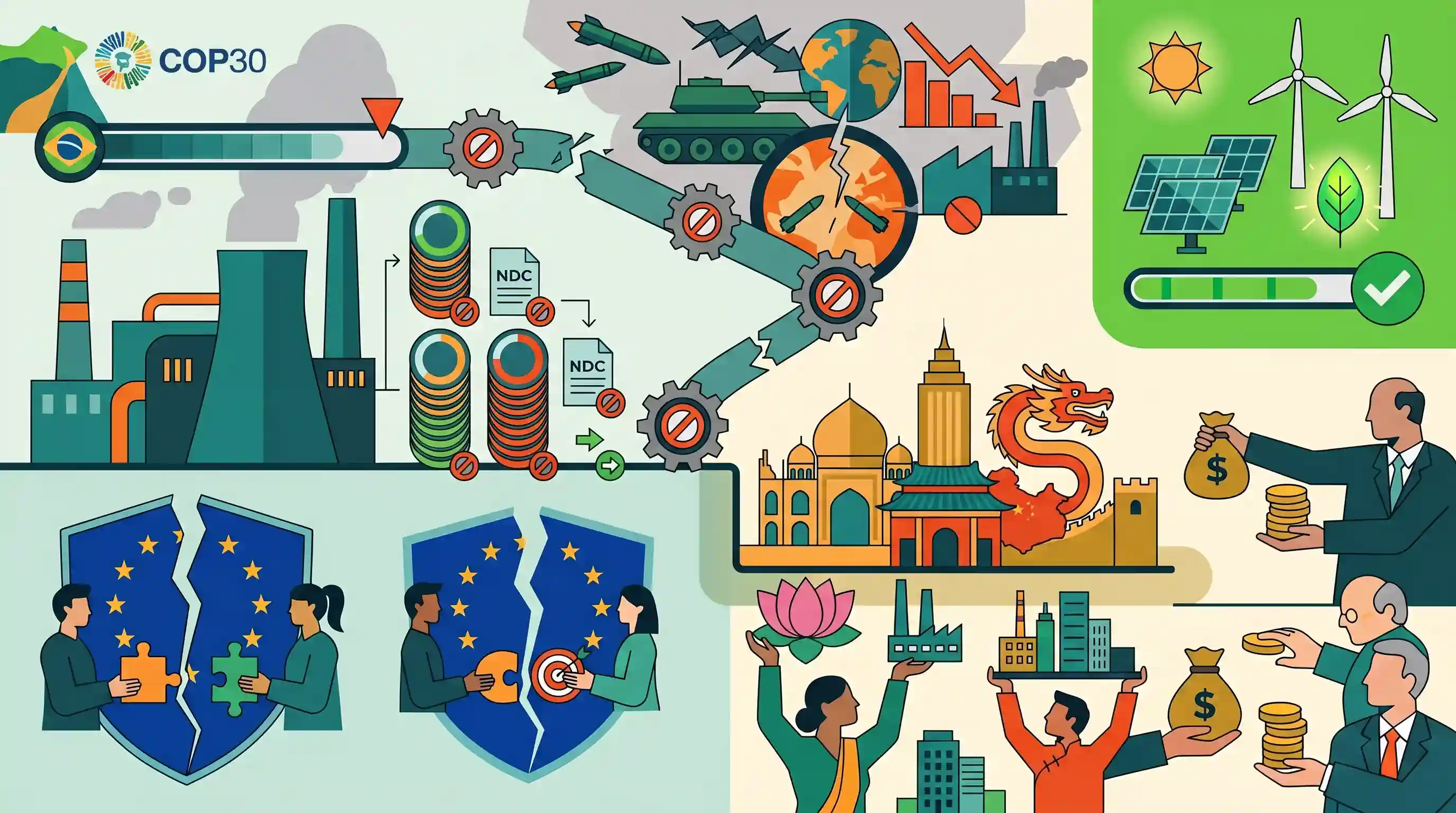
In the run-up to the COP30 climate talks in Brazil, global efforts to combat climate change are stalling as major greenhouse gas emitters delay updating their Nationally Determined Contributions (NDCs). Under the Paris Agreement, countries are required to enhance their NDCs every five years, but only a fraction have done so. The European Union remains divided on its internal target allocations, while countries like India and China have not submitted updates, citing developmental needs and the lack of climate finance from developed nations. Meanwhile, geopolitical conflicts and economic issues are diverting attention from global climate goals, although India remains on track to meet its previously stated climate commitments.
Key Points
- The 30th Conference of the Parties (COP30) to the UNFCCC will be held in Belem, Brazil, in November, but countries are delaying their updated climate targets.
- Under the 2015 Paris Agreement, nations must submit updated Nationally Determined Contributions (NDCs) every five years to limit global warming to 1.5°C to 2°C.
- Currently, only 29 out of 195 signatory countries have submitted updated NDCs, with the EU failing to reach a consensus and major emitters like China and India yet to declare theirs.
- Developing nations like China and India assert their right to fossil fuel usage for economic development and demand stronger financial commitments from developed nations.
- Global climate ambitions are being derailed by geopolitical and economic distractions, including the Russia-Ukraine war and inflation.
- India remains on track to meet its existing NDCs, which include reducing GDP emissions intensity by 45% over 2005 levels, achieving 50% power capacity from non-fossil sources, and creating a 2.5-3 billion tonne carbon sink.
Important Terms
UNFCCC

An international environmental treaty adopted in 1992 to stabilize greenhouse gas concentrations. It provides the foundational framework for global climate negotiations and annual Conference of the Parties (COP) meetings.
UPSC context
GS Paper 3: Environment; tests understanding of the origin and structure of global climate governance.
Paris Agreement
A 2015 legally binding international treaty aimed at limiting global warming to well below 2°C, preferably 1.5°C, compared to pre-industrial levels. It utilizes a bottom-up approach for climate action.
UPSC context
GS Paper 3: Environment; core topic for international conventions and global temperature stabilization targets.
Nationally Determined Contributions (NDCs)
Climate action plans submitted every five years by countries under the Paris Agreement. They outline national targets for reducing emissions and adapting to climate change with progressively increasing ambition.
UPSC context
GS Paper 3: Environment; essential for tracking India's 'Panchamrit' commitments and global mitigation progress.
Climate Finance
Financial resources (public, private, or transnational) mobilized to help developing nations mitigate and adapt to climate change, often a central point of negotiation regarding historical responsibility.
UPSC context
GS Paper 3: Economy/Environment; tests knowledge of Global North-South equity and international funding mechanisms like GCF.
COP30
The 30th UN Climate Change Conference scheduled for 2025 in Belém, Brazil. It is considered a milestone for submitting updated NDCs and focusing on Amazon conservation.
UPSC context
GS Paper 3: Environment; focuses on 'Implementation COP' goals and current developments in climate diplomacy.
Common But Differentiated Responsibilities (CBDR)
A principle within the UNFCCC acknowledging that all states share responsibility for climate change but have differing capabilities and historical roles in causing emissions.
UPSC context
GS Paper 3: Environment; vital for explaining India’s diplomatic stance on climate justice and equity.
Prelims Trap
"The Paris Agreement makes it legally binding for signatory countries to achieve their Nationally Determined Contributions (NDCs)."
While submitting and updating NDCs every five years is legally binding (the ratchet mechanism), achieving the specific domestic targets within them is entirely voluntary and not legally enforced.
Static Concepts Connected
What is the CBDR-RC principle under the UNFCCC?
- Origin & Core: Formalized at the 1992 Rio Earth Summit, establishing that all states have a shared obligation to address environmental destruction, but unequal responsibility.
- Developed Nations' Role: Historically industrialized nations must take the lead in reducing emissions and are obligated to provide climate finance and technology to developing nations.
- Developing Nations' Rights: Grants developing nations the right to prioritize economic growth and poverty eradication, allowing a slower transition away from fossil fuels.
What are India's updated 2030 Nationally Determined Contributions (NDCs)?
- Emissions Intensity: Reduce the emissions intensity of its GDP by 45% by 2030, compared to the 2005 baseline levels.
- Energy Mix: Achieve 50% of cumulative electric power installed capacity from non-fossil fuel-based energy resources by 2030.
- Carbon Sink: Create an additional carbon sink of 2.5 to 3 billion tonnes of CO2 equivalent through additional forest and tree cover by 2030.
Cross-Topic Patterns
Climate justice vs. EU's Carbon Tax (CBAM)
Developing nations argue that the EU's Carbon Border Adjustment Mechanism (CBAM) violates the Paris Agreement's CBDR-RC principle by penalizing developing country exports under the guise of climate action.
MDB reforms and Global Climate Finance
The stalling of NDCs due to lack of climate finance directly ties into the ongoing G20-led push to reform Multilateral Development Banks (MDBs) to better de-risk green investments in the Global South.

Expect a 2026 Prelims question testing the "ratchet mechanism" alongside India’s updated NDC targets and the Paris Agreement's legalities.
Linked PYQs · 4
Linked PYQs · 4
- 2016PrelimsGS1
The term 'Intended Nationally Determined Contributions' is sometimes seen in the news in the context of
- 2025PrelimsGS1
Consider the following statements : Statement I: Article 6 of the Paris Agreement on climate change is frequently discussed in global discussions on sustainable development and climate change. Statement II: Article 6 of the Paris Agreement on climate change sets out the principles of carbon markets. Statement III : Article 6 of the Paris Agreement on climate change intends to promote inter-country non-market strategies to reach their climate targets. Which one of the following is correct in respect of the above statements?
- 2025MainsGS3
Write a review on India's climate commitments under the Paris Agreement (2015) and mention how these have been further strengthened in COP26 (2021). In this direction, how has the first Nationally Determined Contribution intended by India been updated in 2022?
- 2021MainsGS3
Describe the major outcomes of the 26th session of the Conference of the Parties (COP) to the United Nations Framework Convention on Climate Change (UNFCCC). What are the commitments made by India in this conference?
