Jharkhand Assembly By Election and Tribal Politics
Source:Indian Express ↗
Why It Matters
Although individual election results are not directly tested, the underlying constitutional mechanisms (RPA 1951, electoral disputes) and governance frameworks (Fifth Schedule, tribal rights) are recurring themes in both Prelims and Mains.
Summary
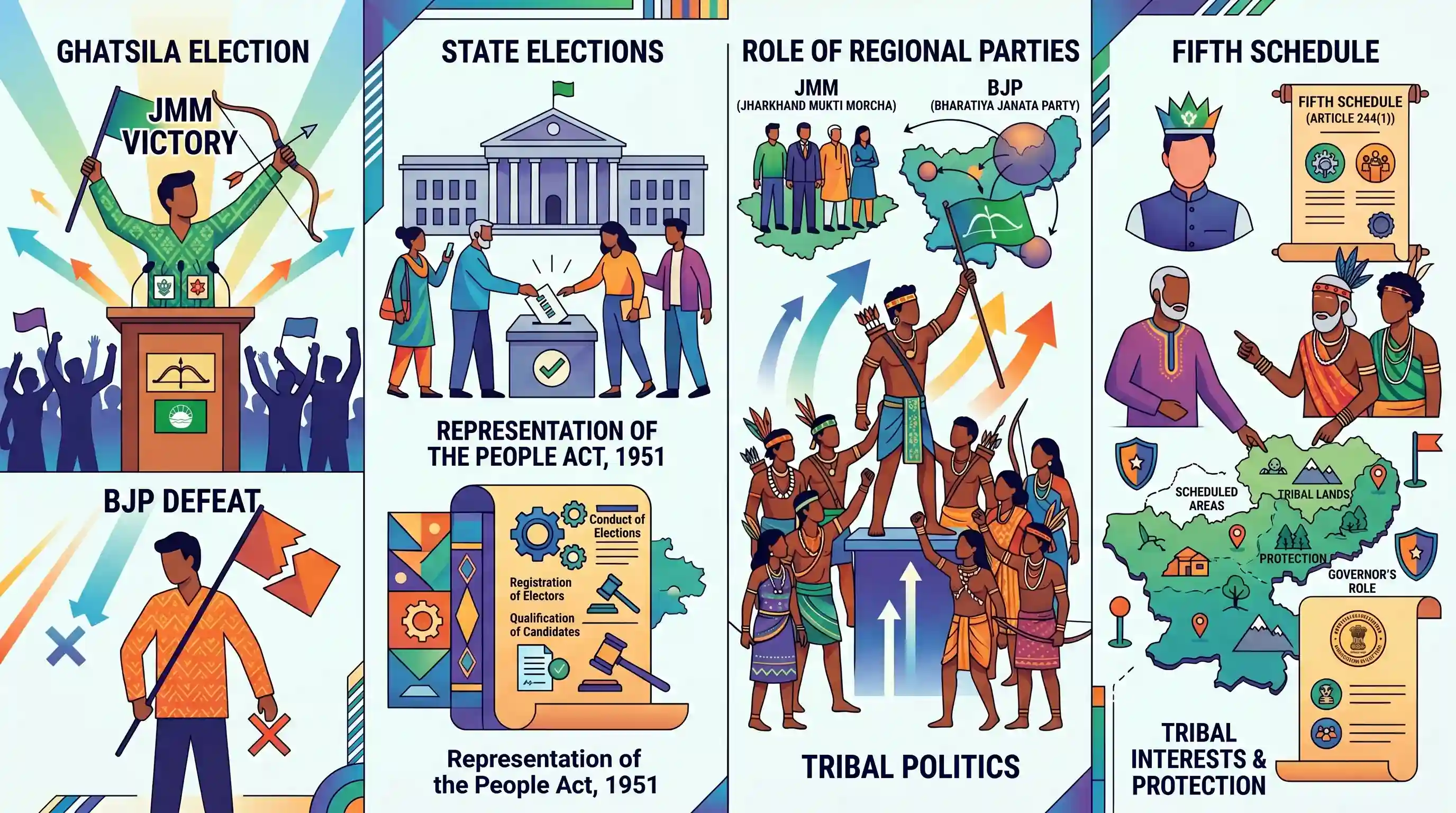
The Jharkhand Mukti Morcha (JMM) has retained the Ghatsila assembly constituency, emerging victorious against the BJP. While the immediate news highlights a specific electoral contest, for UPSC aspirants, it serves as a prompt to study the structural aspects of state assembly elections under the Representation of the People Act, 1951. Additionally, electoral outcomes in states like Jharkhand emphasize the critical role of tribal vote banks, making it essential to revise the Fifth Schedule of the Constitution, which deals with the administration of Scheduled Areas and the protection of tribal interests.
Key Points
- The Jharkhand Mukti Morcha (JMM) successfully retained the Ghatsila assembly seat, defeating the Bharatiya Janata Party (BJP) in a closely watched prestige battle.
- The electoral result underscores the continuing influence of regional parties and tribal identity politics in Jharkhand.
- Understanding state election dynamics requires familiarity with the Representation of the People Act, 1951, which governs the conduct of elections and disputes arising from them.
- Since Jharkhand has significant Scheduled Areas, its political landscape is deeply intertwined with Fifth Schedule provisions that protect tribal land and governance rights.
Important Terms
Representation of the People Act, 1951

Legislation governing the conduct of elections, member qualifications/disqualifications (notably Section 8), registration of political parties, and resolution of electoral disputes under Article 327.
UPSC context
GS Paper II: Essential for topics on 'Salient features of the RPA' and electoral reforms.
Fifth Schedule of the Constitution
Constitutional provisions under Article 244(1) for the administration and control of Scheduled Areas and Tribes in states excluding the Northeast (Assam, Meghalaya, Tripura, Mizoram).
UPSC context
GS Paper II: Polity & Governance; tests knowledge of tribal autonomy and the Governor’s special powers.
Jharkhand Mukti Morcha (JMM)
A regional political party in Jharkhand, founded in 1973 to advocate for tribal rights and statehood; it currently leads the state's ruling alliance.
UPSC context
GS Paper II: Federalism and regionalism; highlights the role of regional parties in Indian democracy.
Bharatiya Janata Party (BJP)
One of India's two major national parties, founded in 1980 (originating from the 1951 Bharatiya Jana Sangh), advocating Hindutva and integral humanism.
UPSC context
GS Paper II: Political Parties; relevant for studying national party dynamics and ideological evolution.
Prelims Trap
"The State Governor has the constitutional authority to declare or alter the boundaries of a Scheduled Area."
Only the President can declare, alter, or revoke a Scheduled Area. The Governor must be consulted and has powers to regulate land transfers, but cannot declare the area.
Static Concepts Connected
What are the key administrative provisions under the Fifth Schedule?
- Presidential Authority: The President holds exclusive power to declare, alter, or revoke the status of a Scheduled Area, after consulting the State Governor.
- Tribes Advisory Council: A constitutionally mandated body of up to 20 members, where three-fourths must be Scheduled Tribe MLAs from the State Legislative Assembly.
- Governor's Regulations: The Governor can restrict tribal land transfers to non-tribals and modify how central or state laws apply.
How does the RPA 1951 handle state assembly election disputes?
- High Court Jurisdiction: Under RPA 1951, election petitions challenging election validity must be filed exclusively before the respective State High Court, not the Election Commission.
- Supreme Court Appeals: Decisions made by the State High Court regarding election petitions can subsequently be appealed to the Supreme Court.
- Grounds for Annulment: Elections can be voided for corrupt practices, improper acceptance/rejection of nominations, or non-compliance with the Constitution or RPA.
Cross-Topic Patterns
Fifth Schedule overlapping with PESA
Tribal electoral dynamics frequently overlap with the Panchayat (Extension to Scheduled Areas) Act, linking political representation directly to grassroots resource governance and minor forest produce.
RPA disputes vs Anti-Defection Law
While RPA handles disputes over the election process itself, post-election MLA disqualifications are governed by the Tenth Schedule, highlighting the contrast between High Court and Speaker jurisdictions.

Expect a multi-statement Prelims 2026 question contrasting Governor powers in Fifth vs Sixth Schedule areas alongside PESA provisions.
Linked PYQs · 4
Linked PYQs · 4
- 2022MainsGS2
Discuss the procedures to decide the disputes arising out of the election of a Member of the Parliament or State Legislature under The Representation of the People Act, 1951. What are the grounds on which the election of any returned candidate may be declared void ? What remedy is available to the aggrieved party against the decision ? Refer to the case laws.
- 2019PrelimsGS1
Under which Schedule of the Constitution of India can the transfer of tribal land to private parties for mining be declared null and void?
- 2022PrelimsGS1
If a particular area is brought under the Fifth Schedule of the Constitution of India, which one of the following statements best reflects the consequence of it ?
- 2025PrelimsGS1
Consider the following statements : With reference to the Constitution of India, if an area in a State is declared as Scheduled Area under the Fifth Schedule I. the State Government loses its executive power in such areas and a local body assumes total administration II. the Union Government can take over the total administration of such areas under certain circumstances on the recommendations of the Governor Which of the statements given above is/are correct?
