Women Reservation Bill Obstacles and Legislative Consensus
Source:Indian Express ↗
Why It Matters
The debate intersects three crucial UPSC themes: the mechanics of delimitation affecting federal representation (North vs South dynamics), women's political empowerment, and the functioning of parliamentary democracy. It illustrates the practical challenges of implementing structural reforms like the Women's Reservation Bill.
Summary
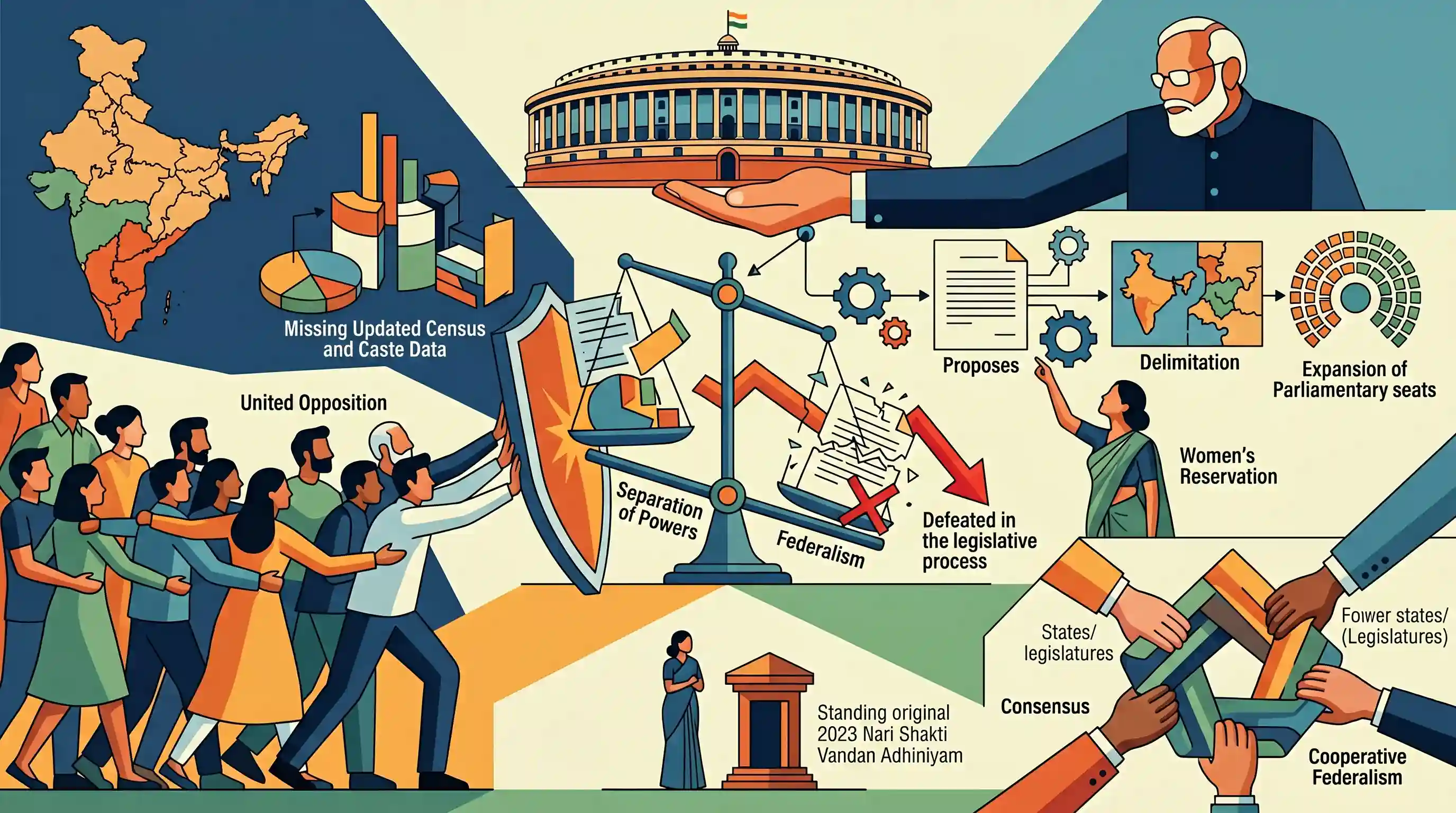
A recent constitutional amendment proposed by the Modi government sought to link the implementation of women's reservation to a fresh delimitation exercise and the expansion of parliamentary seats, effectively lifting a 50-year freeze. The bill was defeated due to strong resistance from a united Opposition, which cited concerns over federal fairness, the lack of updated census and caste data, and the potential marginalization of Southern states. While the original 2023 Nari Shakti Vandan Adhiniyam stands, the defeat serves as a critical lesson on the limits of pushing transformative changes without adequate parliamentary consensus, highlighting the delicate balance required between equitable representation and cooperative federalism in India.
Key Points
- The Modi government faced a significant setback when its constitutional amendment linking women's reservation to the expansion of Lok Sabha seats and fresh delimitation was defeated in Parliament.
- Despite the defeat, the 2023 Nari Shakti Vandan Adhiniyam remains intact, confirming Parliament's commitment to women's reservation.
- A united Opposition raised concerns over the government's haste, the lack of current census data (including caste numbers), and institutional distrust regarding the delimitation mechanism.
- The delimitation exercise risks disrupting the balance between equity in representation and federal fairness, stoking fears of a North vs South divide in political representation.
- The failure highlights the limits of governing by fiat and underscores the necessity of broad consultation and consensus-building in a parliamentary democracy.
Important Terms
Nari Shakti Vandan Adhiniyam

The 106th Constitutional Amendment Act (2023) that reserves one-third of seats in the Lok Sabha and State Assemblies for women, following a post-2026 census and delimitation.
UPSC context
GS Paper II: Welfare Schemes/Governance. Tests knowledge of legislative measures for gender empowerment and implementation hurdles like census-linked triggers.
Delimitation
The process of redrawing electoral boundaries and reallocating seats in legislative bodies based on population data to ensure the principle of 'one person, one vote, one value.'
UPSC context
GS Paper II: Federal Structure. Tests understanding of demographic shifts, the North-South divide, and the constitutional freeze on seat allocation.
Cooperative Federalism
A governance framework where the Central and State governments work as partners to resolve common issues, emphasizing consensus and regional equity over unilateral central authority.
UPSC context
GS Paper II: Separation of Powers/Federalism. Central to analyzing tensions between national legislative goals and the autonomy of states.
Women's Reservation Bill
The umbrella term for legislative proposals (most recently the 106th Amendment) aimed at securing 33% representation for women in India’s lower houses of Parliament and state assemblies.
UPSC context
GS Paper I/II: Social Empowerment/Governance. Essential for discussing political representation and systemic barriers faced by marginalized gender groups.
Parliament
India's supreme legislative body consisting of the President and two houses, responsible for passing laws and constitutional amendments requiring special majorities and broad consensus.
UPSC context
GS Paper II: Legislature. Tests knowledge of parliamentary procedures, the importance of debates, and the mechanism of defeating constitutional bills.
Opposition
Parties in the legislature not in government, whose role is to scrutinize policy, represent diverse interests, and ensure accountability through checks and balances.
UPSC context
GS Paper II: Parliamentary Democracy. Tests the role of non-ruling parties in maintaining federal fairness and demanding data-driven policy.
Prelims Trap
"Orders of the Delimitation Commission can be modified or rejected by the Parliament."
Delimitation Commission orders have the force of law and cannot be challenged in court. Even when laid before Parliament, no modifications are permitted.
Static Concepts Connected
What governs the freeze on state-wise seat allocation in Lok Sabha?
- 42nd Amendment (1976): Froze the state-wise allocation of Lok Sabha seats using the 1971 census until the year 2000 to encourage population control.
- 84th Amendment (2001): Extended this freeze on the total number of seats among states until the first census taken after the year 2026.
- 87th Amendment (2003): Permitted internal territorial readjustment of constituencies within a state based on the 2001 census without changing total seats.
What is the procedure to alter state representation in Parliament?
- Article 368: Changing the representation of states in Parliament is an entrenched provision requiring a rigorous amendment process.
- Special Majority: Requires a two-thirds majority of members present and voting, plus an absolute majority of the total membership in both Houses.
- State Ratification: Must be ratified by the legislatures of at least one-half of the states via a simple majority before Presidential assent.
Cross-Topic Patterns
Delimitation vs. Population Control
Links federalism and representation to demographic policies. Southern states fear being penalized politically for successfully executing the Centre's family planning and population stabilization schemes over the past 50 years.
Parliamentary vs. Local Reservation
Contrast the 106th Amendment's complex delimitation dependencies with the 73rd/74th Amendments, which directly instituted a 33% quota for women in local bodies (Articles 243D/243T) without census prerequisites.

Expect a 2026 Prelims question combining Delimitation Commission powers, the 84th Amendment freeze, and state ratification rules.
Linked PYQs · 4
Linked PYQs · 4
- 2023MainsGS2
Discuss the contribution of civil society groups for women's effective and meaningful participation and representation in state legislatures in India.
- 2019MainsGS2
“The reservation of seats for women in the institutions of local self-government has had a limited impact on the patriarchal character of the Indian Political Process.” Comment.
- 2024PrelimsGS1
How many Delimitation Commissions have been constituted by the Government of India till December 2023?
- 2012PrelimsGS1
With reference to the Delimitation Commission, consider the following statements: 1. The orders of the Delimitation Commission cannot be challenged in a Court of Law. 2. When the orders of the Delimitation Commission are laid before the Lok Sabha or State Legislative Assembly, they cannot effect any modifications in the orders. Which of the statements given above is/are correct?
