Air power proves vital in modern border security operations
Source:Indian Express ↗
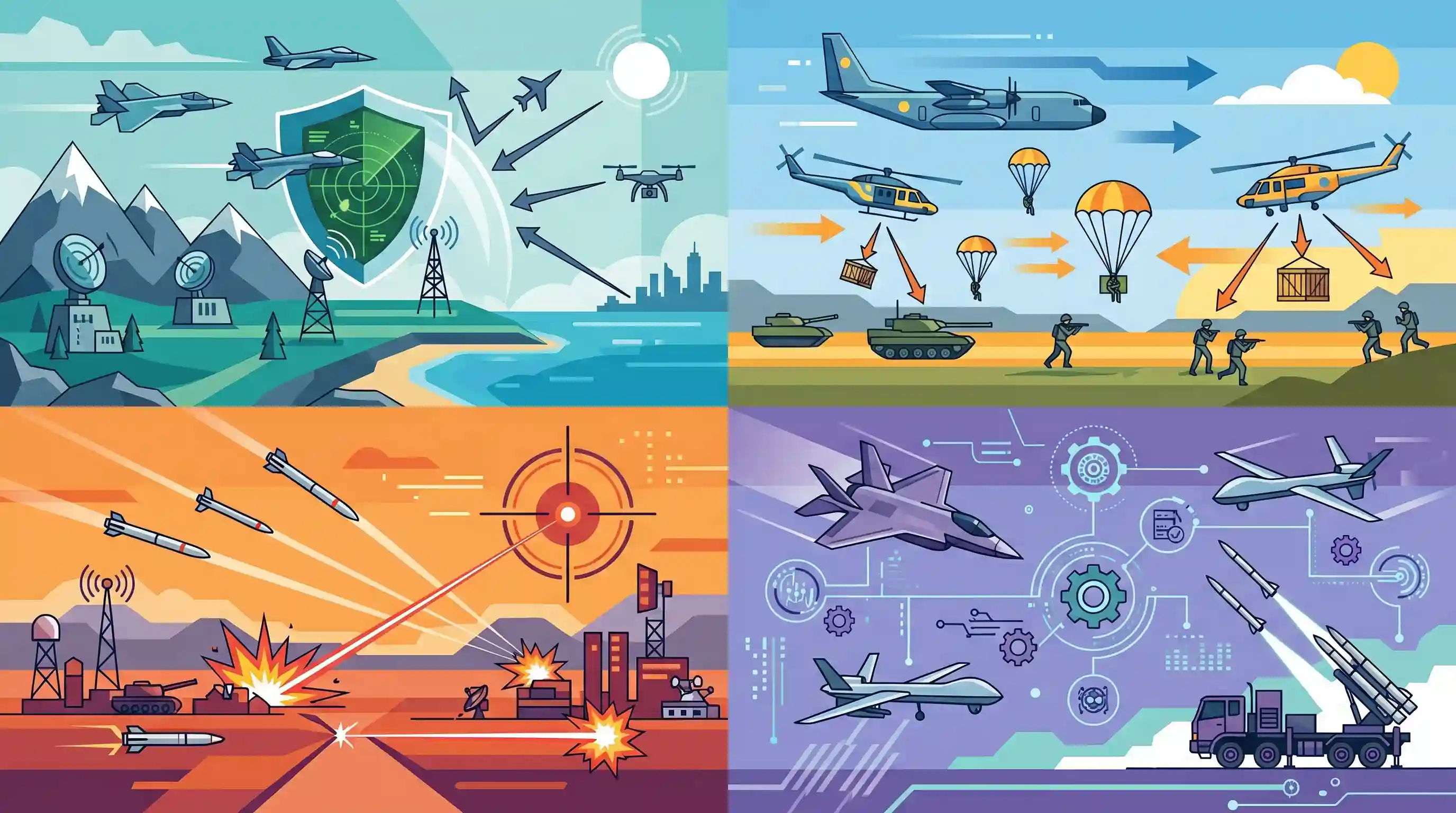
Why It Matters
Understanding the strategic role of air power and defense modernization is crucial for the UPSC GS-3 syllabus, particularly in analyzing how India secures its borders and adapts to modern warfare challenges, including threats from UAVs and hostile neighbors.
Summary
The article underscores the critical role of air power in modern national security, using the context of strategic operations to highlight the Indian Air Force's (IAF) capabilities. It emphasizes that contemporary warfare and border defense rely heavily on air dominance, rapid deployment, and precision strikes. Furthermore, it advocates for the continuous modernization of aerial platforms and air defence systems to effectively neutralize emerging threats and maintain robust deterrence against adversaries.
Key Points
- Highlights the strategic and tactical indispensability of air power in modern warfare and national security frameworks.
- Demonstrates how the Indian Air Force (IAF) leverages advanced aerial platforms and precision capabilities to maintain deterrence and secure borders.
- Emphasizes the shift towards integrating cutting-edge technologies, such as modern air defence systems and unmanned aerial vehicles, to ensure air superiority.
- Underlines the necessity of continuous defence modernization and rapid force projection capabilities to counter evolving regional security threats.
Important Terms
Operation Sindoor

A multi-domain, tri-service military campaign conducted by India in May 2025 to dismantle terror infrastructure in Pakistan and PoJK following the Pahalgam attack.
UPSC context
GS Paper III: Internal Security; tests understanding of India's evolving counter-terrorism doctrine and 'pre-emption and punishment' strategy.
Air Superiority
A state where an air force holds sufficient control of the air to conduct operations without effective interference by an adversary.
UPSC context
GS Paper III: Role of External State/Non-state Actors; tests knowledge of conventional military concepts in border management.
Standoff Weapons
Missiles or bombs launched from a distance that allows the delivery platform to remain outside the range of the target's defensive fire.
UPSC context
GS Paper III: Defence Modernization; relevant for technological advancements in the Indian Air Force and indigenous weapon systems.
Theatre Commands
A unified command structure for the three services (Army, Navy, Air Force) aimed at fostering "jointness" and operational synergy in specific geographical regions.
UPSC context
GS Paper III: Security Forces and their Mandate; tests knowledge of structural military reforms and tri-service integration.
Integrated Air Command and Control System (IACCS)
An automated system that integrates all ground-based and airborne sensors to provide a comprehensive, real-time air situation picture for command and control.
UPSC context
GS Paper III: Science & Technology in Defence; tests understanding of network-centric warfare and electronic air defence infrastructure.
Credible Deterrence
A strategy that uses military force or the threat of it to discourage an adversary from taking a specific action, such as supporting cross-border terrorism.
UPSC context
GS Paper III: National Security; core concept in India's nuclear and conventional military doctrines against regional adversaries.
Prelims Trap
The S-400 Triumf air defence system is a joint venture between India and Russia, similar to BrahMos.
The S-400 is procured entirely from Russia. UPSC often tricks aspirants by extending the 'joint venture' status of BrahMos to other prominent Russian defence imports.
Static Concepts Connected
How do India's key Surface-to-Air Missile (SAM) defence systems differ?
- Akash System: Indigenous short-range SAM (approx 25-30 km) developed by DRDO to target low-flying aircraft, helicopters, and drones.
- S-400 Triumf: Long-range mobile SAM system imported from Russia, capable of tracking and neutralizing a variety of aerial targets up to 400 km.
- MRSAM: Medium-Range systems co-developed as a joint venture between India's DRDO and Israel Aerospace Industries (IAI).
What is the Integrated Air Command and Control System (IACCS)?
- Net-Centric Hub: An automated network that integrates both civilian and military radars to create a comprehensive, real-time composite air situation picture (CASP).
- Quick Response: Eliminates manual delays by transferring sensor data directly to command nodes, crucial for rapidly intercepting fast-moving hostile UAVs or cruise missiles.
Cross-Topic Patterns
Indigenisation vs. Import Reliance
IAF’s mix of imported S-400s and indigenous Akash systems perfectly illustrates India's transitional defence procurement policy under Atmanirbhar Bharat.
Theaterisation of Armed Forces
The push for net-centric air dominance (via IACCS) heavily informs the ongoing debates on creating unified Theatre Commands to eliminate inter-service friction.

Expect a multi-statement Prelims question in 2026 distinguishing between India's joint-venture defence systems and direct imports.
Linked PYQs · 3
Linked PYQs · 3
- 2021MainsGS3
How is S-400 air defence system technically superior to any other system presently available in the world?
- 2023MainsGS3
The use of unmanned aerial vehicles (UAVs) by our adversaries across the borders to ferry arms/ammunitions, drugs, etc., is a serious threat to the internal security. Comment on the measures being taken to tackle this threat.
- 2020MainsGS3
Analyze internal security threats and transborder crimes along Myanmar, Bangladesh and Pakistan borders including Line of Control (LoC). Also discuss the role played by various security forces in this regard.
