India Sets Fiscal Debt to GDP Ratio Target for Future Years
Source:Indian Express ↗
ఇది ఎందుకు ముఖ్యం
Understanding India's shift from fiscal deficit targets to a debt-to-GDP anchor is vital for analyzing modern fiscal consolidation policies, government budgeting, and macroeconomic stability under GS Paper 3.
సారాంశం
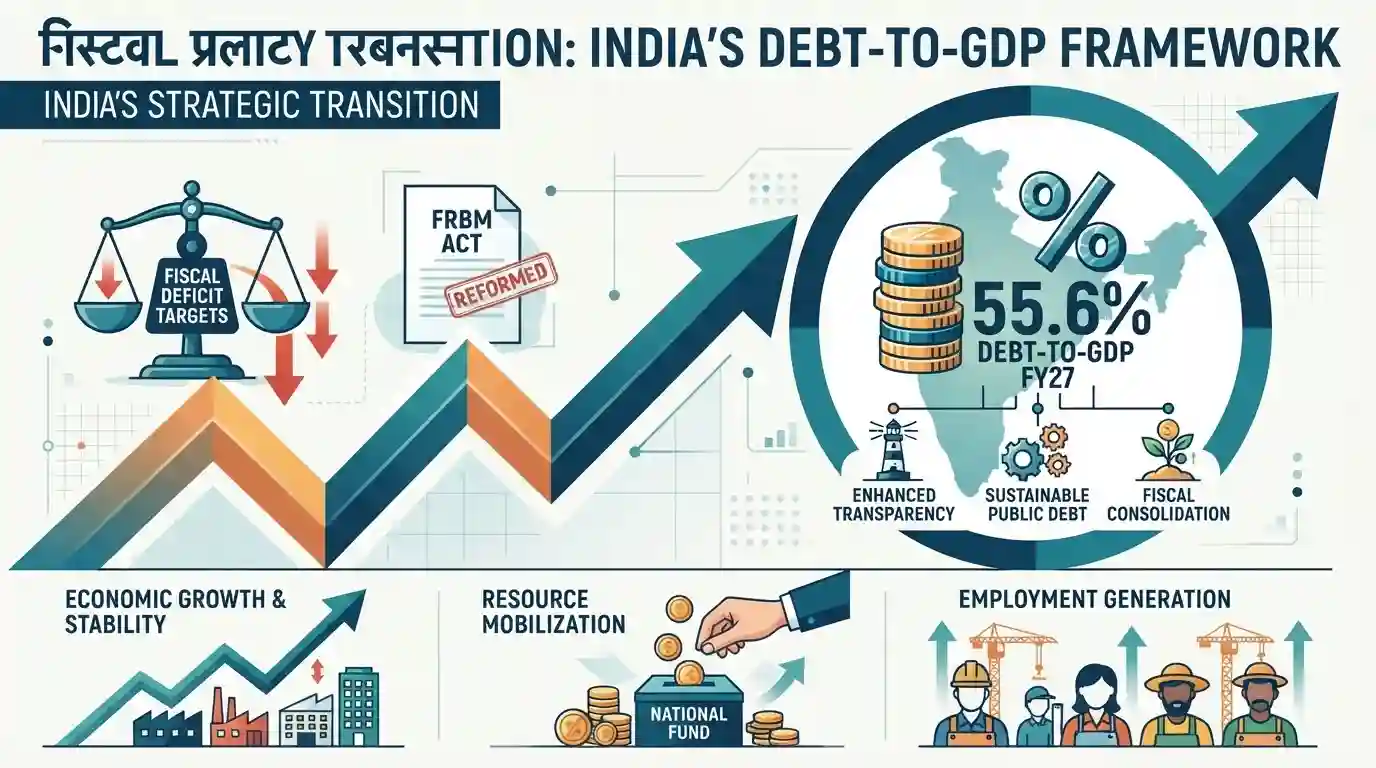
The article discusses India's strategic transition in fiscal policy management, moving from a primary focus on fiscal deficit targets to a debt-to-GDP ratio framework. Specifically, the target for the debt-to-GDP ratio has been set at 55.6% for FY27, signaling a new era of fiscal consolidation, enhanced transparency, and sustainable public debt management in India.
ముఖ్య అంశాలు
- The government has shifted its fiscal consolidation focus from a strict fiscal deficit-centric model to a debt-to-GDP anchor framework.
- The debt-to-GDP ratio target for FY27 has been set at 55.6 percent, marking a new era in Indian public finance management.
- This shift aims to ensure long-term macroeconomic stability, sustainable debt trajectories, and alignment with global fiscal governance standards.
ముఖ్యమైన పదాలు
Fiscal Responsibility and Budget Management (FRBM) Act

An enactment designed to institutionalize financial discipline, reduce fiscal deficit, and manage public debt sustainably in India through statutory targets and transparency requirements.
UPSC context
GS Paper III (Indian Economy - Government Budgeting & Fiscal Policy); tests understanding of fiscal consolidation, deficit targets, and debt management frameworks.
Ministry of Finance
A key ministry under the Government of India responsible for formulating national fiscal policy, taxation, public debt management, and compiling the annual Union Budget.
UPSC context
GS Paper III (Indian Economy - Resource Mobilization & Budgeting); tests knowledge of institutional mechanisms governing government finances and economic policy.
ప్రిలిమ్స్ ఉచ్చు
Shift from fiscal deficit to debt-to-GDP implies the complete scrapping of fiscal deficit targets in the Union Budget.
Aspirants often assume fiscal deficit targets have been completely abandoned. In reality, fiscal deficit (e.g., 4.3% for FY27) serves as the operational glide path for the debt-to-GDP anchor.
అనుసంధానమైన స్థిర భావనలు
What are the key evolution milestones and recommendations of the FRBM Act in India?
- Enactment Year: Enacted in 2003 to institutionalize financial discipline, reduce fiscal deficit, and macroeconomic stability.
- N.K. Singh Panel: N.K. Singh Committee recommended a debt-to-GDP ratio of 60% combined (40% central, 20% state) by 2024-25.
- Strategic Shift: Focus shifted from mere annual deficit numbers to medium-term debt stabilization and sustainable public debt paths.
అంతర-అంశ నమూనాలు
Fiscal Consolidation and Sovereign Bond Yields
Moving to debt-to-GDP anchors directly impacts sovereign credit ratings, sovereign yields, and foreign institutional capital inflows into Indian G-secs.
FRBM Act and Finance Commission Recommendations
Linking fiscal anchors to capex allocation mirrors the recommendations of successive Finance Commissions on capital formation at state and central levels.

Expect a statement-based prelims question on the shift from fiscal deficit to debt-to-GDP ratio under FRBM framework updates.
అనుసంధాన PYQలు · 2
అనుసంధాన PYQలు · 2
- 2018PrelimsGS1
Consider the following statements: 1. The Fiscal Responsibility and Budget Management (FRBM) Review Committee Report has recommended a debt to GDP ratio of 60% for the general (combined) government by 2023, comprising 40% for the Central Government and 20% for the State Governments. 2. The Central Government has domestic liabilities of 21% of GDP as compared to that of 49% of GDP of the State Governments. 3. As per the Constitution of India, it is mandatory for a State to take the Central Government's consent for raising any loan if the former owes any outstanding liabilities to the latter. Which of the statements given above is/are correct?
- 2025MainsGS3
Explain how the Fiscal Health Index (FHI) can be used as a tool for assessing the fiscal performance of states in India. In what way would it encourage the states to adopt prudent and sustainable fiscal policies?
