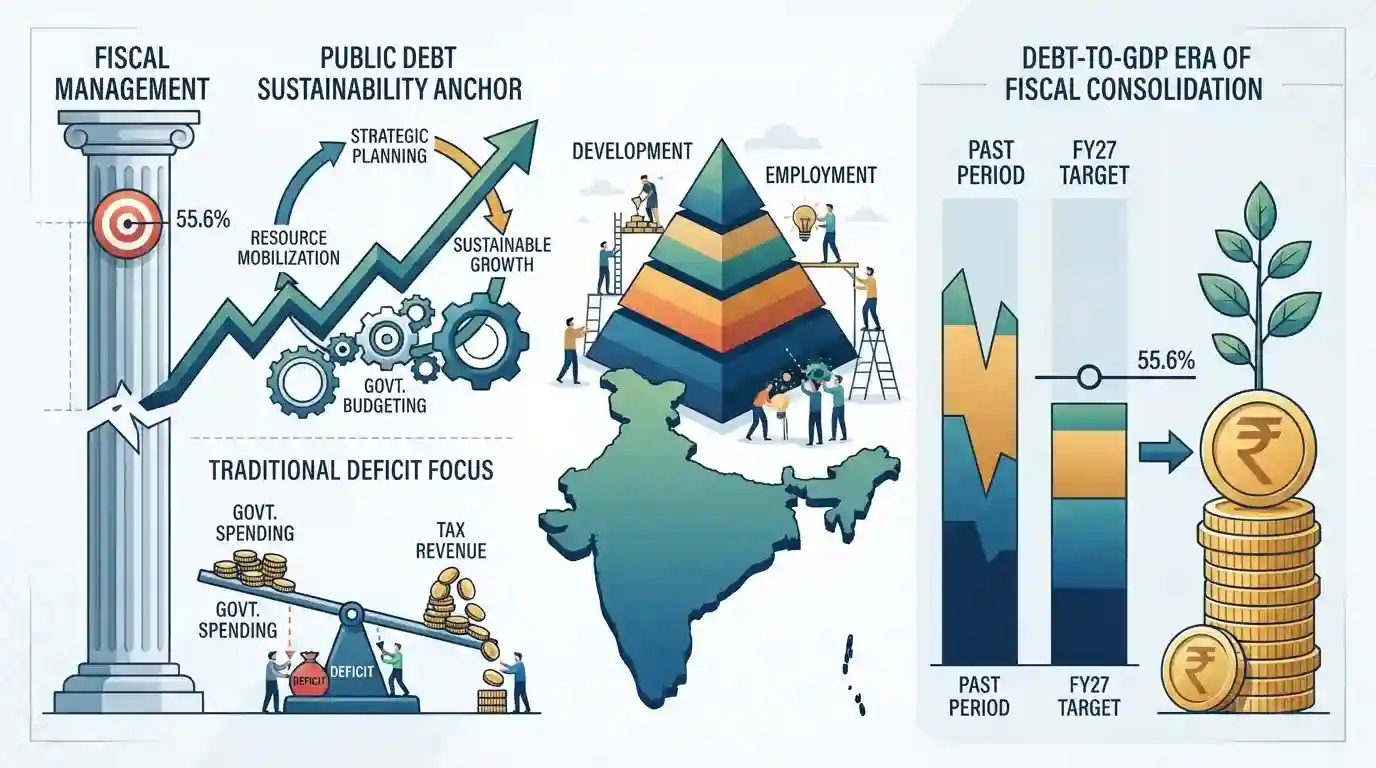
Government sets debt to GDP target at 55.6 percent
Source:Indian Express ↗
ఇది ఎందుకు ముఖ్యం
The shift from a pure fiscal deficit-focused framework to a debt-to-GDP anchoring framework represents a critical evolution in India's fiscal policy and macroeconomic management, directly relevant to questions on government budgeting, fiscal consolidation, and public debt sustainability.
సారాంశం
The Indian government has set a debt-to-GDP target of 55.6% for FY27, marking a structural shift toward a new debt-to-GDP era of fiscal management. This pivot emphasizes public debt sustainability as the core anchor of fiscal consolidation alongside traditional fiscal deficit metrics.
ముఖ్య అంశాలు
- The government has transitioned to a new debt-to-GDP era for fiscal planning, setting a target of 55.6% for FY27.
- This shift moves the primary anchor of fiscal consolidation away from just the fiscal deficit toward managing public debt sustainably relative to economic output.
- The target reflects India's medium-term macro-fiscal strategy to balance growth requirements with debt stabilization.
ముఖ్యమైన పదాలు
FRBM Act

A legislative framework enacted in 2003 to ensure fiscal discipline, reduce fiscal deficit, and achieve macroeconomic stability by institutionalizing prudent public financial management in India.
UPSC context
GS Paper III (Indian Economy - Government Budgeting & Fiscal Policy): Tests understanding of statutory fiscal rules, deficit targets, and public debt management.
Ministry of Finance
The central government ministry responsible for formulating India's economic, taxation, expenditure, and fiscal policies, including the preparation of the annual Union Budget.
UPSC context
GS Paper II/III (Governance and Economy): Important for understanding institutional structures governing economic policy making and public finance in India.
ప్రిలిమ్స్ ఉచ్చు
the FRBM Act makes the 3% fiscal deficit and 40% debt-to-GDP targets legally binding with zero scope for suspension
Aspirants often assume the FRBM Act strictly prohibits any departure from the 3% fiscal deficit target without exemptions, ignoring statutory escape clauses and the modern pivot to debt-to-GDP anchors.
అనుసంధానమైన స్థిర భావనలు
What are the key provisions and evolution of the Fiscal Responsibility and Budget Management (FRBM) Act in India?
- Statutory Origin: Original 2003 Act mandated eliminating revenue deficit and capping fiscal deficit at 3% of GDP by FY08.
- NK Singh Panel: N.K. Singh Committee (2016) recommended a debt-to-GDP ratio of 60% (40% for Centre, 20% for States) as the primary fiscal anchor.
- Escape Clauses: Escape clauses allow temporary deviation from targets due to national security, war, structural reforms, or severe output contraction.
అంతర-అంశ నమూనాలు
Fiscal Policy and Sovereign Ratings
Shifting fiscal consolidation anchors from deficit to debt-to-GDP ratios connects public finance management with sovereign rating upgrades and international bond index inclusion.
Capex Cycles and Debt Sustainability
Medium-term macro-fiscal strategy targets intersect with capital expenditure cycles, influencing how infrastructure financing is sustained without breaching debt ceilings.

FRBM review + Debt-to-GDP anchors vs traditional fiscal deficit targets will feature in a multi-statement Prelims conceptual question.
అనుసంధాన PYQలు · 2
అనుసంధాన PYQలు · 2
- 2025MainsGS3
Explain how the Fiscal Health Index (FHI) can be used as a tool for assessing the fiscal performance of states in India. In what way would it encourage the states to adopt prudent and sustainable fiscal policies?
- 2013MainsGS3
What were the reasons for the introduction of Fiscal Responsibility and Budget Management (FRBM) Act, 2003 ? Discuss critically its salient features and their effectiveness.
