India Namibia Partnership Outlines New African Engagement Model
Source:The Hindu ↗
Why It Matters
Africa is increasingly central to India's foreign policy and its aspiration to lead the Global South. Questions about the nature of India-Africa cooperation and the contrast with other global powers' engagements in Africa frequently appear in GS Paper 2.
Summary
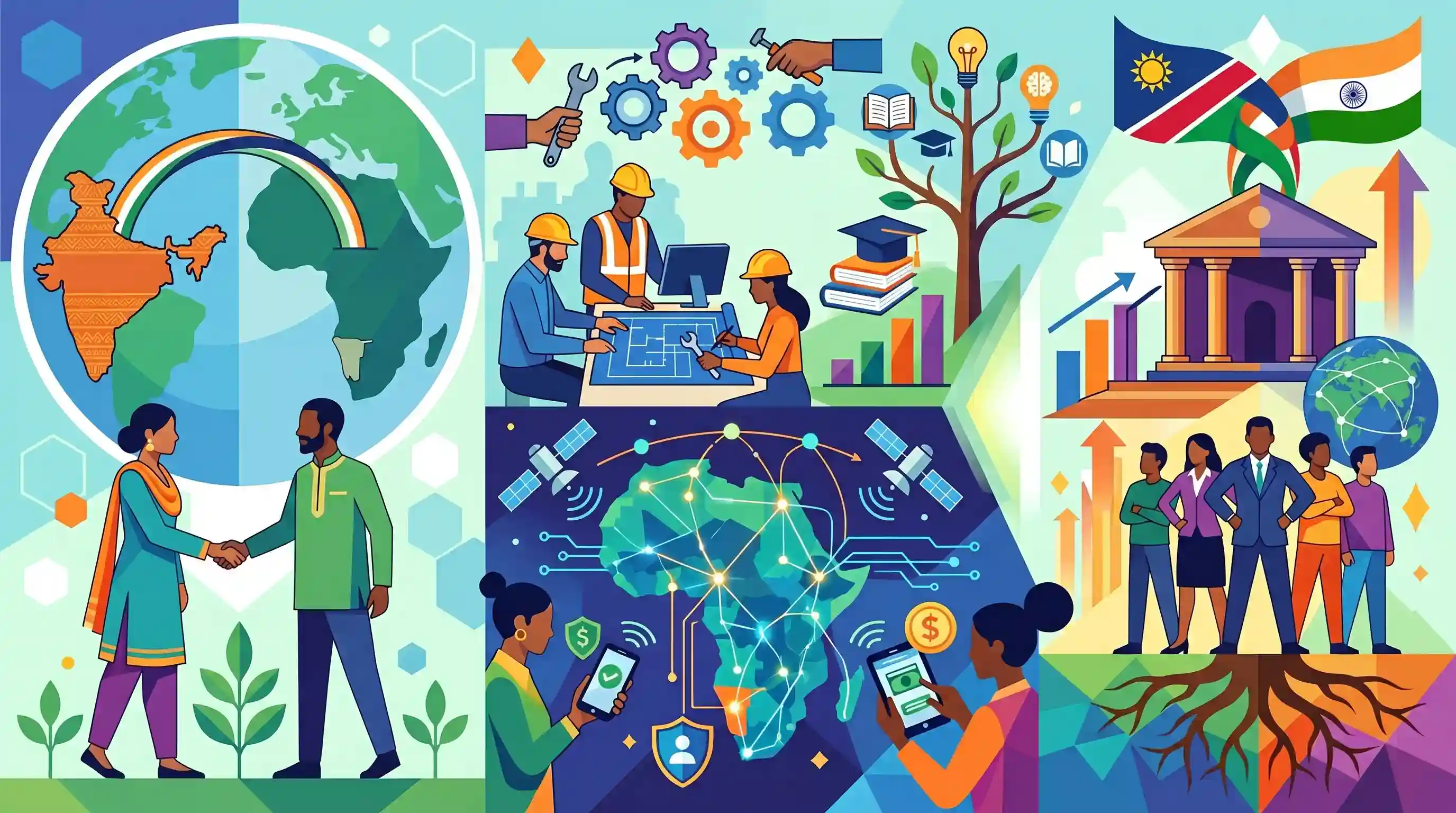
The article analyzes India's updated diplomatic and economic engagement strategy with Africa, emphasizing the partnership with Namibia. It notes that India is offering an alternative to traditional developmental models by prioritizing mutual respect, capacity building, and digital public infrastructure over prescriptive interventions. By leveraging shared priorities and South-South cooperation, India is reinforcing its strategic influence in the African continent, laying a robust foundation for long-term institutional and economic ties.
Key Points
- The article highlights India's evolving approach to engaging with African nations, using Namibia as a prime example of a non-prescriptive, mutually beneficial partnership.
- India's engagement model contrasts with traditional donor-recipient dynamics, focusing instead on capacity building, digital partnerships (DPI), health cooperation, and shared economic growth.
- Namibia's strategic location and natural resources present significant opportunities for India's economic and energy security interests.
- This bilateral relationship underscores India's broader foreign policy objective to position itself as a key voice and reliable partner for the Global South.
Important Terms
African Union (AU)

A continental union consisting of 55 member states in Africa, established in 2002 to promote economic integration, peace, and security. It is a key partner for India's strategic outreach.
UPSC context
GS-II (International Institutions); vital for understanding India-Africa relations, G20 membership (G21), and India's UN Security Council reform aspirations.
Digital Public Infrastructure (DPI)
Interoperable digital blocks (like UPI, Aadhaar) that provide society-wide essential services. India offers these as open-source, inclusive alternatives to traditional developmental models in the Global South.
UPSC context
GS-III (Economy/Technology) and GS-II (IR); tests India's "fintech diplomacy" and its role as a digital leader among developing nations.
South-South Cooperation
A framework for collaboration among developing nations (Global South) to share technology, resources, and knowledge, emphasizing mutual respect and non-prescriptive assistance over traditional North-South aid.
UPSC context
GS-II (International Relations); a core principle of India's foreign policy and its historic leadership role within the Non-Aligned Movement.
Global South
Nations primarily in the Southern Hemisphere (developing or least-developed) that share historical colonial legacies and common developmental challenges in the current global economic order.
UPSC context
GS-II (International Relations); tests India's strategic positioning as a "bridge" between the developed North and developing South.
ITEC (Indian Technical and Economic Cooperation)
India's flagship development partnership program (est. 1964) that provides technical training and capacity building to professionals from over 160 partner countries, particularly in Africa.
UPSC context
GS-II (Bilateral Relations/International Initiatives); essential for questions on India's "soft power" and its non-conditional development assistance model.
Critical Minerals
Strategically vital resources like Uranium, Rare Earth Elements, and Lithium essential for energy transition and high-tech industries. Namibia is a major supplier for India's nuclear energy.
UPSC context
GS-I (Geography/Resources) and GS-III (Energy Security); tests understanding of strategic resource security and bilateral economic interdependencies.
Capacity Building
A demand-driven approach to development focusing on developing human skills and institutional strength rather than just providing infrastructure, ensuring the partner nation leads its own growth.
UPSC context
GS-II (Developmental Processes); tests the "Indian model" of partnership, which emphasizes local empowerment over prescriptive interventions or debt-trap diplomacy.
Prelims Trap
The Kampala Principles (2018) are guidelines issued by the WTO to regulate international trade with African nations.
The Kampala Principles (2018) actually refer to the 10 guiding principles outlined by PM Modi for India's engagement with Africa, prioritizing non-prescriptive partnerships.
Static Concepts Connected
What is the Indian Technical and Economic Cooperation (ITEC) programme?
- Origin: Instituted in 1964, it is the flagship capacity-building and skill development programme administered by India's Ministry of External Affairs.
- Core Philosophy: Based on South-South cooperation, it offers fully-funded training to professionals in partner nations without imposing prescriptive conditionalities.
Why is Namibia strategically significant for India's energy transition?
- Uranium Reserves: Namibia is one of the world's leading producers of uranium, which is directly required to fuel India's expanding civilian nuclear energy program.
- Battery Minerals: Rich deposits of lithium and cobalt make it a crucial upstream partner for securing supply chains for India's EV manufacturing and green energy goals.
Cross-Topic Patterns
DPI as a Soft Power Tool
India is shifting from traditional financial aid to exporting Digital Public Infrastructure (like UPI), positioning tech-sharing as a non-debt-trap alternative to China's Belt and Road Initiative.
Critical Minerals and Strategic Autonomy
Securing lithium and uranium from African nations like Namibia reduces India's reliance on Chinese supply chains, linking domestic clean energy goals directly to South-South bilateral diplomacy.

Expect a 2026 question contrasting India's capacity building & DPI exports (Kampala Principles) against China's BRI debt-trap in Africa.
Linked PYQs · 2
Linked PYQs · 2
- 2025MainsGS2
India-Africa digital partnership is achieving mutual respect, co-development and long-term institutional partnerships. Elaborate.
- 2021MainsGS2
If the last few decades were of Asia's growth story, the next few are expected to be of Africa's.” In the light of this statement, examine India's influence in Africa in recent years.
